







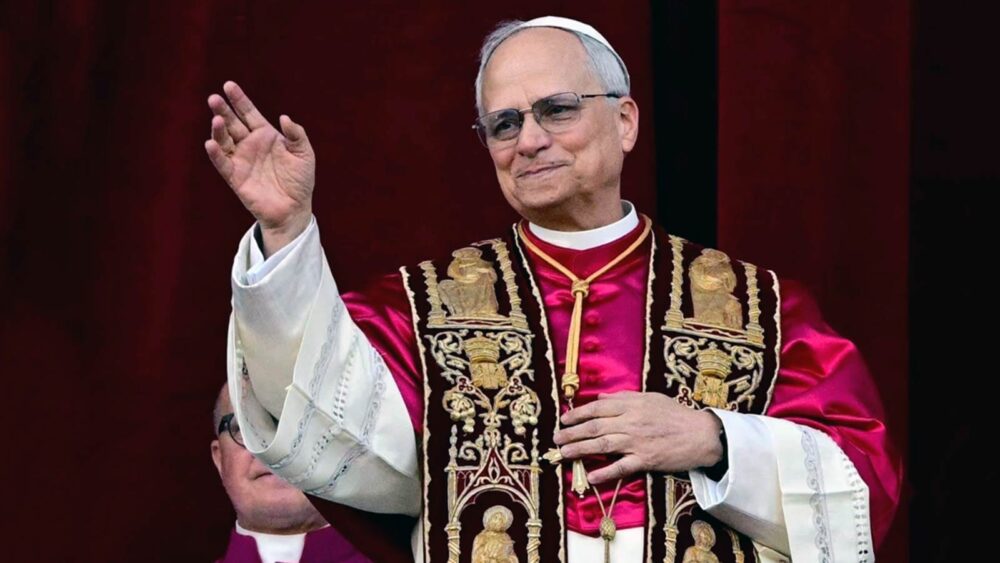
As Christmas celebrations unfolded across the globe, Pope Leo XIV delivered a midnight Mass homily that, while firmly rooted in Catholic tradition, managed to break through religious boundaries and resonate powerfully with non-Catholic audiences. Observers say the moment once again highlighted what many have begun to call the “Pope Leo difference”—not a dramatic departure from doctrine, but a distinctive moral clarity that speaks to a fractured world hungry for meaning, dignity, and hope.
In substance, Leo XIV’s Christmas homily echoed the theological continuity of his predecessors. He quoted Pope Benedict XVI, recalling a 2012 Christmas reflection on humanity’s spiritual blindness and the danger of societies that leave “no room for others either, for children, for the poor, for the stranger.” He also cited Pope Francis, drawing from Francis’ 2024 midnight Mass homily on the Nativity as a “gift and task” to bring hope where it has been lost, affirming that “with him, hope does not disappoint.”
The pope went further back into the Church’s intellectual heritage by invoking St. Augustine, whom he described as his spiritual father. Quoting Augustine, Leo XIV reflected on the paradox at the heart of Christianity: “Human pride weighed you down so heavily that only divine humility could raise you up again.” He contrasted a modern economy that reduces people to “mere merchandise” with the Incarnation itself—God choosing to become human in order to reveal the infinite dignity of every person.
“While humanity seeks to become ‘god’ in order to dominate others,” the pope said, “God chooses to become man in order to free us from every form of slavery. Will this love be enough to change our history?”
For practicing Catholics, the message felt familiar, even comforting—part of a long line of Christmas homilies that emphasize humility, compassion, and the sanctity of human life. Yet the striking element of this year’s address was not how it sounded to Catholics, but how deeply it moved those outside the faith.
A Message That Crossed Religious Lines
The impact was evident almost immediately. Damon Silvers, a longtime policy adviser at the AFL-CIO and now a visiting professor at University College London, shared a report on Pope Leo XIV’s homily on social media. Silvers, who is not Catholic, wrote that he had been “so impressed” by the pope’s Christmas words.
“Some of it has been deeply Christian—naturally,” Silvers noted, “in a way I don’t believe as theology. But this statement I believe to be a true one about the nature of God and God’s relationship to us, to the extent we can comprehend who and what God is.”
The article Silvers shared quoted Leo XIV directly: “Where there is room for the human person, there is room for God.” For many readers, that line seemed to transcend confessional boundaries, offering a vision of human dignity that felt both moral and metaphysical.
A similar reaction surfaced closer to home for many Catholics. One non-Catholic observer, reflecting on the pope’s first Christmas, remarked during a casual neighborhood conversation, “Your pope is the pope the world needs right now. I don’t know if he is what your church needs, but he is what the world needs.”
Beyond Ethics, Toward Meaning
Such responses point to a deeper dynamic at work. Interreligious dialogue, critics often argue, risks collapsing into a search for the lowest common ethical denominator—general calls for kindness, tolerance, or peace that offend no one but inspire few. Pope Leo XIV’s Christmas message appeared to do something different.
Rather than stripping away theology, the pope leaned into one of Christianity’s central mysteries: the Incarnation. Yet it was precisely this theological depth—God becoming human—that seemed to capture the imagination of non-Catholics. By framing human dignity not merely as a social value but as something revealed through divine humility, Leo XIV articulated a vision of the human person that many found arresting, even if they did not share the underlying faith.
In an era marked by political polarization, economic inequality, and a growing sense of spiritual dislocation, the pope’s words offered more than ethical guidance. They offered an anthropology—a way of understanding what it means to be human—that resonated across belief systems.
A Pope for a Fractured World
As Leo XIV continues his papacy, analysts say moments like this Christmas homily help explain his unusual reach. He has not changed Church teaching, nor has he softened its core claims. Instead, he has presented them with a clarity and humility that allows others to listen, even when they disagree.
At a time when global leaders often struggle to articulate a moral vision that rises above politics, Pope Leo XIV’s Christmas message suggested that ancient truths, expressed with conviction and compassion, can still speak powerfully to the modern world.
Whether Catholic or not, many who listened this Christmas heard something rare: a call not just to be better people, but to rediscover the dignity at the heart of being human.