







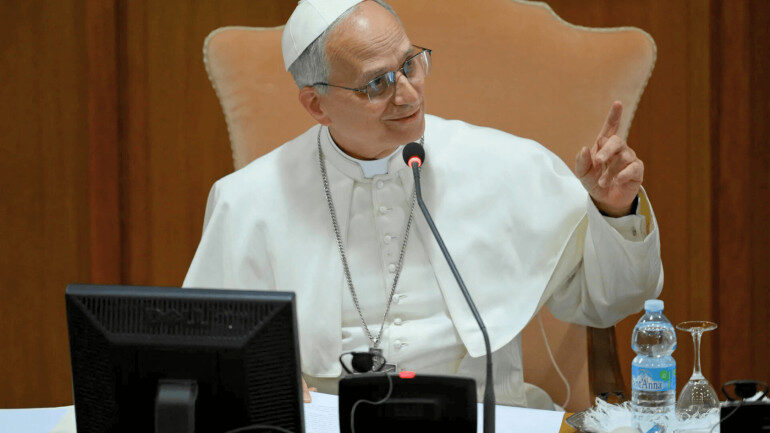
Pope Leo XIV has issued a strong moral and policy warning over the growing influence of overly affectionate AI chatbots, cautioning that emotional dependency on artificial intelligence could pose serious psychological, social, and ethical risks. In a message released ahead of the Catholic Church’s World Day of Social Communications, the pontiff urged governments and technology companies to introduce strict regulations to prevent humans from forming deep emotional attachments to AI-powered companion bots.
The US-born head of the Roman Catholic Church expressed concern that increasingly human-like chatbots — designed to appear caring, empathetic, and constantly available — could reshape emotional behavior, blur reality, and undermine authentic human relationships.
“Because chatbots that are made overly ‘affectionate,’ in addition to always present and available, can become hidden architects of our emotional states, and in this way invade and occupy people’s intimate spheres,” Pope Leo wrote on January 24.
He warned that as AI systems become more persuasive and emotionally responsive, users may struggle to distinguish between genuine human interaction and algorithmic simulation.
“As we scroll through our information feeds, it becomes increasingly difficult to understand whether we are interacting with other human beings, bots, or virtual influencers,” he added.
Growing Concerns Over ‘AI Psychosis’
Pope Leo’s remarks come amid rising global alarm over what researchers and mental health professionals have termed “AI psychosis” — an informal phrase describing cases in which heavy AI chatbot use contributes to paranoia, emotional dependency, delusions, or detachment from reality.
The phenomenon has drawn attention after multiple reports of teenagers developing psychological distress following prolonged interactions with AI chat platforms.
The AI industry — including companies such as OpenAI — has come under intensified scrutiny from:
- Policymakers
- Educators
- Child-safety advocates
- Mental health professionals
Following allegations that some teenage users died by suicide after extended engagement with AI chatbots, regulators have increased pressure on tech firms to enhance safety measures and transparency.
According to OpenAI’s internal research, more than one million ChatGPT users — roughly 0.07% of weekly active users — showed signs of mental health crises, including mania, psychosis, or suicidal ideation.
Pope Leo: Emotional Dependence on AI Is a Moral and Social Risk
Pope Leo emphasized that emotional bonds with machines could distort human development, especially among young people.
“Appropriate regulation can protect people from an emotional attachment to chatbots and contain the spread of false, manipulative or misleading content,” he wrote.
“This is essential to preserve the integrity of information against deceptive simulation.”
He warned that AI systems capable of mimicking empathy and affection may exploit vulnerable individuals, shaping emotions without accountability.
“Public communication requires human judgment, not just data patterns. Humanity must remain the guiding agent,” the Pope said.
Call for Transparency in AI-Generated Content
Beyond mental health concerns, Pope Leo also called for a clear and enforceable distinction between human-created content and AI-generated material, including in journalism, media, and digital communications.
“Authorship and sovereign ownership of the work of journalists and other content creators must be protected. Information is a public good,” he stated.
He stressed that AI should serve as a tool that strengthens human connection, rather than replace or erode the human voice.
“The future of communication must be one where machines serve to connect and facilitate human lives — not diminish creativity, accountability, or moral responsibility.”
Warnings About Critical Thinking, Creativity, and Power Concentration
Pope Leo further cautioned that overdependence on AI could weaken fundamental human skills.
“Overreliance on AI weakens critical thinking and creative abilities,” he warned.
“Meanwhile, monopolized control of these technologies raises serious concerns about inequality and the centralization of power.”
His statement echoes broader global anxieties about:
- Corporate dominance in AI
- Data ownership
- Digital inequality
- Ethical oversight of powerful technology platforms
A Pope More Engaged With the Digital Age
Since his election in 2025, Pope Leo XIV has positioned himself as one of the most digitally engaged pontiffs in modern history. Unlike some of his predecessors, he has openly prioritized technology ethics, AI governance, and digital responsibility as central themes of his papacy.
Shortly after taking office, he declared that artificial intelligence would be a defining issue of his leadership, calling for the development of a global ethical framework for emerging technologies.
“Technology must serve human dignity — not redefine it,” he said in an earlier address.
In December 2025, Pope Leo reportedly met with the parent of a 14-year-old boy who allegedly died by suicide after prolonged engagement with an AI chatbot, reinforcing his pastoral and personal concern for families affected by digital harms.
Global Momentum for AI Regulation Grows
The Pope’s warning aligns with broader international efforts to introduce stricter AI regulations, including:
- The European Union’s AI Act
- Proposed child-safety AI laws in the United States
- UNESCO’s global ethical AI guidelines
- Government initiatives in Asia to regulate AI companions and deepfake content
Experts say the Pope’s moral authority could further accelerate global discussions on AI governance.
“This is one of the strongest faith-based interventions on AI ethics to date,” said a digital policy analyst.
“It bridges mental health, morality, regulation, and technology responsibility.”
The Core Message: AI Must Serve Humanity — Not Replace It
At the heart of Pope Leo XIV’s message is a central principle:
AI should enhance human life, not manipulate human emotion or replace human connection.
“The challenge is to ensure that humanity remains the guiding agent,” he wrote.
“Machines must serve human relationships — not substitute them.”
As AI chatbots become more lifelike, emotionally responsive, and widely accessible, the Pope’s warning underscores a growing global concern: technology’s power over the human mind must be matched with strong ethical boundaries, legal oversight, and social responsibility.