


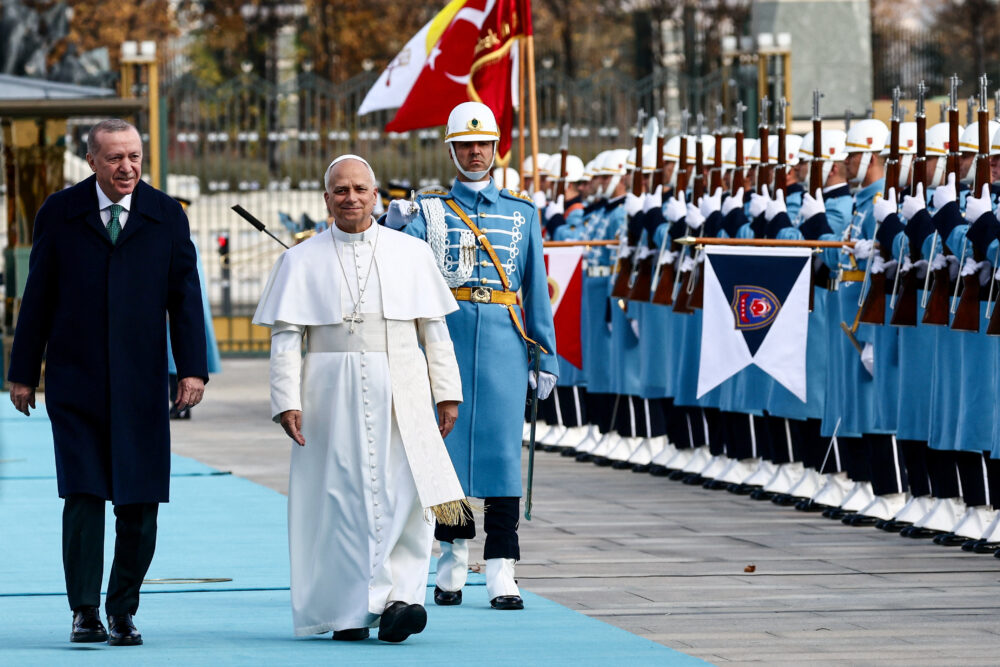
At the beginning of his first international visit, Pope Leo XIV cautioned the world against sliding into an era of intensified global conflict, warning that the very future of humanity is under serious threat. Speaking in Turkey, the Pope appealed to Turkish President Recep Tayyip Erdogan to play a stabilizing role by promoting dialogue and peace at a time of growing international tensions.
The trip includes a major historical and spiritual milestone, as Pope Leo will take part in a Christian anniversary in Turkey before travelling to Lebanon just days after Israeli airstrikes struck Beirut. Though the journey was originally planned by the late Pope Francis, Pope Leo has fully embraced its core message of unity and bridge-building since assuming the papacy earlier this year.
Referring to the current state of global violence, Pope Leo echoed a phrase often used by his predecessor, describing modern conflicts as a “third world war fought in fragments,” pointing to wars in Ukraine, Syria, Myanmar and other regions.
Since becoming Pope six months ago, he has been known for his careful and balanced approach. However, this diplomatic tour is expected to test his global influence more closely than ever before.
A central moment of the journey will take place in the Turkish town of Iznik, the ancient city of Nicaea, where Pope Leo will join leaders of multiple Christian traditions to mark the 1,700th anniversary of the historic Council of Nicaea. In the year 325 AD, more than 200 bishops met there and formally affirmed the belief in Jesus as the Son of God, shaping what later became the Nicene Creed. Although Christianity later split into Eastern and Western branches, this gathering will emphasize unity, reconciliation, and healing old divisions.
During his stay in Turkey, the Pope will also visit the iconic Blue Mosque, continuing a tradition followed by his two immediate predecessors. He is scheduled to hold meetings with religious leaders as part of broader interfaith outreach before departing for Lebanon.
Despite the recent Israeli airstrikes in Beirut, the Vatican has confirmed that Pope Leo’s visit to Lebanon will proceed as planned. There, he will meet with religious figures and interact with young people, offering moral encouragement to Lebanon’s Christian community, which makes up roughly one-third of the country’s population.
On the final day of the visit, Pope Leo will celebrate Mass at Beirut’s waterfront near the site of the devastating 2020 port explosion, where he will pray for the more than 200 lives lost and thousands who were injured.
While the Pope has spoken openly on humanitarian issues such as the dignity of migrants, he has remained far less overtly political than Pope Francis. His cautious style has drawn support from both progressive and conservative sections within the Catholic Church, allowing him to maintain a delicate balance between reform and tradition.
Unlike Pope Francis, who frequently made personal calls to communities affected by war, Pope Leo has preferred a quieter but persistent call for peace. During meetings with President Erdogan and Lebanese civic leaders on this trip, he may be pressed to offer more direct opinions on ongoing conflicts in the region.
As is customary, he is expected to share his reflections with journalists during a press conference on the return flight to Rome. Notably, for the Turkish leg of the tour, Pope Leo will deliver his remarks in English — spoken with his distinctive Chicago accent — and will use some French during his time in Lebanon.