



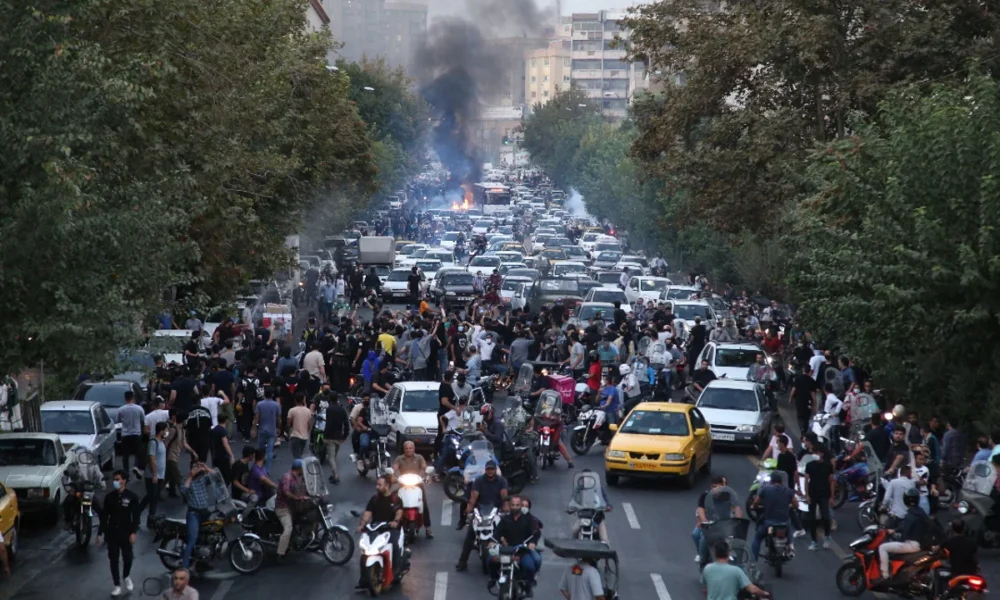
Iran is once again confronting a familiar yet increasingly volatile cycle: protest, crackdown, silence — and then protest again. For years, public anger has simmered beneath the surface, fueled by deep political disillusionment, economic hardship, and a system widely seen as resistant to meaningful reform. Today, however, many observers believe the country may be approaching a more consequential turning point.
Repeated waves of nationwide protests have marked Iran’s recent history. Each uprising has been driven by a mix of economic pain, social repression, and frustration with entrenched power structures. Chronic mismanagement, widespread corruption, and the crushing weight of international sanctions have only compounded the strain on ordinary Iranians. While past protests have often been met with swift and violent repression, moments such as the 2022 demonstrations following the death of Mahsa Amini showed how deeply societal norms could be shaken, even if political power remained unchanged.
On Friday, Supreme Leader Ayatollah Ali Khamenei, now 86 and in power for more than three decades, addressed the latest unrest. Acknowledging the economic grievances that have ignited public anger, he nevertheless reverted to the regime’s long-standing narrative. Khamenei distinguished between what he described as “legitimate protest” and what he labeled rioting by “mercenaries,” issuing a clear warning that disorder would be met with force.
Yet this time, Iran’s old playbook may be under strain.
A Changed Political and Geopolitical Landscape
These are the first major protests since the 12-day war between Iran and Israel last summer — a conflict that drew in the United States and resulted in significant damage to Iran’s nuclear facilities. The war exposed vulnerabilities in Iran’s deterrence posture and punctured the image of invincibility that the leadership has long cultivated.
In the immediate aftermath, some Iranians hoped the government would seize the moment to reshape its relationship with society — leveraging a brief surge of nationalism into a more inclusive and flexible social contract. Instead, dissent was once again suppressed, and the gulf between rulers and ruled widened further.
“The expectation of change after the war has turned into deeper disappointment,” said a Tehran-based political analyst. “That sense of missed opportunity is feeding today’s anger.”
The Return of a Symbolic Challenger
Adding a new dimension to the unrest is the resurgence of monarchist slogans and growing visibility of Reza Pahlavi, the son of Iran’s last shah, who lives in exile. While Pahlavi has been a presence in Iranian opposition politics for years, recent protests suggest his symbolic appeal is growing.
Chants such as “This is the last battle, Pahlavi will return” and “Long live the Shah” have echoed in Tehran and other cities — a notable shift from earlier protests that focused primarily on economic grievances or social freedoms.
Pahlavi has openly encouraged protesters to remain in the streets and thanked them for their courage, urging them to sustain momentum. Supporters see him as a unifying figure beyond the Islamic Republic, while critics question whether his movement can broaden its appeal beyond symbolic defiance.
“The rhetoric has changed,” said an Iranian sociologist. “Invoking the monarchy is not just nostalgia — it’s a direct rejection of the Islamic Republic itself.”
So far, the protests have not matched the scale of the 2009 Green Movement or the breadth of the 2022 unrest. But the political messaging appears more explicit, signaling a shift from protest within the system to protest against it.
The Trump Factor and External Pressure
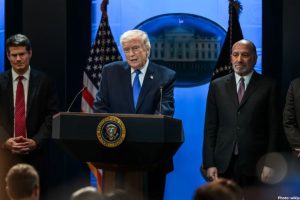
Another variable weighing heavily on Tehran is the occupant of the White House. U.S. President Donald Trump has publicly warned Iran against violently repressing protesters, comments Iranian officials have dismissed as interference. Still, recent global events suggest Tehran may be more cautious than it appears.
The U.S. response to unrest in Venezuela, where Washington adopted an unusually aggressive posture, has not gone unnoticed in Tehran. Iranian leaders are acutely aware that Trump has shown little interest in adhering to traditional diplomatic norms.
“There is genuine concern in Tehran about how far Washington might go if images of mass repression emerge again,” said a regional security expert. “This is not 2019 or 2022 — the geopolitical environment is harsher and more unpredictable.”
A Regime Showing Signs of Fatigue
For many Iranians, this latest episode feels hauntingly familiar: the same leadership, the same warnings, and the same reluctance to change course. But the context is markedly different. Iran’s economy is weaker, its regional position has been challenged, and public patience appears thinner than ever.
The regime still controls powerful tools of repression — the security forces, the courts, and state media. Yet sustaining control through force alone may be increasingly costly, both domestically and internationally.
“This is a tired system facing a population that has little left to lose,” said an exiled Iranian commentator. “That combination is inherently unstable.”
An Uncertain Ending
For millions of Iranians at home and abroad, the current unrest represents another chapter in a long struggle between a rigid state and a restless society. Whether this wave of protests will fade like many before it — or push the country toward a more profound reckoning — remains unclear.
What is clear is that Iran stands at a pivotal moment. With shifting internal dynamics and a volatile global backdrop, the familiar cycle of protest and repression may no longer guarantee the same outcome. This time, the ending could be far less predictable.