



India has not been included in a new US-led strategic initiative, Pax Silica, which aims to build a secure and trusted global supply chain covering critical minerals, energy inputs, semiconductors, artificial intelligence (AI) infrastructure, and advanced manufacturing. The development comes at a time when an India-US trade agreement remains unresolved despite multiple rounds of high-level discussions and technical negotiations.
Pax Silica seeks to strengthen supply chain resilience among a group of like-minded nations as the US and its allies accelerate efforts to reduce dependence on China, particularly in strategic sectors such as rare earths, semiconductors, and AI technologies. The diversification push has gained urgency following China’s recent restrictions on rare earth magnet exports, which disrupted global manufacturing and technology supply chains.
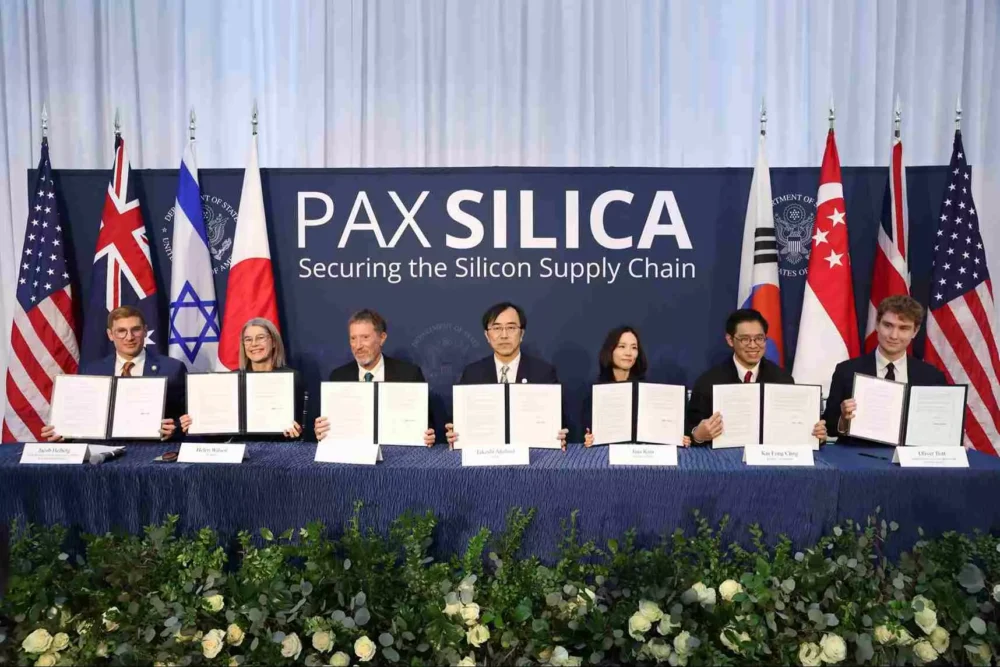
According to a statement issued by the US Department of State, the inaugural Pax Silica Summit brings together counterparts from Japan, the Republic of Korea, Singapore, the Netherlands, the United Kingdom, Israel, the United Arab Emirates, and Australia. “Together, these countries are home to the most important companies and investors powering the global AI supply chain,” the statement said.
The initiative is described as a framework to create a “secure, prosperous, and innovation-driven silicon supply chain” spanning everything from critical mineral sourcing and energy infrastructure to semiconductor fabrication, AI deployment, and logistics. “Rooted in deep cooperation with trusted allies, Pax Silica aims to reduce coercive dependencies, protect the materials and capabilities foundational to artificial intelligence, and ensure aligned nations can develop and deploy transformative technologies at scale,” the State Department noted.
Participating countries have committed to jointly addressing vulnerabilities across priority areas, including critical minerals, semiconductor design and packaging, logistics and transportation networks, computing infrastructure, and power generation. Measures under the initiative include pursuing joint ventures and strategic co-investments, safeguarding sensitive technologies from undue foreign control, and building trusted technology ecosystems such as fibre-optic networks, data centres, foundational AI models, and digital applications.
Experts, however, point out that India’s absence may reflect current gaps in its semiconductor and critical minerals processing ecosystem rather than a strategic snub. Ganesh Sivamani, Associate Fellow at the Centre for Social and Economic Progress (CSEP), said countries included in Pax Silica already occupy pivotal positions in global technology supply chains.
“The US leads in semiconductor design and intellectual property, while the Netherlands is indispensable for lithography machines used in chip manufacturing,” Sivamani said. “If you look at each of the participating countries, they bring a clear comparative advantage to the existing semiconductor value chain.”
He added that while India has articulated long-term ambitions in this sector, its ecosystem is still evolving. “India is strong in chip design and has significant quartz reserves, which are used in silicon production. However, we lack the capacity to process quartz to the ultra-high purity levels required for semiconductor manufacturing,” Sivamani noted. Drawing parallels with earlier initiatives, he said India joined the Minerals Security Partnership (MSP) only after its launch in 2022, suggesting a similar trajectory for Pax Silica.
Industry representatives echoed these views, highlighting structural constraints. CH Rao, Secretary General of the Federation of Minor Minerals Industry (FEMMI), said China’s dominance in critical mineral processing remains a key challenge. “Several countries, including India, export raw materials for rare earth processing because China has built massive refining capacities,” Rao said. “The US initiative is clearly aimed at reducing China’s influence, and India should ideally be part of such frameworks.”
Rao added that India’s exclusion may also be linked to unresolved trade frictions with Washington. “This could reflect broader trade deal challenges. But once differences are addressed and domestic processing capacity improves, India should be able to join the initiative,” he said.
The geopolitical stakes were underscored earlier this year when US Treasury Secretary Scott Bessent described China’s export controls on critical minerals as a case of “China versus the rest of the world,” adding that the US expects strong backing from “Europe, India and other Asian democracies.”
While India remains outside Pax Silica for now, experts believe its participation could materialise in later phases, provided domestic capabilities and strategic alignments continue to evolve.