




1989 was a landmark year in human history. There were momentous world-changing events taking place. The division that had scarred the world since the end of World War II was coming to an end. The winds of change in the Soviet Union, Hungary, Romania, Czechoslovakia, and Poland had reached gale force. The Berlin Wall, which divided East Germany and West Germany, crumbled, and finally, peace seemed visible in Northern Ireland. In another part of the world, South Africans waited in anticipation for the end of apartheid and the release of Nelson Mandela after twenty-seven years.
At that pivotal moment of history, on the freezing morning of December 10, 1989, His Holiness the 14th Dalai Lama, clad in a maroon and saffron robe and sandals, stepped out of the Grand Hotel in Oslo, Norway. He had arrived in the Scandinavian nation to accept the Nobel Peace Prize, provided in the will of Alfred Nobel, the Swedish industrialist and inventor of dynamite. He was the first Asian to receive the honor.
The fourteenth Dalai Lama was born on July 6, 1935, in a farming family in the northeastern Tibetan province of Amdo. His parents named him Lhamo Thondup. After His Holiness the 13th Dalai Lama passed away in 1933 at the age of 57, the most venerated monks of Lhasa began searching for the next spiritual leader. They arrived at the doorstep of the mud-and-stone house of Lhamo Thondup during a harsh winter. The monks placed an array of objects in front of the two-year-old. He immediately grabbed one that belonged to His Holiness the 13th Dalai Lama. After a few more assessments, the monks proclaimed him to be the reincarnation of the previous Dalai Lama. They renamed him Jetsun Jamphel Ngawang Lobsang Yeshe Tenzin Gyatso (Holy Lord, Gentle Glory, Eloquent, Compassionate, Learned Defender of the Faith, Ocean of Wisdom). On February 22, 1940, he was enthroned as His Holiness the 14th Dalai Lama and immediately moved into the Potala Palace, the 17th-century, thousand-room residence overlooking the city of Lhasa. The small boy began monastic training and undertook Buddhist philosophical studies. In March 1959, after the failure of the uprising, His Holiness the Dalai Lama disguised himself as a soldier and trekked across the border into India. The Indian Prime Minister Jawaharlal Nehru granted him asylum. From then onwards, India became the spiritual master’s home, and he eventually established his headquarters in McLeod Ganj, a suburb of Dharamsala in the foothills of the Himalayas. In the years to come, he became actively involved in international causes, including efforts to bridge the gap between science and spirituality, with a particular focus on Buddhism. He extensively lectured around the world, speaking before eclectic audiences about love, peace, anger, humility, reincarnation, and rebirth.
In October 1989, three decades since his arrival in India, a five-member committee consisting of Norwegian academics and politicians announced that the Dalai Lama would be the recipient of the Nobel Peace Prize. Jakob Sverdrup, secretary to the Nobel Committee and director of the Nobel Institute revealed, that His Holiness the Dalai Lama was the “among the favorites from the beginning” and Egil Aarvik, the chair of the Nobel Committee divulging the reason for bestowing the honor said, “first and foremost for his consistent resistance to the use of violence…”
Norway’s King Olav V, the entire Norwegian cabinet, Norwegian Government officials, and the diplomatic corps assembled at a ceremony in the assembly hall at the University of Oslo. The slight, soft-spoken, seemingly ever-smiling His Holiness Dalai Lama received a diploma and a gold medal, along with a cash prize of three million Swedish crowns, worth approximately $455,000. The spiritual master began his acceptance speech with a brief Buddhist chant. Then he switched to English. In his acceptance speech, he stated, “I accept the prize with profound gratitude on behalf of the oppressed everywhere and for all those who struggle for freedom and work for world peace… Our struggle must remain nonviolent and free of hatred… I accept it as a tribute to the man who founded the modern tradition of nonviolent action for change, Mahatma Gandhi, whose life taught and inspired me…”
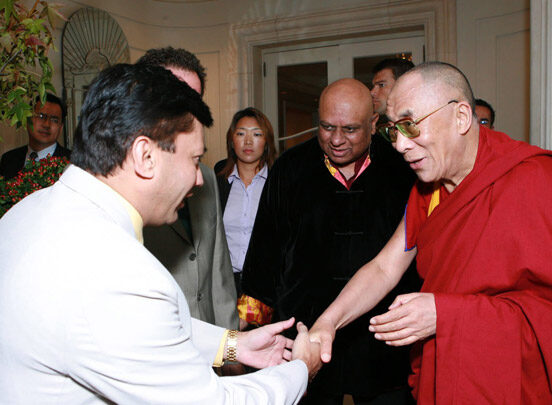
Then, years later, on the warm morning of September 11, 2006, I stood at the entrance of the Peninsula Hotel in Beverly Hills, awaiting a very special guest: His Holiness the 14th Dalai Lama. He had graciously accepted our invitation to be the guest of honor at “World Peace Through Cinema,” a unique event in Hollywood that I was hosting. His Holiness the Dalai Lama is perhaps one of the most in-demand personalities in the world. We had earlier approached him to honor us with his presence in Hollywood. After reviewing his extensively packed calendar of events around the world, he suggested September 11, 2006. On that day, His Holiness the Dalai Lama was granted honorary citizenship by the Canadian Government, and he flew into the United States from Vancouver. The US State Department Diplomatic Security Service officers and Geshe Tsultrim Gyaltsen-la received him at the Los Angeles International Airport. His Holiness, dressed in his traditional maroon robes, was taken straight from the aircraft to the cars waiting below and escorted as a state guest to the Peninsula hotel in Beverly Hills. Upon his arrival at the hotel, as the Secret Service stepped back, I enthusiastically clasped the hand of His Holiness the Dalai Lama for a keepsake photograph.

Marking the fifth anniversary of the 9/11 attacks, the highlight of that day was an extraordinary and rare meeting between His Holiness the Dalai Lama and another towering figure of Buddhism: Zen Master Thich Nhat Hanh (Thay), founder of the Plum Village International Community of Engaged Buddhists in France. The two leading lights of the Buddhist faith had met only once before, decades ago, and this was to be their last meeting. The energy in the hotel’s small hall was electric. The room fell into a hushed stillness as the two spiritual leaders greeted one another. You could feel the shift in the very air. Our guest list that day included carefully chosen individuals from Hollywood’s most influential circles. Among them were Goldie Hawn, Sharon Stone, Carol Mendelsohn, Laurence Fishburne, Victoria Principal, Jeff Skoll, Marc Shmuger, Chris McGurk, Blair Westlake, and Stephan Davis. Hollywood star Robert Downey Jr. also made an unannounced appearance. He quietly took a seat, listened intently, and later shared fragments of his spiritual journey, describing himself as a “Jewish-Buddhist.” He spoke of past interests in Christianity and Hare Krishna teachings. At that time, he was clawing his way back from years of addiction and legal troubles.
The event opened with a solemn memorial. Each attendee placed a candle into a fountain holding 2,973 pebbles – one for every life lost during the 9/11 attacks. Hanif Wally Dahya, a New York investment banker who had lost several close friends that day, shared his deeply personal reflections. Then, Thich Nhat Hanh, with serene simplicity, addressed the gathering: “Each of us should live life in such a way that a future is possible for our children and for our children’s children. Do the things that should be done to help with the collective awakening… and then the miracle will happen.” The monastic sangha followed with chants of “May the Day Be Well” and an invocation to the Bodhisattva Avalokiteshvara.
As everyone settled down in the hall, His Holiness the Dalai Lama began to speak. He talked of the depth of interconnectedness in all of existence, stating, “Everything is interconnected. My interest is linked to everyone else’s. Our survival and future are linked. The destruction of your so-called enemy is the destruction of yourself.” The wisdom of the East filled the room with a delightful blend of sincerity and witty comments. His trademark high-pitched laughter peppered the talk. “To understand true compassion,” he added, “look at children. They’re naturally open and honest. They don’t care about backgrounds, religion, or nationality—only that others smile and play with them.” He emphasized cinema’s potential to inspire compassion and change, stating that Hollywood holds the power to move the world toward greater empathy and understanding.
The celebrity-filled room was lighter as the spiritual master repeatedly threw his head back and burst into one of his long, deep laughs. It was impossible not to be moved by his humility, warmth, and sense of humour. The chief attraction had visibly touched many of our guests. At the end of the talk, flanked by his close aides and bodyguards, His Holiness the Dalai Lama patiently and energetically clasped their hands and posed for photos with Hollywood’s glitterati. Each luminary, with millions of fans worldwide, had a picture taken with the Nobel Peace Prize laureate. Later, he placed a Khata, the traditional ceremonial white silk scarf, around my neck, a gesture of respect, honor, and goodwill, and representing compassion.
On July 6, 2025, His Holiness the Dalai Lama, who has navigated the multifaceted intersections of spiritual wisdom, science, and geopolitics, celebrates his 90th birthday. At this juncture of human history, his writings and words remain a great source of inspiration. One can share one of his favorite verses, found in the writings of the renowned eighth-century Buddhist saint Shantideva:
“For as long as space endures,
And for as long as living beings remain,
Until then may I too abide,
To dispel the misery of the world.”
By: Bhuvan Lall