







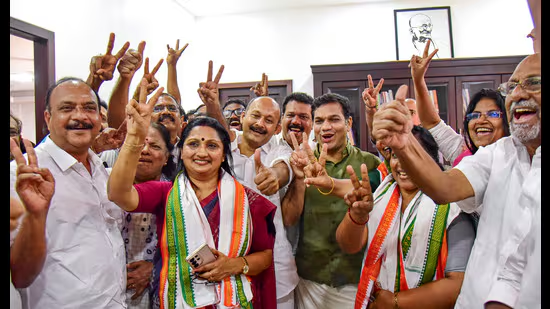
The recent local body election results in Kerala have signalled a notable shift in the state’s political undercurrents, with the Congress-led United Democratic Front (UDF) emerging ahead of the ruling CPI(M)-led Left Democratic Front (LDF). The outcome is being closely watched as a bellwether for the Kerala Assembly elections scheduled for April next year.
The setback is particularly significant for the LDF, which has been in power since 2016 and had dominated local self-government institutions for nearly a decade. In a reversal from the 2020 local body polls—when the LDF secured control of 11 out of 14 district panchayats—the ruling alliance managed to retain an edge in only seven this time. Several rural and urban local bodies that were once considered Left strongholds have swung in favour of the UDF.
Political analysts say the verdict reflects voter fatigue, social coalition shifts, and the inability of the ruling front to effectively counter emerging narratives. “Local body elections often act as a referendum on governance, and this result shows that sections of the electorate are seeking alternatives,” a senior political observer based in Thiruvananthapuram said.
Sabarimala Gold Theft Controversy
One of the most damaging issues for the LDF, especially in central and southern Kerala where the CPI(M) enjoys substantial Hindu support, was the alleged gold theft from the Sabarimala temple. The arrest of a senior party leader in connection with the case gave the Opposition a potent campaign plank.
Both the Congress and the BJP aggressively highlighted the controversy, framing it as a moral and administrative failure of the Left government. While the CPI(M) attempted to counter by accusing the Congress of aligning with the right-wing Jamaat-e-Islami, the Opposition hit back by pointing out that the Left itself had engaged with the organisation until 2019.
“The Sabarimala issue dented the CPI(M)’s credibility among its traditional Hindu voters, who view temple-related matters with deep sensitivity,” a political analyst noted.
A Lacklustre Campaign Narrative
The LDF largely relied on its welfare and development record, projecting achievements such as enhanced social security pensions—now at ₹2,000 for nearly 49 lakh beneficiaries—and monthly assistance of ₹1,000 for women from below-poverty-line families.
However, analysts say these schemes, which proved electorally effective during the Covid-19 period, failed to strike a chord this time. “Welfare fatigue is real. Voters now want visible improvements in daily governance rather than repetition of old achievements,” said a former bureaucrat familiar with Kerala’s local governance.
Flagship programmes such as extreme poverty eradication, housing for the poor, and waste management—implemented through local bodies—did not translate into electoral dividends, suggesting a disconnect between policy rollout and public perception.
Alienation of Muslim Voters
The CPI(M) also appears to have lost ground in Muslim-majority regions, particularly in north Kerala. The perception that the Left had softened its opposition to the Hindutva agenda weakened minority confidence in the alliance.
Controversies surrounding Kerala’s eventual participation in the PM-SHRI school scheme, after years of resistance, raised questions about ideological consistency. Matters worsened when SNDP Yogam general secretary Vellappally Natesan made provocative remarks against Muslims in Malappuram district. The Chief Minister and CPI(M)’s silence on the issue was widely interpreted as political opportunism.
“The Left’s failure to strongly rebut communal rhetoric alienated minority voters who once saw it as a firm secular bulwark,” a UDF leader said.
Christian Vote Consolidation Behind Congress
In central Kerala, the Christian electorate—previously divided between the Congress, Left, and BJP—appears to have consolidated behind the UDF. This marks a turnaround from the 2020 local body and 2021 Assembly elections, when the Congress lost ground after Kerala Congress (M) aligned with the LDF.
Despite lacking high-profile Christian leadership, the Congress managed to regain trust, while the BJP’s attempt to expand its Christian outreach, fielding nearly 15% Christian candidates, failed to yield results.
“The Christian community seemed to make a strategic choice, favouring the UDF as the most viable alternative to the Left,” said a senior journalist tracking church-state dynamics.
Rising Anti-Incumbency and Economic Stress
After nearly a decade in power, the Vijayan government is facing visible anti-incumbency. The CPI(M)’s social media campaign projecting a third consecutive term as a “certainty” appears to have backfired, creating resentment among undecided voters.
Economic pressures have added to public dissatisfaction. Kerala has recorded persistently high inflation, pushing up prices of essential commodities. While government aid cushioned households during the pandemic, rising costs have hurt low-income workers in traditional sectors such as cashew and coir.
Additionally, human-animal conflict has emerged as a major local issue. Nearly one-fourth of Kerala’s 941 village panchayats have reported wildlife attacks. “The government’s inability to address this effectively has triggered anger in rural areas,” a local body representative said.
As the Assembly elections draw closer, the local body verdict serves as a warning signal for the LDF and a morale booster for the UDF, setting the stage for an intensely contested political battle in Kerala.