



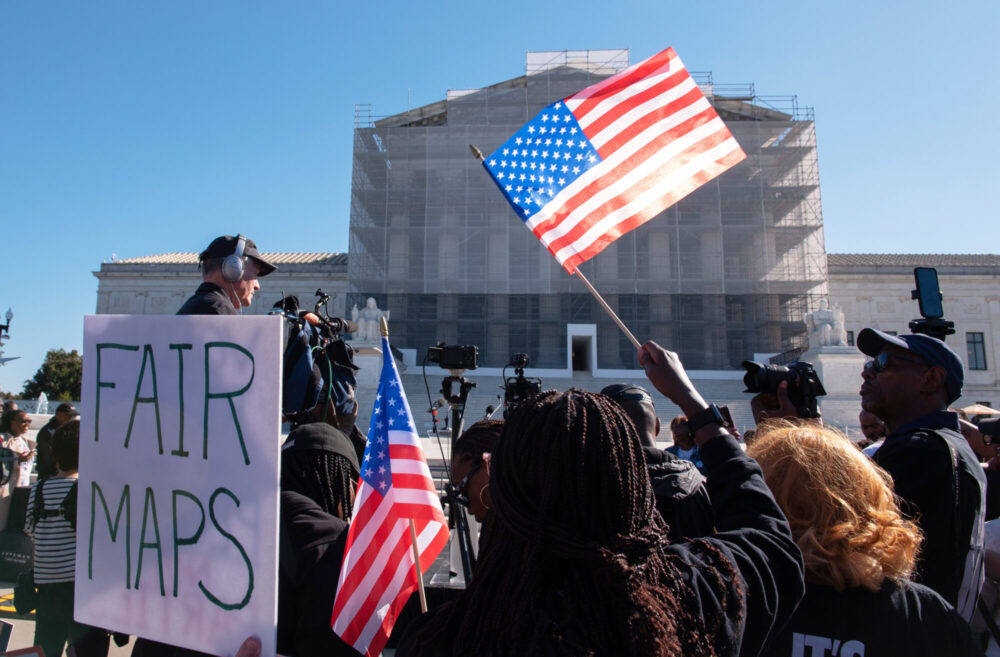
Recent Democratic gains in Mississippi’s legislature have underscored the continuing power of the U.S. Voting Rights Act (VRA) — even as the Supreme Court appears poised to sharply curtail the law’s reach, potentially blocking similar victories nationwide.
Last month, Black Democratic candidates picked up two additional seats in Mississippi’s House following a court-ordered redrawing of legislative districts. The change broke a long-standing Republican supermajority in a state where nearly 40 percent of the population is Black — the highest proportion in the United States.
The redistricting victory was driven by litigation under the Voting Rights Act, a cornerstone of U.S. civil rights law enacted in 1965. But legal experts warn that such outcomes may soon become impossible if the Supreme Court continues narrowing how — and whether — the law can be enforced.
“This becomes almost an impossible hill to climb,” said Mississippi civil rights attorney Carroll Rhodes, who led the lawsuit that resulted in the special election.
A Law Under Sustained Judicial Assault
Over the past decade, the Supreme Court has steadily weakened the Voting Rights Act. In 2013, the Court’s landmark ruling in Shelby County v. Holder eliminated the federal “preclearance” requirement that forced states with histories of racial discrimination — including Mississippi — to seek Justice Department approval before changing voting rules or district maps.
That decision, authored by Chief Justice John Roberts, allowed states to enact new maps without federal oversight. Mississippi’s 2022 legislative districts, which Rhodes later challenged successfully, were drawn under this post-Shelby framework.
“They were able to do it directly because of Shelby County,” Rhodes said. “Roberts got it wrong.”
Rhodes echoed the late Justice Ruth Bader Ginsburg, who famously compared the decision to “throwing away your umbrella in a rainstorm because you are not getting wet.”
Private Lawsuits Now in Jeopardy
The next potential blow could be even more severe. Several cases before the Supreme Court challenge whether private individuals and civil rights groups can sue under Section 2 of the Voting Rights Act — a power long assumed but never explicitly spelled out in the statute.
If the Court eliminates that right, enforcement would fall almost entirely to the federal government — a shift that alarms voting-rights advocates.
“Despite claims of neutrality, enforcement would depend entirely on who controls the Justice Department,” Rhodes said. “That’s dangerous.”
The concern is amplified by recent court actions. Earlier this month, the Supreme Court blocked a lower-court VRA ruling and allowed Texas to redraw congressional districts at the request of President Donald Trump, potentially adding up to five Republican House seats.
Mississippi Shows What’s at Stake
Despite mounting obstacles, Rhodes’ work in Mississippi demonstrates what the VRA can still achieve. In a state where white voters overwhelmingly vote against Black candidates in contested elections, the law has been critical in creating majority-Black districts that allow minority voters to elect candidates of their choice.
“When you have a large, geographically concentrated minority population that cannot elect representatives because the majority always votes against them, the districts must be redrawn,” Rhodes explained.
At one point, Mississippi had nearly 50 Black legislators, including committee chairs. Over time, party realignment and GOP consolidation produced Republican supermajorities. That changed with the recent court-ordered redistricting.
Breaking the supermajority could have tangible effects on budgets, taxation, and spending — areas that often require enhanced legislative thresholds.
Is the Court Shifting — or Just Delaying?
While Chief Justice Roberts has long been viewed as hostile to voting-rights enforcement, some legal observers note a recent pattern of incrementalism rather than outright demolition. In the pending Louisiana v. Callais case, the Court delayed a final ruling, allowing minority-friendly districts to remain in place through the current election cycle.
Rhodes believes Roberts may be reassessing the consequences of Shelby County.
“He thought the protections were no longer necessary,” Rhodes said. “But I think he’s seen the damage that decision caused.”
Technology, Gerrymandering, and a Legal Catch-22
Modern redistricting tools have made it easier to disguise racial discrimination behind claims of partisan map-drawing. The Supreme Court ruled in 2019 that partisan gerrymandering is beyond federal constitutional review — even while continuing to police racial considerations.
In states like Mississippi, Rhodes says, that distinction is artificial.
“Race and party here are inseparable,” he said. “That line is a fiction.”
Algorithms and mapping software, he warned, can be engineered to dilute minority voting power while maintaining plausible deniability.
A Personal History — and an Uncertain Future
Born in 1951, Rhodes grew up in the segregated South. He recalls separate water fountains, courtroom balconies for Black spectators, and routine voter suppression tactics that existed before the VRA.
After the law passed, his parents and neighbors registered and voted in every election — a transformation he fears could be reversed.
If Section 2 enforcement collapses, civil rights groups would be forced to rely on the 14th and 15th Amendments, which require proof of intentional discrimination — a far higher legal bar.
“All legislators have to say is, ‘We acted in good faith,’” Rhodes said. “And going forward, it will be nearly impossible to prove otherwise.”
The Bigger Picture
Mississippi’s recent Democratic gains may prove to be a last demonstration of the Voting Rights Act’s strength in its current form. As the Supreme Court weighs decisions that could reshape redistricting law for decades, the question is no longer whether the VRA is weakened — but whether it can survive as a meaningful tool at all.
What’s at stake is not just partisan balance, but whether minority representation achieved through decades of struggle can still be defended in American courts.