








NEW DELHI — The Union government is preparing to give India’s 77th Republic Day celebrations a strong cultural and diplomatic imprint, with plans to foreground the national song Vande Mataram while hosting top European Union leaders as chief guests. The move reflects a twin push: reaffirming India’s civilisational identity at a landmark moment and advancing strategic engagement with Europe through high-level diplomacy.
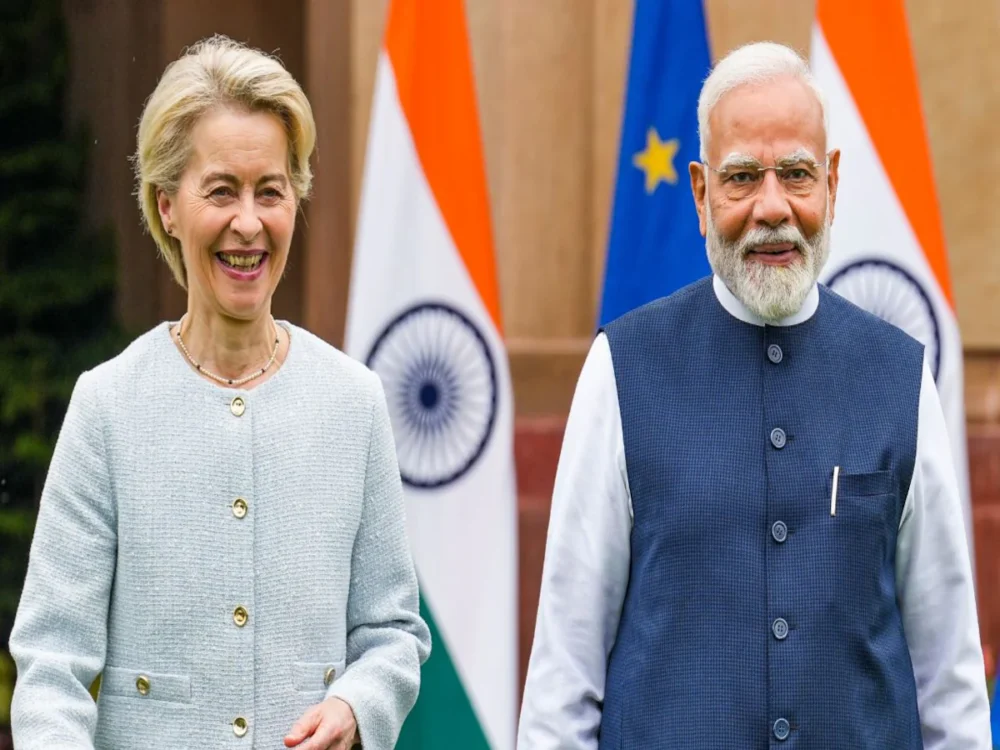
According to senior officials, the Ministry of Defence has approved a “Vande Mataram theme” for the Republic Day parade on January 26, 2026, to mark 150 years since the first two stanzas of the song were published in 1875. European Commission President Ursula von der Leyen and European Council President António Costa are expected to attend the celebrations as chief guests, sharing the dais with President Droupadi Murmu and Prime Minister Narendra Modi.
A Rare Diplomatic Configuration
While Republic Day traditionally features the head of government or state of a single country as chief guest, inviting leaders of a regional bloc is not without precedent. In 2018, India hosted the leaders of the 10-nation ASEAN grouping. Officials said the decision to invite the EU’s top leadership underlines the importance New Delhi attaches to its relationship with Europe at a time of global economic realignments.
On January 27, the day after the parade and the customary “At Home” reception at Rashtrapati Bhavan, the visiting EU leaders are scheduled to participate in an EU-India Summit with Prime Minister Modi. Officials indicated that the summit is expected to focus on finalising the long-pending EU-India Free Trade Agreement (FTA), negotiations for which have stretched over several years.
Vande Mataram at the Centre of Celebrations
The cultural focus of this year’s celebrations will revolve around Vande Mataram, a song composed by Bankim Chandra Chattopadhyay, which played a pivotal role in the Indian freedom movement. Though only its first two stanzas are sung as the national song, Vande Mataram remains a potent symbol of anti-colonial resistance and national awakening.
Officials said the Republic Day programme will include a ceremonial torch relay, special musical compositions, and a themed flypast by the Indian Air Force. Planners are also considering moving the flypast from its traditional slot at the end of the parade to the middle of the event in order to improve visibility and audience engagement along Kartavya Path.
Rebranding and Wider Outreach
As part of the rebranding exercise, the government is examining proposals to include a “150 Years of Vande Mataram” logo on official invitations and passes. There is also a plan under consideration to rename enclosures and drop the long-used “VIP” and “VVIP” labels, replacing them with more neutral terminology.
The Ministry of Culture has been tasked with expanding public participation by integrating its campaign portal with the My Bharat platform, which officials estimate has a user base of around two crore people. Alongside the main celebrations in Delhi, musical performances are planned across the country, including by Army bands in cantonments and by school, college and National Cadet Corps (NCC) bands on campuses nationwide.
Media and Global Outreach
The Ministry of Information and Broadcasting has been directed to produce 25 one-minute films highlighting the history of Vande Mataram and its author. In parallel, the Ministry of External Affairs has been asked to ensure that Indian embassies and missions worldwide organise cultural evenings and a “Global Music Festival” centred on the national song.
Ambassadors and heads of mission have also been encouraged to write opinion pieces for local newspapers in their host countries, explaining the historical and cultural significance of Vande Mataram and its relevance to India’s freedom struggle.
Part of a Broader Narrative
Officials said the thematic emphasis is part of a broader attempt to refresh the symbolism of national celebrations. In 2023, the government briefly experimented with emphasising “Bharat” over “India” in official invitations, before reverting to “Republic of India” in several contexts. Whether the Vande Mataram branding will become a recurring feature of Republic Day celebrations remains unclear.
What is evident, however, is that the 2026 Republic Day is being positioned as both a cultural milestone and a diplomatic signal — blending historical remembrance with contemporary global engagement. With Europe’s top leadership in attendance and trade talks expected to reach a critical stage, the celebrations are set to carry significance far beyond the ceremonial pageantry of January 26.