







At the World Economic Forum (Davos), a high-profile panel featuring top policymakers, global CEOs, and leading economists explored a defining question for India’s future: Can India rise to become the world’s third-largest economy?
The session — moderated by Kalli Purie, Vice-Chairperson and Executive Editor-in-Chief of the India Today Group — brought together Gita Gopinath, Ashwini Vaishnaw, Sunil Bharti Mittal, and Juvencio Maeztu Herrera to unpack India’s economic momentum, reform agenda, and long-term growth challenges.
With strong GDP growth, expanding reforms, and rising global investor interest, India arrived at Davos with unprecedented optimism. Yet, panelists agreed that sustaining this upward trajectory will require faster execution, deeper reforms, and bold policy decisions.
India’s Momentum: Growth Backed by Structural Reform
Opening the discussion, Gita Gopinath, Harvard professor and former IMF Chief Economist, praised India’s recent economic transformation.
“The digital infrastructure build-out is impressive. The progress made on GST, including recent simplifications, has been extremely helpful,” she said.
Responding to Kalli Purie’s central question — how India can maintain its growth momentum — Gopinath emphasized the challenge of sustaining income growth while meeting long-term national development goals.
“To keep the momentum going and achieve the 2047 vision of a developed India, the key challenge is raising capital income and sustaining productivity,” she said.
She noted that India is currently in a strong macroeconomic position, benefiting from healthy growth and controlled inflation.
“Not just growth, but inflation being in the low single digits — that puts India in a good place,” she added.
Land, Labour, and Legal Reform: Persistent Bottlenecks
Despite optimism, Gopinath underscored structural constraints that continue to slow progress — especially in land acquisition and legal processes.
“It remains extremely difficult to acquire land in India and secure clean land titles. This is a serious constraint on manufacturing and infrastructure growth,” she said.
She also highlighted the urgent need for judicial reform, calling it “absolutely critical” to improving business confidence and accelerating project execution.
On employment, Gopinath pointed out a major mismatch between India’s demographic dividend and labour-driven growth.
“Only about 30% of India’s growth is coming from labour. That needs to change if India wants to integrate deeply into global supply chains,” she noted.
While welcoming India’s new labour laws, she stressed that far larger reforms are needed to boost workforce participation and productivity.
Human Capital and Skills: A Make-or-Break Factor
Another central concern raised was human capital development.
“There is a mismatch between job creation and workforce skills. Scaling up education, training, and skilling is absolutely critical,” Gopinath said.
She warned that without significant investment in education and workforce readiness, India risks missing out on high-value global manufacturing and technology opportunities.
Pollution: A Hidden Economic Threat
When asked what else could slow India’s rise, Gopinath highlighted pollution as a major — and often underestimated — barrier to growth.
“Pollution is a serious challenge in India — far more consequential than tariffs,” she said.
Citing World Bank estimates, she noted that around 1.7 million people die annually in India due to pollution, making it both a public health crisis and an economic drag.
“If people feel the environment is unhealthy to live in, it becomes a deterrent — especially for global talent and investors,” she warned.
She urged India to address environmental challenges “on a war footing.”
A Changing Global Order
Gopinath also addressed global uncertainty, particularly amid trade disruptions and geopolitical shifts.
“We have permanently moved away from the previous 80 years of the global economic order. We are not going back,” she said, referencing the long-term impact of protectionism and shifting trade alliances.
Business Perspective: ‘India Will Be Number Three’
Turning to the private sector, Kalli Purie asked Sunil Bharti Mittal, Chairman of Bharti Enterprises, how India can accelerate growth further.
Mittal expressed strong confidence in India’s trajectory.
“India is already in a great spot. We will become the world’s third-largest economy. If I may say so — it’s written in the stars,” he said.
However, he emphasized that India must scale its economy significantly, targeting a $25–30 trillion GDP to firmly secure that global ranking.
“We will get to number three, but we need to scale much faster,” he noted.
Mittal praised the government for creating a stable and business-friendly environment, saying the fundamentals for private sector growth are now in place.
“The business community needs an enabling environment, stability, and a committed government — and we have that today,” he said.
Yet, he cautioned that global competition and trade barriers remain the biggest external risks.
“What can derail India is the competitive intensity of the world. Trade agreements will matter more than ever,” he said.
Reflecting on India’s regulatory transformation, Mittal recalled the bureaucratic hurdles of the past.
“Earlier, getting one licence meant running to multiple departments. That era is gone,” he said.
He urged policymakers to trust Indian companies more.
“Transfer more faith to Indian industry. We will do the right things and comply,” he added.
Global CEO View: India as a Growth Powerhouse
Offering an international investor’s perspective, Juvencio Maeztu Herrera, CEO of Ingka Group (IKEA), spoke warmly about India’s potential.
“I am emotionally biased toward India — I lived and worked here for six years,” he said.
Herrera described India as a rare combination of market scale, youth, and democracy.
“India is a massive market, has a young population, and has the ability to leap from agriculture to advanced AI faster than any other country,” he said.
He praised India’s openness to investor engagement.
“When companies face obstacles, they can knock on doors — and they are heard,” he noted.
However, he suggested India could grow even faster by aligning more closely with global standards, particularly in manufacturing.
“India deserves far more than one percent of global furniture production,” he said.
His advice to global CEOs entering India was clear:
“Don’t come for short-term profits. India doesn’t need you. Commit long-term, engage locally, and understand the country from within.”
Government Reforms: Cutting Red Tape at Scale
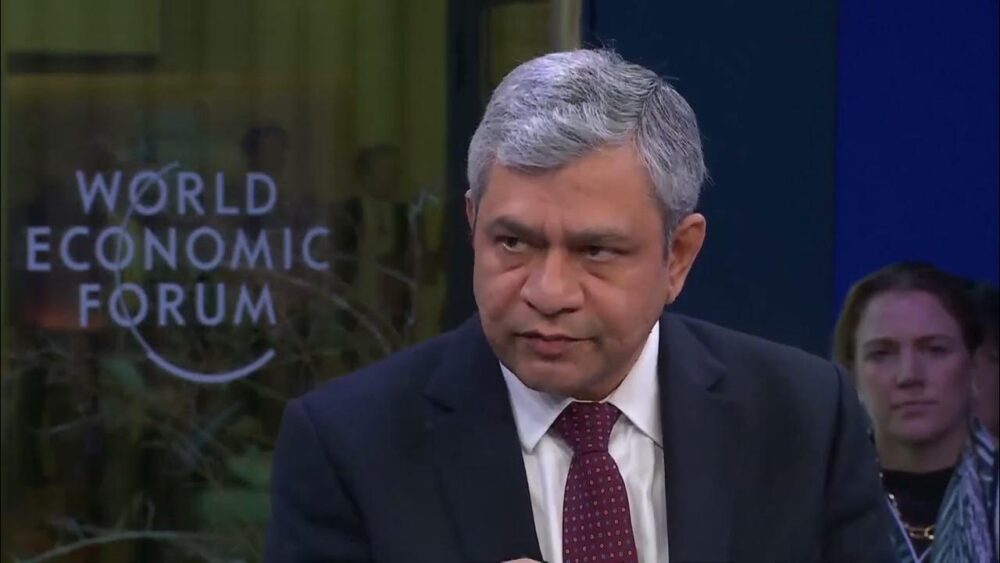
Addressing ease of doing business, Ashwini Vaishnaw, India’s Union Minister for IT, Railways, and Information & Broadcasting, outlined the scale of recent regulatory reform.
“Over the last decade, 1,600 laws have been removed, and 35,000 compliances eliminated,” he said.
He explained that many outdated laws from the colonial era are being rewritten or scrapped.
“To get a telecom tower permit once took 270 days — now it takes just seven,” Vaishnaw revealed.
Similarly, railway terminal approvals have been reduced from six years to just two and a half months.
He added that India has modernised its criminal justice and telecom frameworks, replacing legal systems dating back to the 1800s.
Trade, Tariffs, and Global Resilience
On global trade tensions, Vaishnaw said India remains resilient despite tariff pressures.
“Our exports have continued to grow despite tariffs,” he said.
He noted that electronics has become India’s third-largest export category, and the country is expanding into new markets through balanced trade agreements.
“The world increasingly sees India as a trusted and reliable value-chain partner,” he said.
Conclusion: India’s Moment Is Real — Execution Will Decide the Future
The Davos panel made one message clear: India’s opportunity is historic, but execution will determine whether ambition becomes reality.
India’s economic rise is backed by reforms, demographics, digital infrastructure, and global investor interest. Yet challenges — including land reform, judicial efficiency, pollution, skills, and global competition — remain decisive.
Summing up the session, Kalli Purie captured the spirit of optimism:
“India is a force for good — and its rise is written in the stars.”