



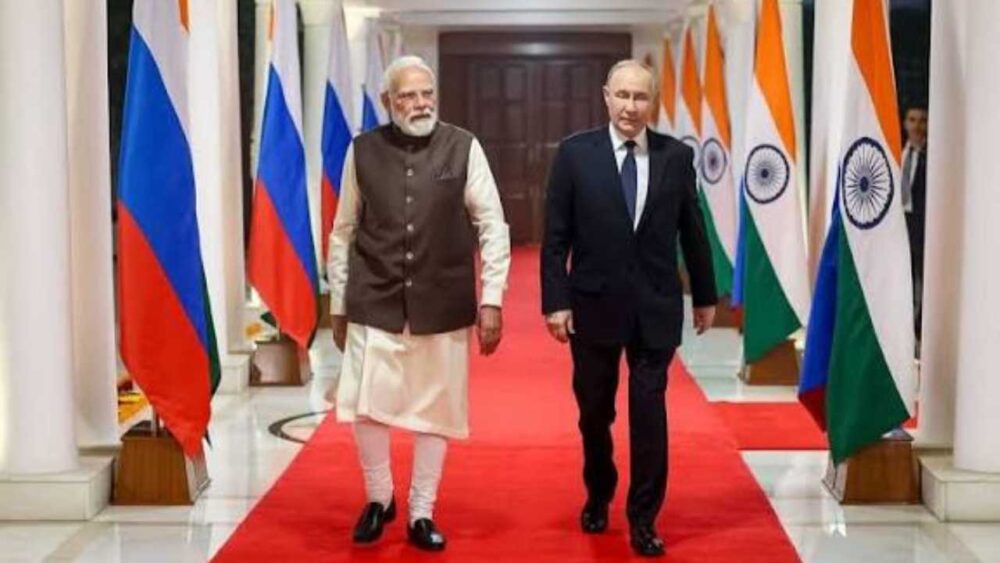
When Russian President Vladimir Putin landed in New Delhi on Thursday, Prime Minister Narendra Modi greeted him with a warm embrace — an unmistakable signal that Moscow still has powerful friends despite global isolation over the Ukraine war.
After pausing to watch a cultural performance, Modi and Putin drove together to the Prime Minister’s residence for a private dinner. The optics were clear: India remains committed to its long-standing partnership with Russia.
Yet behind this display of camaraderie lies a complex balancing act. As New Delhi rolls out the red carpet for Putin, it is simultaneously trying to repair economic ties with Washington — a key strategic rival of Moscow.
This dual-track diplomacy reflects India’s attempt to secure benefits from both major powers: discounted Russian oil and advanced defense technology on one side, and American market access, investment, and potential tariff relief on the other.
India’s Two-Front Strategy
Putin’s visit comes at a moment when India is fighting to finalize a crucial trade agreement with the United States after being hit with 50% tariffs, half of which stemmed from New Delhi’s purchase of inexpensive Russian crude.
Hoping to soften Washington’s stance, India has recently reduced Russian oil imports and agreed to buy 2.2 million metric tons of liquified petroleum gas (LPG) from the U.S. Still, Moscow remains an indispensable defense supplier at a time when India faces heightened tensions with China and Pakistan.
India’s challenge is made even more complicated by the fact that Russia and China have strengthened their own strategic partnership — while China continues supplying major weapons systems to Pakistan.
Why India Still Needs Russia
India’s relationship with Moscow is rooted in the Cold War, when the Soviet Union became India’s primary security partner as Washington deepened ties with Pakistan. To this day, Russia remains India’s largest arms supplier, according to SIPRI.
Modern conflicts have reinforced this partnership:
- Russian Su-30 jets form the backbone of India’s fighter fleet.
- Beijing’s JF-17 jets, co-produced with Pakistan, are reportedly used against Indian aircraft.
- India is also considering the Su-57 — Russia’s most advanced fighter — as it seeks to upgrade its air power.
But most headlines in recent years have revolved around oil. India became one of the biggest buyers of Russian crude after Western sanctions sent prices crashing, arguing that its priority was protecting its own economy.
Trump’s reaction was swift: heavy tariffs and new sanctions on Russian energy companies — measures that dampened India’s December oil imports to their lowest level in years.
Putin, ahead of his trip, questioned the double standards:
The U.S. continues buying Russian nuclear fuel, so why shouldn’t India be allowed to buy oil?
China Enters the Equation
Pressure from Washington has pushed New Delhi into an uneasy thaw with Beijing. Shortly after the American tariffs, Modi traveled to China for the first time in seven years, attending a summit hosted by Xi Jinping.
It was also the last time Modi and Putin met — sharing an hour-long conversation inside the Russian presidential limousine that signaled renewed alignment between the two leaders.
Walking a Diplomatic Tightrope
Though Trump and Modi share personal rapport, Washington’s patience is being tested. Even so, the U.S. sees India as essential to counterbalancing China and has expanded cooperation on technology, defense manufacturing, and intelligence sharing.
India insists that pursuing deeper ties with the U.S. does not contradict its relationship with Russia.
“There is no contradiction,” says ORF fellow Nandan Unnikrishnan. “India can pursue a major trade deal with Washington while maintaining functional ties with Moscow.”
But Washington is watching closely, particularly as Putin’s visit could lead to new defense agreements.
India now has to walk carefully: preserving a critical military partnership with Russia, securing economic relief from the U.S., and managing a delicate regional environment dominated by China’s growing influence.