







In a landmark virtual assembly, the Global Organization of People of Indian Origin (GOPIO) brought together the direct descendants of Mahatma Gandhi and Netaji Subhas Chandra Bose for the first time. The summit served as a high-level strategic forum for female leaders to address structural barriers in global politics, corporate governance, and the evolving role of the 30-million-strong Indian diaspora.
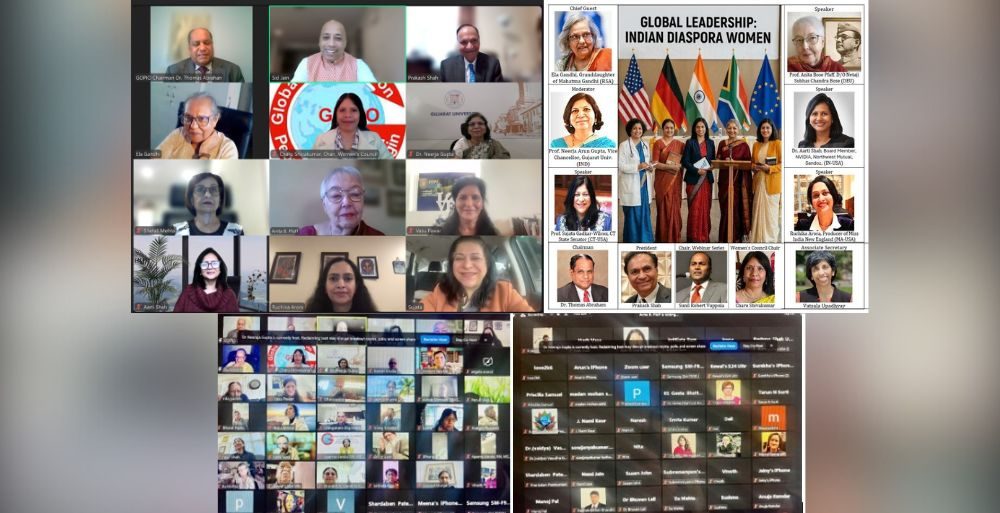
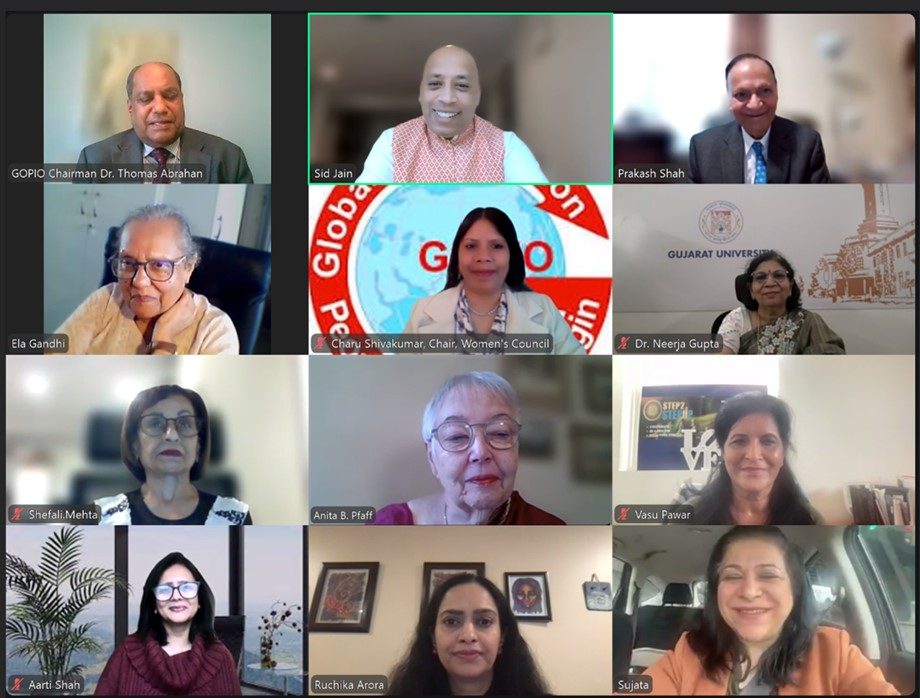
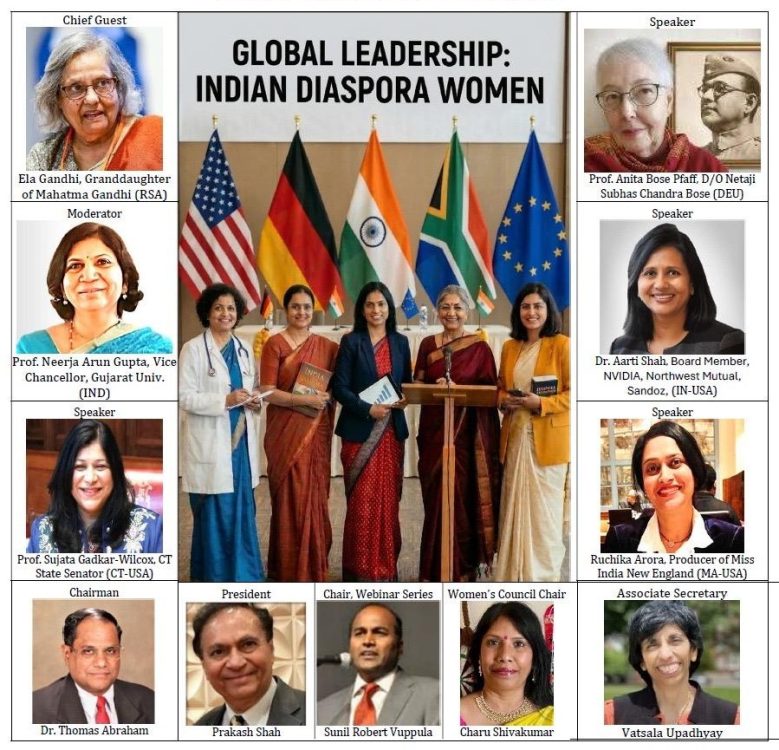
The geopolitical and social influence of the Indian diaspora reached a symbolic crescendo this week as two of India’s most storied historical legacies converged on a single digital platform. The Global Organization of People of Indian Origin (GOPIO) Women’s Council hosted a high-level webinar titled “Indian Diaspora Women: Leading and Transforming the Social, Educational, Political, and Corporate Spheres,” marking the first time in recorded history that Smt. Ela Gandhi and Professor Anita Bose-Pfaff—the granddaughter of Mahatma Gandhi and the daughter of Netaji Subhas Chandra Bose, respectively—shared a public stage.
The event, moderated by Dr. Neeraja Arun Gupta, Vice Chancellor of Gujarat University, transcended mere nostalgia. It functioned as a rigorous examination of the “triple burden” facing women in the modern workforce and the unique challenges of the diasporic identity. As the Indian diaspora continues to exert significant soft power and economic influence globally, the assembly highlighted how the intellectual and political capital of these women is reshaping international relations from South Africa to Germany and the United States.
The Legacy of Resistance and Representation
The keynote address by Ela Gandhi, a former Member of Parliament in South Africa and a veteran of the anti-apartheid struggle, provided a sobering look at the evolution of democratic reforms. Drawing a direct line from her grandfather’s philosophy of non-violence to her own work in South African negotiations, Gandhi emphasized that political representation remains a hollow victory if it does not address the domestic realities of women. She noted that while legal frameworks for equality have improved, the societal expectation for women to manage the household, childcare, and a professional career—the aforementioned triple burden—persists as a barrier to true equity.
In a poignant juxtaposition, Professor Anita Bose-Pfaff offered a perspective from the heart of Europe. As a distinguished scholar and the daughter of the revolutionary leader who led the Indian National Army (INA), Bose-Pfaff reflected on her father’s progressive views on gender. She reminded the audience that Netaji Subhas Chandra Bose was a pioneer in military and political gender integration, appointing Captain Lakshmi Sahgal to lead the Rani of Jhansi Regiment. Bose-Pfaff’s own journey as a “half-Indian” academic in Germany served as a case study in the complexities of cultural identity and the persistent “glass ceilings” that remain in Western professional spheres despite advancements in education.
Breaking the Political and Corporate Glass Ceilings
The conversation shifted from historical legacy to contemporary legislative power with the contribution of Prof. Sujata Gadkar-Wilcox, the first Indian-American and Asian American woman elected to the Connecticut State Senate. Gadkar-Wilcox provided a candid assessment of the patriarchal structures that dominate American politics. She argued that the barriers to entry for women of color are not merely cultural but structural, citing pay disparities and lack of grassroots support systems as primary deterrents. Her call to action was clear: institutional change is required to transform the political landscape from one of tokenism to one of genuine equity.
On the corporate front, Dr. Aarti Shah, a board member for NVIDIA, Northwestern Mutual, and Sandoz, pivoted the discussion toward executive leadership and the integration of personal values with corporate strategy. Shah, who has reached the upper echelons of the tech and pharmaceutical industries, introduced a framework she termed the “Four E’s”: Energy, Energetic Edge, Execute, and the underlying spiritual core that drives servant leadership. Her insights suggested that for diaspora women, the synthesis of traditional Indian values—such as resilience and education—with global corporate practices is a competitive advantage in the 21st-century economy.
Strategic Goals for the Diaspora
GOPIO Chairman Dr. Thomas Abraham and President Prakash Shah utilized the forum to outline the organization’s roadmap for the coming years. With a biennial convention scheduled for Mumbai in December 2026, the leadership is focusing heavily on dual nationality advocacy and the formalization of a global mentoring network. This network aims to connect established titans like Dr. Shah and Senator Gadkar-Wilcox with younger women across the diaspora, ensuring that the “brain drain” of previous decades is replaced by a “brain circulation” that benefits both India and the host nations.
The event also touched upon the cultural and aesthetic dimensions of empowerment. Ruchika Arora, involved with the Miss India U.S.A. pageant, argued that such platforms are evolving into incubators for leadership development and public speaking, rather than mere beauty contests. By aligning with UN themes for 2026, these organizations are attempting to bridge the gap between traditional cultural expressions and modern advocacy for justice and rights.
A Unified Vision for the Future
As the webinar concluded, the consensus among the speakers was that spirituality—distinct from religiosity—remains a grounding force for the diaspora. Whether navigating the halls of the Connecticut Senate or the boardrooms of Silicon Valley, the speakers pointed to universal values as the “North Star” for facing global crises.
Writer and historian Dr. Bhuvan Lall noted the profound historical weight of the meeting. The reconciliation of the two dominant streams of the Indian independence movement—the non-violent path of Gandhi and the militant nationalism of Bose—through the voices of their female descendants marks a new chapter in how the diaspora interprets its history.
Siddharth Jain, GOPIO International General Secretary, closed the session by noting that the “balance of the world” is maintained by women, who comprise 50% of the population but often carry a disproportionate share of its social and emotional labor. As GOPIO prepares for its 2026 Mumbai summit, the message is clear: the Indian diaspora woman is no longer a silent participant in the global story; she is its primary architect.
GOPIO Women’s Council invites Diaspora Women to join its global network. One can join the WhatApp group at https://chat.whatsapp.com/H77drPXbYRT5UAVB5w8eYU?mode=gi_t.
GOPIO Women’s Council can be reached by contacting its Chairperson: Charu Shivakumar, Tel: +1 626-497-5537 or Charu_shivakumar@yahoo.com
For more info on GOPIO contact Sid Jain at +1 (201) 889-8888 or email at Secretary@GOPIO.net.
About GOPIO – Founded in 1989, GOPIO is a non-partisan, not-for-profit, secular organization with Individual Life Members and chapter delegates from over 100 chapters in 36 countries. GOPIO’s volunteers are committed to enhancing cooperation and communication between NRIs/PIOs and the local communities, building networks, bonds, friendships, alliances, and the camaraderie of citizens and colleagues alike. GOPIO volunteers believe that when they help network the global Indian community, they facilitate making tomorrow a better world for the Indian Diaspora, the countries they live in and India.