








As Minnesota lawmakers introduce a landmark resolution condemning anti-Hindu discrimination, a stark contradiction has emerged in the American heartland. Despite being the most highly educated and economically successful religious demographic in the United States, Hindu Americans are facing an unprecedented surge in digital hostility, temple vandalism, and identity-based prejudice.
The trajectory of the Hindu American community has long been cited as the gold standard of the immigrant success story. From the high-tech corridors of Silicon Valley to the prestigious wards of the nation’s leading hospitals, Indian-origin professionals—who comprise the vast majority of the U.S. Hindu population—have woven themselves into the very fabric of American excellence. Yet, a recent legislative move in the Minnesota Senate has cast a spotlight on a darkening underside to this prosperity: a rising tide of Hinduphobia that threatens to undermine decades of integration.
The resolution, introduced by Minnesota lawmakers, does more than just offer platitudes. It formally recognizes the “social, economic, and cultural life” contributed by Hindu Americans while simultaneously issuing a sharp condemnation of religious discrimination. It is a dual-track acknowledgment of a community that is at once essential to the nation’s infrastructure and increasingly vulnerable to its prejudices. This legislative intervention arrives at a critical juncture where professional achievement is no longer serving as a shield against bigotry.
To understand the weight of this moment, one must look at the data. According to the Pew Research Center Religious Landscape Study (2023–24), Hindus are the most highly educated religious group in the country, with roughly 70% holding a bachelor’s degree or higher. This intellectual capital translates directly into economic power; Indian-American households consistently rank among the highest-earning demographics. The leadership of the American corporate landscape reinforces this, with titans like Google, Microsoft, and Adobe headed by individuals of Indian origin.
However, the Minnesota resolution suggests that this very visibility has become a double-edged sword. As the community’s presence grows, so too does a “new challenge” of negative narratives. Research conducted by the Network Contagion Research Institute (NCRI) reveals a disturbing trend in the digital commons. Anti-Indian and anti-Hindu content on the social media platform X tripled in volume during 2025, racking up over 300 million views.
The NCRI report identifies a “spillover effect” where legitimate policy debates—specifically those concerning the H-1B visa program—devolve into toxic identity-based attacks. What begins as a critique of labor economics frequently shifts into rhetoric portraying Hindus as “economic replacers” or “demographic invaders.” By late 2025, these sentiments moved from the fringes of the internet into the mainstream, where even peaceful Diwali celebrations were met with waves of coordinated religious abuse.
The disconnect between the community’s internal values and its external perception is profound. Rooted in the ancient philosophy of dharma, Hindu traditions emphasize pluralism, intellectual inquiry, and a non-proselytizing approach to faith. These values have fostered a vibrant cultural presence across the U.S., manifested in thousands of temples and the widespread adoption of yoga and meditation. Yet, in certain academic and media circles, these same traditions are increasingly viewed through narrow ideological lenses that miss the lived reality of the practitioners.
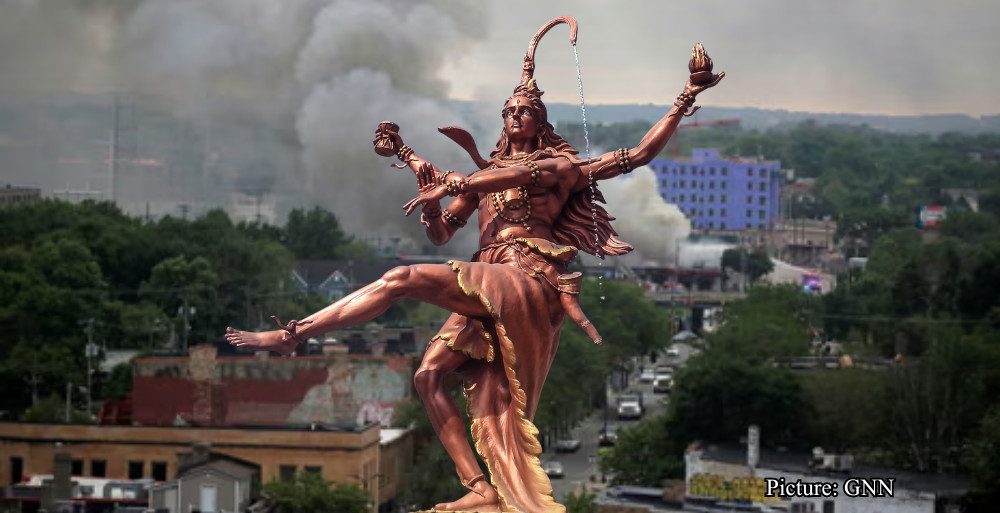
The consequences of this shifting climate are not merely theoretical; they are physical. Across the country, Hindu temples have been targeted with graffiti and vandalism, prompting leaders like Congressman Shri Thanedar to demand more rigorous federal investigations. In Sugar Land, Texas, a statue of the deity Lord Hanuman became a flashpoint when it was publicly denounced as a “false god,” highlighting a growing intolerance for Hindu religious symbols in the public square.
A survey by the Carnegie Endowment for International Peace found that one in four Indian Americans reported being the target of a slur since 2025. Perhaps more tellingly, many respondents expressed a growing discomfort with wearing visible religious markers, such as the bindi or tilak. This psychological retreat suggests that the “success paradox” is taking a toll: a community can be indispensable to a country’s economy while still feeling unwelcome in its streets.
This is a far cry from the early 20th century, though the echoes are haunting. In 1923, the Supreme Court case United States v. Bhagat Singh Thind famously denied citizenship to Indian migrants, labeling them “aliens ineligible for citizenship.” While the Immigration and Nationality Act of 1965 reopened the doors and allowed for the rise of the high-skill professional class, the current wave of Hinduphobia suggests that the ghost of the “Hindoo” stereotype has never truly been exorcised; it has simply been updated for the digital age.
The Minnesota resolution represents a vital policy pivot. By situating Hinduphobia within the broader framework of American pluralism and religious freedom, lawmakers are attempting to bridge the gap between economic integration and social acceptance. For supporters, this is not an exercise in identity politics but a necessary defense of the American promise.
As the United States continues to grapple with its identity in a hyper-connected, often polarized era, the experience of the Hindu American community serves as a bellwether. If a community that has contributed so much to the nation’s scientific, medical, and technological advancement can still find itself targeted by coordinated hate, it raises fundamental questions about the resilience of American tolerance. Recognizing the problem, as Minnesota has done, is the first step toward ensuring that the “paradox of success” does not become a permanent feature of the immigrant experience.