






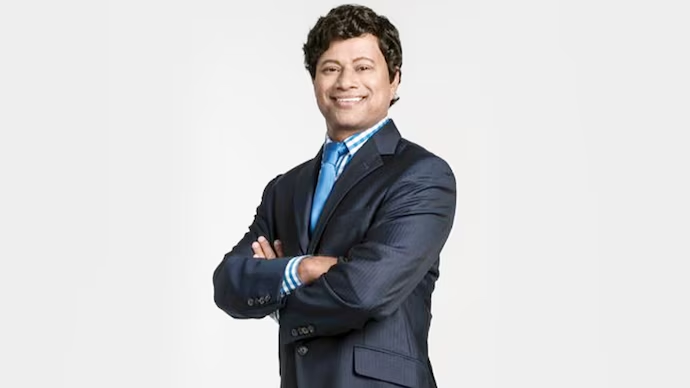
Calling for stronger civic engagement and political participation, US Congressman Shri Thanedar urged Indian Americans to play a more active role in shaping the country’s future, warning that disengagement could carry long-term consequences for the community’s influence, opportunities, and security in the United States.
Thanedar delivered the keynote address at the inaugural India Abroad Dialogue, held in Detroit on December 13, where political participation, immigration, and India–US relations took centre stage. Framing civic involvement as a necessity rather than a choice, he stressed that political decisions directly affect everyday life.
“Politics impacts your life,” Thanedar told the audience. “It impacts your immigration status. It impacts your job status. It impacts every part of your life—your children’s lives.”
Linking Participation to Power and Policy
Thanedar said Indian Americans, despite being one of the fastest-growing and most professionally accomplished immigrant communities in the US, often remain underrepresented in political processes. He cautioned that staying on the sidelines weakens the community’s ability to shape policies that affect immigration pathways, economic mobility, and civil rights.
“Disengagement has real consequences,” he said, adding that political influence is built through sustained participation—voting, volunteering, organizing, and running for office.
His remarks came amid heightened national debates on immigration, artificial intelligence, trade, and global security, all of which, he noted, disproportionately affect immigrant and minority communities.
Strategic Importance of India–US Relations
Situating his message within a broader geopolitical context, the Democratic congressman underscored the growing strategic importance of the India–US partnership, particularly as global power dynamics shift.
“The United States needs India because China has become so aggressive,” Thanedar said. “China is a real threat to the United States,” he added, citing cyber threats, economic competition, and regional security challenges.
He argued that collaboration between Washington and New Delhi is essential for long-term global stability and technological leadership, especially in emerging sectors such as advanced manufacturing, clean energy, and artificial intelligence.
Caution on Trade and Tariff Tensions
Addressing recent trade disputes and tariff-related tensions between the two democracies, Thanedar warned against unilateral actions that could strain bilateral ties.
“I don’t think that is productive for a good India–US relationship,” he said. “There should be a better dialogue to be able to do this so that we can have a lasting good relationship with these two countries.”
He emphasized that differences should be resolved through structured dialogue and sustained engagement, rather than policy decisions that risk alienating key partners.
Michigan as a Bridge to India
Thanedar highlighted Michigan’s expanding economic and technological links with India, particularly in manufacturing, mobility, and high-skilled immigration. Representing a state deeply rooted in the automotive and industrial economy, he said India has become a natural partner in Michigan’s global growth strategy.
“Michigan and India are already economically linked,” he noted, pointing to collaboration in both public-sector initiatives and private technology investments.
As a concrete example, Thanedar cited Ford Motor Company’s recently announced $370 million investment in India, calling it a reflection of confidence in India’s manufacturing capabilities and long-term economic trajectory.
“That vision reflects confidence in India’s growth in manufacturing capability and its long-term growth,” he said, adding that Michigan-based companies continue to expand internationally while maintaining strong roots at home.
Defending Immigration and Talent Mobility
Thanedar also pushed back strongly against rising anti-immigrant rhetoric in US politics, rejecting claims that immigrants take jobs away from American workers.
“We are a nation of immigrants,” he said. “America’s greatness is not despite immigrants. It’s because of the contribution of immigrants.”
He stressed that high-skilled immigration has been a cornerstone of US innovation and economic leadership, particularly in sectors such as technology, engineering, and mobility.
“Immigration has greatly benefited America by giving us the best shot at recruiting talent from all over the world,” Thanedar said, describing India as “a fantastic source for remarkable talent in STEM.”
A Call to Action
In closing, Thanedar delivered a direct appeal to Indian Americans across the country to become more deeply involved in civic life—not just during elections, but year-round.
“Participate,” he urged. “We have to be participating. We have to be part of the mainstream.”
He encouraged community members to volunteer, engage in grassroots organizing, support civic institutions, and consider public service as a way to amplify their collective voice.
“We are a strong, proud community,” Thanedar concluded. “And when we stand together, we can accomplish anything we set our minds to.”
The message resonated with attendees, many of whom said the dialogue underscored the growing responsibility—and opportunity—for Indian Americans to shape the political and economic future of the United States.