





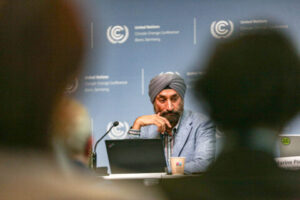




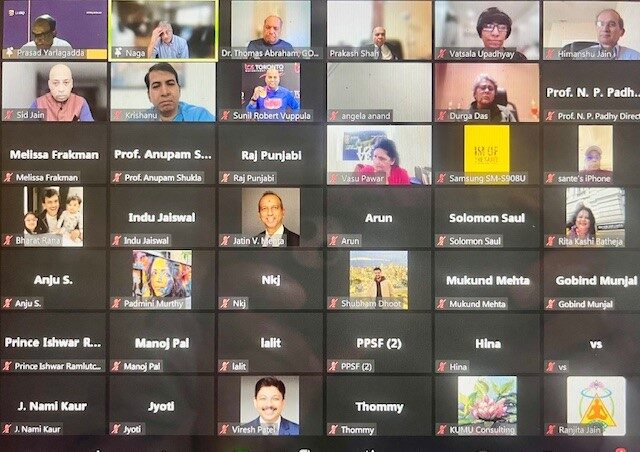
The Global Organization of People of Indian Origin (GOPIO) hosted its November 2025 webinar, “Shaping Technologies for the Future – Role of Diaspora,” bringing together distinguished scientists, entrepreneurs, educators, and innovators of Indian origin from around the world. The session showcased how the global Indian community continues to influence advancements in artificial intelligence, nanotechnology, critical minerals, sustainability, space technologies, and water innovation.
Opening Remarks
GOPIO International President Prakash Shah emphasized how STEM fields have shaped India’s global footprint.
“Science, Technology, Engineering and Math have fueled sixty years of Indian migration to the West,” Shah said. “What was once labeled ‘brain drain’ has today enriched every major innovation hub across the Western world. Indian professionals have been central to nearly every major technological leap of the past six decades.”
Strengthening Global Connections
GOPIO Founder and Chairman Dr. Thomas Abraham reflected on the organization’s journey since 1989 and its mission to engage the global Indian community.
“For thirty-six years, GOPIO has worked to bring the diaspora into mainstream public life and support community issues,” he noted. “We are now broadening this mission to connect innovators, technologists, and scientists worldwide with partners in India.”
Dr. Abraham announced new plans to identify and connect diaspora experts working in AI, clean energy, nanotechnology, critical minerals, and advanced computing.
Framing the Discussion
Webinar Series Chair Sunil Vuppala welcomed participants, describing the event as part of an ongoing initiative to unify the diaspora’s intellectual strength with India’s development.
“Each monthly webinar features voices reshaping the global Indian identity through excellence and innovation,” he said, praising the speakers for blending academic expertise with entrepreneurial spirit.
NIT Directors Share India’s Innovation Vision
Two Directors of India’s National Institutes of Technology—Dr. N.P. Padhy of MNIT Jaipur and Dr. Anupam Shukla of SVNIT Surat—were honored guests.
Director Padhy spoke about India’s rapid technological evolution:
“India is no longer merely participating in global tech advancements — we’re helping lead them,” he said. “Partnerships between domestic talent and the diaspora are essential to achieving national priorities in clean energy, digital innovation, and space research.”
He stressed the need for interdisciplinary research, saying that breakthroughs emerge when AI, materials science, and sustainable engineering work hand in hand.
Global Experts on Emerging Technologies
Prof. Prasad Yarlagadda, Dean at the University of Southern Queensland (Australia), moderated the panel. Drawing on four decades in nanotechnology and advanced manufacturing, he predicted that universities will shift to becoming learning hubs by 2035–2050 rather than traditional teaching institutions. He also discussed ongoing collaborations with IISc Bengaluru and IIT Madras.
Materials, Minerals, and Manufacturing Insights
Dr. Himanshu Jain, Distinguished Chair at Lehigh University and currently at UC Davis, spoke on the future of glass in clean energy and sustainable infrastructure.
“Glass is humanity’s oldest manufactured material, yet it is central to tomorrow’s solutions — from photonics to agriculture,” he said, highlighting innovations in solar mirrors, efficient building materials, and glass-based fertilizers.
Dr. D.R. Nagaraj, Professor at Columbia University, presented on the “Mines of the Future,” emphasizing that clean energy transitions rely heavily on responsible mining.
“Without minerals, modern civilization ceases to exist,” he said. He underscored the need for precision mining powered by AI and robotics, especially for 54 critical minerals that sustain global supply chains.
Entrepreneurs Driving Change
Bhavini Patel, Executive Director of Sustainable Pittsburgh, discussed the human side of technological transformation.
“Technology is ultimately about people — who creates it, who accesses it, and who benefits,” she said, advocating for greater inclusion and leadership among women in tech and public policy.
Melissa Frakman, CEO and Managing Partner of EMVC, highlighted India’s booming fintech landscape and the diaspora’s key role.
“Our entrepreneurs need more than capital — they need global networks and cultural fluency,” she said. “Diaspora investors provide these critical bridges.”
Krishanu Acharya, CEO of Suhora Technologies, shared how satellite-based AI is transforming national security, mining, and disaster response.
“We design India-first solutions that are ready for global deployment,” he said, emphasizing the importance of ethical, human-centered AI.
Dr. Durga Das, Founder and CEO of AiroWater, showcased technology that extracts potable water from humidity.
“There is far more water in the air than in the ground, yet we still dig for it,” he said, explaining how his company’s atmospheric water systems are helping cities like Chennai and Cape Town tackle water scarcity.
A Call for Continued Collaboration
The session concluded with a strong message from GOPIO leadership to deepen collaboration between the diaspora and innovators in India.
“From AI and space to minerals and water, the Indian diaspora continues shaping the world’s technological future,” Dr. Abraham said. “GOPIO is committed to being the bridge that connects these global capabilities.”
GOPIO Secretary Siddarth Jain delivered the vote of thanks, and Associate Secretary Vatsala Upadhyay provided technical support for the Zoom proceedings.
Contact Information
For more details, contact Sid Jain
Phone: +1 (201) 889-8888
Email: Secretary@GOPIO.net