






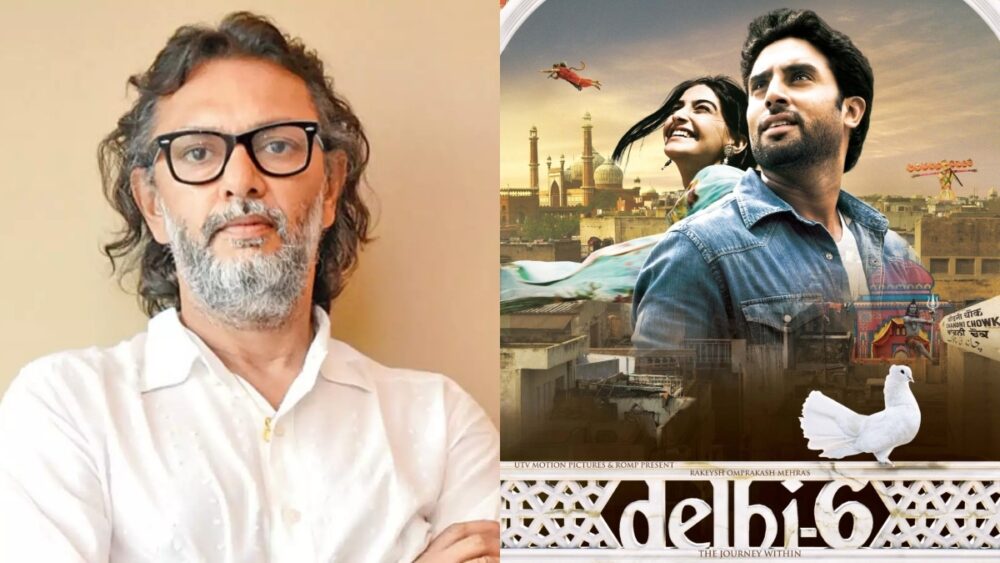
More than 15 years after its release, Delhi 6 continues to provoke conversation — not for its box-office performance, but for the artistic risks it took and the uncomfortable truths it attempted to confront. Director Rakeysh Omprakash Mehra has now revealed that India, even today, is not ready to accept the film’s original version, one that begins with the death of its protagonist, played by Abhishek Bachchan.
Released in 2009, Delhi 6 was an ambitious cinematic exploration of identity, faith, community, and the contradictions of urban India. At the time, the film struggled commercially and divided audiences. Over the years, however, it has steadily gained critical reappraisal, emerging as one of the most intellectually ambitious Hindi films of its era.
In a recent conversation, Mehra disclosed that the version Indian audiences saw was not the film he originally made — and that the unreleased cut remains, in his view, far more honest and artistically complete.
A Film That Began With Death
According to Mehra, the original cut of Delhi 6 opens not with hope, but with finality.
“The original film opens with the ashes immersion of Abhishek’s character in the Ganges,” Mehra said. “And over that, a voiceover comes, in Abhishek’s voice, saying, ‘These are my ashes.’ That’s how the story begins. In the very opening frame, you are told that your hero is dead.”
The revelation fundamentally alters how the film is perceived. Instead of a conventional protagonist’s journey, Delhi 6 becomes a posthumous reflection — a meditation on belonging, disillusionment, and moral failure.
Mehra refers to this version as the “Venice cut” or “director’s cut,” named after its screening at the Venice Film Festival.
“That’s the original version. I still have it with me. That’s the one that went to the Venice Film Festival,” he said. “They saw the film, they freaked out. They said, ‘Wow,’ and they gave it a lovely reception. That’s why I call it the Venice cut.”
Internationally, the film was recognised for breaking away from mainstream Bollywood conventions. Trade magazine Variety famously described it as “(un)Bollywood,” positioning it as a radical departure from formula-driven Hindi cinema.
Why the Film Was Changed for India
Despite its global reception, Mehra ultimately altered the film’s ending for its Indian theatrical release — a decision he now deeply regrets.
“Out of foolishness. Sheer foolishness,” Mehra admitted candidly. “We filmmakers are foolish people — mad, foolish, all of that.”
He explained that pressure came not from censorship, but from well-meaning voices within the industry who believed the film was too bleak.
“There was so much dark humour in the film. There was so much going on that everybody who saw the cut said, ‘Leave it with some hope,’” he recalled. “And I fell for it. I shouldn’t have.”
The revised ending softened the film’s moral reckoning, diluting its philosophical punch. In doing so, Delhi 6 lost the very discomfort that made it powerful.
A Film Ahead of Its Time
At its core, Delhi 6 interrogates ideas of nationalism, religious identity, communal paranoia, and the myth of moral purity — themes that have only grown more relevant in the years since its release.
Set in the narrow lanes of Old Delhi, the film uses a microcosmic neighbourhood to examine how fear and suspicion can transform ordinary people into agents of hatred. Bachchan’s character, caught between cultures and identities, ultimately becomes a casualty of the very society he hopes to understand.
Mehra believes that India’s inability to accept the original cut reflects a broader cultural discomfort with moral ambiguity.
“India hasn’t evolved enough,” he suggested, implying that audiences still demand clear heroes, redemption arcs, and emotional reassurance — even when reality offers none.
From Box Office Failure to Cult Reputation
When Delhi 6 released in 2009, it failed commercially and was widely misunderstood. Its non-linear narrative, symbolic imagery, and refusal to provide easy answers alienated mainstream audiences.
Yet, with time, the film has been reclaimed by critics, scholars, and cinephiles. Today, it is frequently cited as one of the most underrated Hindi films of the 2000s — a work that dared to question the moral certainties of its time.
Its growing stature underscores a recurring truth in Indian cinema: films that challenge social comfort zones often age better than those designed purely for immediate success.
Will the Director’s Cut Ever Be Released?
For now, the Venice cut remains unreleased in India. While Mehra has confirmed that he still possesses the original version, he has not indicated any immediate plans for a public release.
The question lingers: would contemporary audiences be more receptive today?
With Indian cinema increasingly embracing darker themes, unconventional narratives, and morally complex protagonists, Delhi 6’s original version may finally find the audience it was denied in 2009.
Until then, the film stands as a reminder of what happens when artistic courage collides with commercial caution — and of the stories that remain untold because a society isn’t quite ready to hear them.