






President Donald Trump’s inconsistent statements regarding Iran have raised significant concerns among lawmakers and foreign policy analysts, highlighting the risks of miscommunication in a volatile geopolitical landscape.
WASHINGTON – President Donald Trump’s recent remarks concerning U.S. relations with Iran have led to confusion and uncertainty about the country’s foreign policy and military readiness in the Middle East. With tensions escalating between the two nations, the president’s conflicting messages have prompted questions from lawmakers and analysts regarding America’s strategic approach to the ongoing crisis.
The backdrop to this tumultuous situation involves the U.S. withdrawal from the Joint Comprehensive Plan of Action (JCPOA), commonly referred to as the Iran nuclear deal, in May 2018. The agreement aimed to restrict Iran’s nuclear capabilities in exchange for the lifting of economic sanctions. Since the U.S. exited the deal, Iran has progressively reduced its compliance, which has resulted in heightened hostilities and a precarious security environment in the region.
Inconsistent Messaging from the Administration
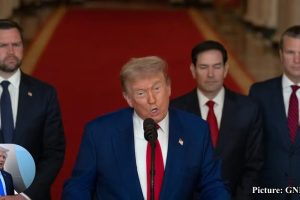
In recent public appearances, Trump has alternated between advocating for caution and issuing stern warnings of potential military action against Iran. For instance, during a rally in North Carolina, he stressed his preference for peace, yet simultaneously cautioned that the U.S. would respond decisively to any Iranian aggression. “Iran is a very bad player. You will see what happens. But we don’t want to escalate it,” Trump stated, encapsulating the duality of his position.
This mixed messaging has drawn concern from lawmakers across the political spectrum. Senator Lindsey Graham, a prominent ally of Trump, emphasized the necessity for a clear and coherent strategy regarding Iran. “We need to understand what our policy is. Are we going to deter Iran or are we going to engage with them?” Graham remarked, underscoring a bipartisan demand for clarity in U.S. foreign policy.
Domestic and International Reactions
The ambiguity surrounding Trump’s statements has reverberated beyond the halls of Congress, affecting international perceptions of U.S. reliability. Allies in Europe and the Middle East are closely scrutinizing American actions and rhetoric, some expressing apprehension about the unpredictability of U.S. policy. A senior European diplomat remarked, “We need to know if we can rely on the U.S. for our security framework, especially in these volatile times.”
Iranian officials have also capitalized on the uncertainty in U.S. messaging. Iranian President Ebrahim Raisi asserted, “We will respond to any aggression from America with strength and decisiveness,” indicating that Tehran perceives the current situation as a critical test of its resolve against U.S. threats.
Potential Implications for U.S. Foreign Policy
The ramifications of Trump’s inconsistent statements could extend far beyond immediate diplomatic challenges. Analysts suggest that prolonged uncertainty in U.S. policy may embolden adversaries while alienating allies. “When leaders are unclear about their intentions, the risk of conflict increases,” warned Dr. Emily M. Landau, a senior research fellow at the Institute for National Security Studies. This heightened risk of miscalculation could have serious consequences in a region already marked by instability.
Moreover, the current environment may complicate future efforts to revive negotiations regarding the JCPOA. The Biden administration has indicated a willingness to re-enter discussions with Iran, but Trump’s rhetoric could undermine these diplomatic initiatives. A former State Department official noted, “If the U.S. remains divided in its approach, it will be difficult to persuade Iran to come back to the table.” The challenges of negotiating a nuclear deal are compounded by the current political landscape, where domestic dissent and international skepticism coexist.
Historical Context of U.S.-Iran Relations
The strained dynamics between the U.S. and Iran are deeply rooted in a complex history that dates back to the 1953 CIA-backed coup that ousted Iran’s democratically elected Prime Minister Mohammad Mossadegh. This intervention fostered a longstanding atmosphere of distrust and hostility between the two nations. Over the decades, various U.S. administrations have grappled with how to manage relations with Iran, vacillating between strategies of diplomatic engagement and military confrontation.
Past incidents, such as the Iran hostage crisis in 1979 and subsequent sanctions, have only intensified the adversarial relationship. The 2015 JCPOA was seen as a significant diplomatic breakthrough, yet its unraveling has led to renewed tensions and destabilized the region further. As the situation continues to evolve, the need for a coherent and consistent U.S. approach has never been more critical.
In conclusion, the mixed signals emanating from the Trump administration regarding Iran present considerable challenges for U.S. foreign policy. As tensions rise and the geopolitical landscape shifts, the importance of clear communication and strategic consistency cannot be overstated. The stakes are high, and the potential for miscommunication could have far-reaching consequences for regional stability and international relations.