







The U.S. Commission on International Religious Freedom has issued a landmark recommendation to impose targeted sanctions on the Rashtriya Swayamsevak Sangh and India’s intelligence agency. This move marks a fundamental departure from previous diplomatic caution, identifying institutionalized Hindu nationalism as a primary driver of religious liberty violations in the world’s most populous nation.
The long-standing diplomatic dance between Washington and New Delhi faced a sophisticated structural shock this week as the U.S. Commission on International Religious Freedom (USCIRF) released its 2026 Annual Report. In a move that observers describe as a “watershed moment” for bilateral relations, the bipartisan federal body explicitly called for targeted sanctions against the Rashtriya Swayamsevak Sangh (RSS)—the ideological parent organization of India’s ruling Bharatiya Janata Party (BJP)—and the Research and Analysis Wing (R&AW), India’s premier foreign intelligence agency.
The recommendations, which include asset freezes and visa bans, represent the most aggressive stance ever taken by a U.S. government entity against the foundational institutions of the modern Indian state. For years, the USCIRF has designated India as a “Country of Particular Concern” (CPC), but the 2026 report goes a step further by naming the specific “machinery” it claims is responsible for the systemic “responsibility and tolerance of severe violations of religious freedom.”
From the Fringes to the Center of Policy
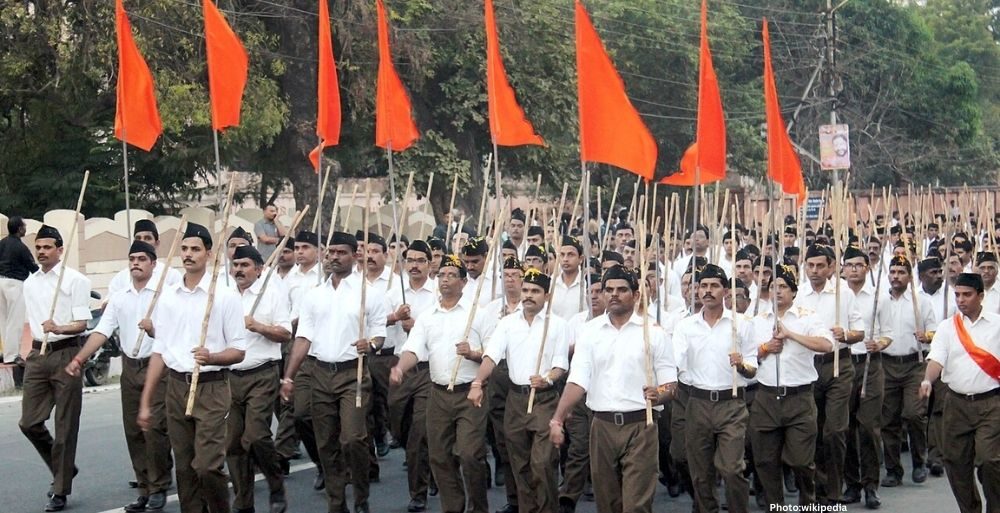
The RSS is no ordinary NGO; it is the heartbeat of the Hindutva movement, an ideological framework that seeks to define Indian culture in terms of Hindu values. With millions of volunteers and a network of schools, charities, and paramilitary-style training camps, the RSS provides the grassroots muscle and ideological vetting for much of India’s current political leadership, including Prime Minister Narendra Modi, who spent decades as an RSS pracharak (organizer).
By naming the RSS, the USCIRF is effectively challenging the narrative that religious violence in India—ranging from lynchings over cattle slaughter to the demolition of minority places of worship—is the work of “fringe elements.” Instead, the Commission argues these acts are structural, ideological, and sustained. The report suggests that the assault on religious freedom is not a series of random malfunctions but the intended output of a powerful institutional engine.
“This is an acknowledgment that the crisis in India is being enabled and normalized by powerful institutions, not just individual bad actors,” the report notes. The inclusion of R&AW alongside the RSS further complicates the picture, suggesting that the Commission sees a nexus between domestic ideological enforcement and the state’s external security apparatus.
The Economic and Diplomatic Stakes
While the USCIRF is an independent advisory body whose recommendations are not legally binding on the State Department, its reports carry immense weight in Congressional circles and international financial oversight. The suggestion of sanctions against the RSS—an entity with deep financial ties to the global Indian diaspora—could trigger a compliance nightmare for international banks and non-profits.
If the State Department were to adopt even a fraction of these recommendations, the diplomatic fallout would be seismic. India has historically reacted with fierce indignation to USCIRF reports, labeling them as “interference” and “biased.” However, the 2026 report arrives at a time when the “shared values” rhetoric often used to bolster the U.S.-India strategic partnership is under intense scrutiny.
Critics of the Indian government have long argued that the West has turned a blind eye to domestic backsliding in exchange for India’s role as a counterweight to China. The USCIRF’s latest move signals that the “tolerance threshold” in Washington may be shifting. By focusing on asset freezes, the Commission is targeting the financial lifeblood of the nationalist movement, potentially affecting a vast network of affiliated organizations across Europe and North America.
A Moral and Theological Reckoning
Beyond the geopolitical chess match, the report has ignited a profound debate over the soul of Hinduism and the definition of secularism. The USCIRF’s findings emphasize that the targeting of Muslims, Christians, Dalits, Adivasis, and Sikhs has created a climate of “deepening exclusion and fear.”
Interestingly, the report finds support among a growing segment of the Hindu diaspora who argue that Hindutva does not speak for all Hindus. These advocates suggest that a faith rooted in dignity and moral courage must stand against domination. For these groups, the USCIRF recommendation is not an attack on the religion itself, but a necessary surgical strike against a supremacist politics that has captured Hindu identity.
The report also highlights the vulnerability of dissenters. It notes that journalists, scholars, and human rights advocates who document these violations often face legal harassment, surveillance, and physical threats. By elevating these concerns to the level of proposed sanctions, the U.S. government is providing a degree of international protection—or at least recognition—to those who have paid a high price for speaking out.
The Path Ahead
The ball is now in the court of the U.S. State Department. Historically, the executive branch has been hesitant to impose sanctions on “strategic partners,” often citing “national interest waivers” to avoid penalizing India. However, the specificity of the 2026 report—naming the RSS and R&AW directly—makes it much harder to ignore.
As the 2026 report circulates through the halls of the Rayburn House Office Building and the Harry S Truman Building, the central question remains: Will the U.S. prioritize its geopolitical alignment with New Delhi, or will it uphold its statutory commitment to global religious freedom?
For the religious minorities on the ground in India, the USCIRF’s call is a glimmer of accountability. For the Indian government, it is a provocative challenge to its internal sovereignty. And for the international community, it is a stark reminder that the “steady sanctification of exclusion” in a major democracy eventually demands a global response. The real test of this report will not be in the ink on the page, but in whether it forces a genuine reckoning with the scale of the crisis facing Indian democracy.