









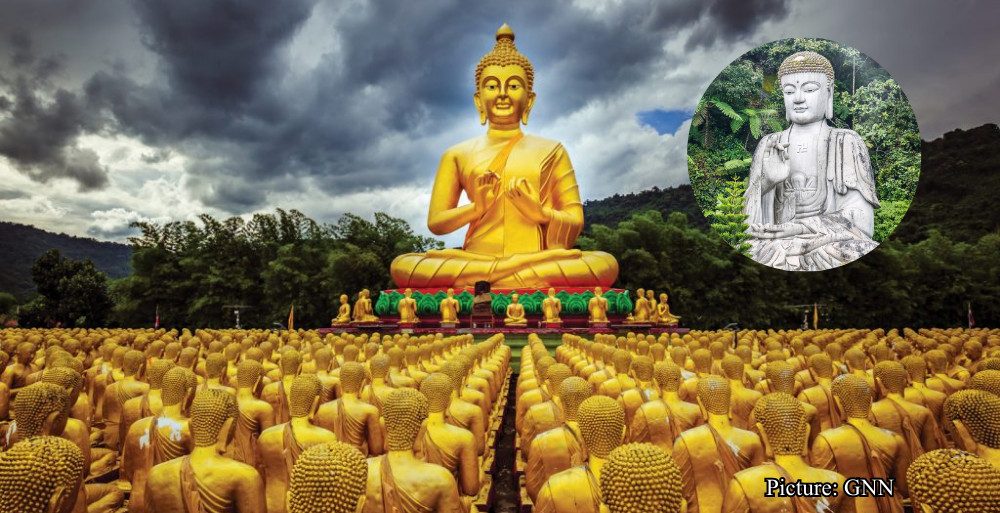
A comprehensive analysis by the Pew Research Center reveals that Buddhism is the only major global faith currently in a state of population decline, falling by 5% over the last decade. This demographic contraction is driven by a “perfect storm” of rapid aging in East Asian strongholds, fertility rates well below replacement levels, and a significant net loss of adherents through religious switching.
The global religious landscape is shifting, but while most major faiths are expanding alongside a growing human population, Buddhism has entered a period of unprecedented contraction. According to a sophisticated analysis of 201 countries and territories conducted by the Pew Research Center, the number of individuals identifying as Buddhist globally dropped from 343 million in 2010 to 324 million in 2020. This 5% decline stands in stark contrast to a world that grew by 12% during the same period, signaling a profound demographic decoupling from the global trend.
The implications of this shift are not merely spiritual but deeply economic and geopolitical. As the religion’s footprint recedes, its share of the global population has slipped from 4.9% to 4.1%. To understand why the “Middle Way” is narrowing, researchers point to a complex interplay of geography, biology, and the modern secularization of East Asia.
The Demographic Trap of East Asia
Buddhism’s fate is inextricably tied to the Asia-Pacific region, where 98% of its adherents reside. Specifically, the faith is concentrated in five powerhouse economies: China, Japan, South Korea, Taiwan, and Hong Kong. In these territories, which account for roughly four-in-ten Buddhists worldwide, the total number of practitioners plummeted by 32 million—a staggering 22%—between 2010 and 2020.
These regions are currently grappling with what economists call a “demographic winter.” The median age in these areas is significantly higher than the global average, and birth rates have remained stubbornly low for decades. This has created an “inverted pyramid” population structure, where a massive cohort of aging practitioners is not being replaced by a younger generation.
“Buddhists are the world’s only major religious group whose population shrank in the last decade,” the Pew report notes. This is largely because Buddhists are, on average, older and have fewer children than any other religious group routinely studied. The median age for Buddhists globally is 40, nine years older than the global median of 31. By comparison, the median age for Muslims is 24, while Hindus stand at 29 and Christians at 31. Only Jews, with a median age of 38, come close to the Buddhist demographic profile, yet the Jewish population has continued to see modest growth where Buddhism has not.
The Replacement Crisis
The biological engine of religious growth is the Total Fertility Rate (TFR). For a population to remain stable without the aid of immigration or mass conversion, it requires a “replacement-level” fertility of approximately 2.1 children per woman. Buddhists are the only major religious group currently failing to meet this threshold on a global scale.
Between 2010 and 2015, the estimated fertility rate for Buddhist women was just 1.6 children per woman. This is a full child less than the global average. When fertility remains this low over several decades, the result is a “brick-shaped” or “top-heavy” demographic structure. In such a scenario, the death rate eventually begins to outpace the birth rate, leading to the absolute decline in numbers observed in the Pew data. While the combined general populations of China, Japan, and South Korea grew by a modest 5% during the 2010–2020 window, the Buddhist sub-populations within those nations shrank much faster, suggesting that the religion is bearing the brunt of regional secularization and urbanization.
The Paradox of Conversion and “Switching”
Perhaps the most surprising finding in the report involves religious switching—the process of changing from the religion of one’s childhood to a different identity in adulthood. On the surface, Buddhism appears to be a highly attractive “market” for seekers. For every 100 adults raised as Buddhists, 12 adults from other backgrounds join the faith. Proportionally, Buddhism attracts more converts than Christianity, Hinduism, or Islam.
However, these gains are being erased by even larger exits. For every 100 people raised in Buddhist households, 22 eventually leave the faith, either to join another religion or to identify as “religiously unaffiliated.” This results in a net loss of 10 adherents for every 100 people raised in the tradition.
This volatility is most visible in the high-income nations of East Asia. In Japan, nearly half of those raised Buddhist no longer identify with the religion as adults. In South Korea, the figure is even higher, with six-in-ten adults walking away from their childhood faith. These trends suggest that as Asian societies modernize and urbanize, traditional Buddhist practices—often tied to ancestral rites and rural temple life—are struggling to maintain relevance among the youth.
In contrast, Southeast Asian nations like Thailand tell a different story. In Thailand, which boasts the world’s largest Buddhist population, the bond between national identity and the Sangha remains robust. Nearly all Thais raised Buddhist continue to identify as such in adulthood. However, even Thailand is now facing its own demographic slowdown, with falling birth rates that may eventually mirror the contraction seen in the north.
As the global population continues to climb toward 8 billion and beyond, the shrinking of the Buddhist community serves as a harbinger of the demographic challenges facing developed, secularizing nations. Without a significant shift in birth rates or a massive wave of new conversions, the influence of one of history’s great philosophical traditions may continue to wane in the decades to come.