







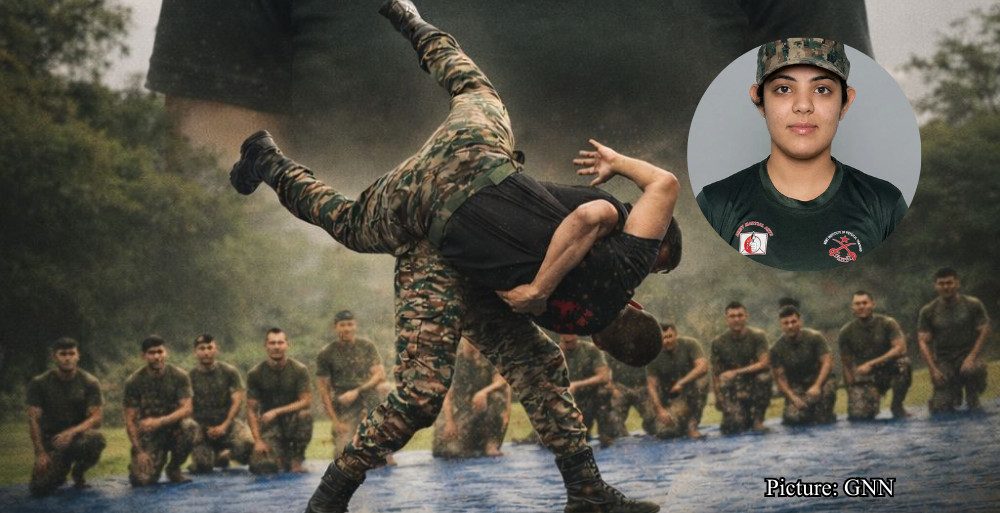
Lieutenant Deeksha Tripathi has become the first female combatant to successfully complete the Indian Army’s grueling Martial Arts Routine (AMAR) at the Army Institute of Physical Training. This milestone marks a significant shift in the operational integration of women into high-intensity, close-quarters combat roles within the nation’s defense framework.
The landscape of the Indian Armed Forces underwent a transformative shift this week as Lieutenant Deeksha Tripathi etched her name into military history. By successfully navigating the relentless physiological and psychological demands of the Army Martial Arts Routine (AMAR), Lieutenant Tripathi has dismantled one of the final bastions of male exclusivity in specialized combat training. Her achievement, announced by the Leh-based Fire and Fury Corps, serves as a potent signal of the evolving nature of the Indian soldier in an era of unconventional warfare.
The AMAR course, conducted at the prestigious Army Institute of Physical Training (AIPT) in Pune, is not merely a physical fitness program; it is a sophisticated combat system designed to push the human body to its absolute mechanical and mental limits. Since its introduction in 2023, the curriculum has gained a reputation as one of the most punishing regimens in the Indian military’s training catalog. It was developed specifically to modernize the Army’s approach to Close-Quarters Battle (CQB), replacing antiquated unarmed combat drills with a lethal, structured hybrid of traditional Indian martial arts and contemporary international tactical techniques.
For Lieutenant Tripathi, the journey to qualification was defined by what military officials described as “sheer grit and relentless determination.” While the specific details of her previous assignments remain classified for operational security, her association with the Fire and Fury Corps—the formation responsible for the sensitive and high-altitude borders of the Ladakh region—suggests a background forged in some of the most inhospitable terrain on Earth. In the thin air of the Himalayas, where oxygen levels are low and temperatures frequently plummet below freezing, the margin for error is nonexistent.
The AMAR protocols are uniquely tailored for such high-altitude environments. In these regions, where heavy weaponry may be sidelined by terrain or where silent, rapid engagements are required, the ability to engage in hand-to-hand combat is a vital survival skill. The routine focuses on offensive assaults, defense against sharp-edged weapons, and the use of improvised tools in a “force-on-force” scenario. For a soldier deployed in the hostile conditions of the Line of Actual Control (LAC), these skills are the difference between operational success and catastrophe.
The broader implications of Lieutenant Tripathi’s success cannot be overstated. For decades, women in the Indian military were largely restricted to medical, legal, and educational wings. However, the last decade has seen a rapid acceleration of gender integration across combat and combat-support arms. From the induction of women as fighter pilots in the Indian Air Force in 2016 to their presence on the decks of frontline warships, the “glass ceiling” is being systematically dismantled.
Lieutenant Tripathi follows in the footsteps of pioneers like Major Deeksha C. Mududevan of the Army Medical Corps, who in late 2022 became the first woman to earn the coveted Balidan Badge of the elite Special Forces. These individual success stories are coalescing into a new institutional reality: women are no longer just “participating” in the military; they are excelling in the most demanding combat roles the state has to offer.
The strategic necessity for such training is driven by the changing face of modern conflict. Today’s soldiers face unconventional warfare scenarios where firearms might not always be the primary or even the most effective tool. The AMAR course prepares soldiers for “real-time” scenarios—moments of chaos where a soldier must rely on muscle memory and mental fortitude to neutralize a threat. By opening these courses to women, the Indian Army is ensuring that its entire talent pool is equipped with the highest level of lethality and resilience.
Military analysts suggest that the success of officers like Lieutenant Tripathi will likely encourage the Ministry of Defence to further expand the roles available to women. Currently, while women serve in the Artillery and Army Aviation—both considered combat arms—they remain excluded from the core Infantry and the Armoured Corps. However, as the performance gap in elite training courses like AMAR continues to close, the arguments for maintaining these final exclusions are becoming increasingly difficult to sustain.
The Army’s official statement on Tuesday emphasized that Lieutenant Tripathi did not just pass the course; she “excelled with flying colors.” This distinction is crucial. It reinforces the meritocratic nature of the Indian Army, where the standards for elite certification are not lowered for any demographic. To earn the right to be called an AMAR-qualified combatant, Tripathi had to meet the same grueling benchmarks as her male counterparts, proving that combat effectiveness is a product of training and spirit rather than gender.
As the Indian Army continues to face complex security challenges on its northern and western borders, the integration of highly skilled, combat-trained female officers like Lieutenant Deeksha Tripathi provides a versatile edge. Her achievement is a testament to the modernizing impulse of the Indian state—a move toward a more inclusive, yet more lethal, fighting force capable of meeting the demands of 21st-century warfare.