









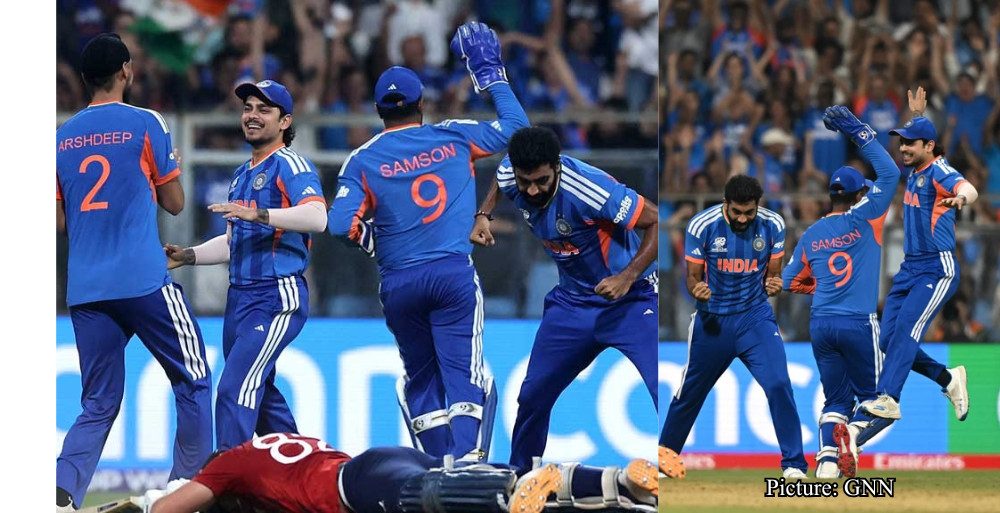
MUMBAI — India advanced to the ICC Men’s T20 World Cup final on Thursday after defeating England by seven runs in a high-scoring semifinal at the Wankhede Stadium, surviving a century from Jacob Bethell to defend a total of 253.
The host nation posted 253 for seven behind a commanding 89 from opener Sanju Samson and aggressive cameos from Ishan Kishan and Shivam Dube. England nearly completed a record-breaking chase, finishing on 246 for seven as the match was decided in the final over. India now moves to the tournament showpiece while England exits following a valiant effort from their middle order.
England captain Harry Brook won the toss and elected to field, a decision that initially appeared sound as Jofra Archer tested the Indian openers with a quick introductory spell. However, Samson seized control of the innings early, countering Archer’s pace with a boundary down the ground before swivel-pulling a short-pitched delivery for six over fine-leg. The early momentum shifted permanently toward the batting side during the powerplay.
Abhishek Sharma provided brief support, striking two boundaries off spinner Will Jacks before holing out to a fielder in the deep. His departure brought Ishan Kishan to the crease, who immediately established a productive partnership with Samson. The collaboration proved the backbone of the Indian innings, though it was nearly interrupted when Samson was on 15. The opener popped a catch off Archer, but a “twitchy Brook dropped” the chance, according to the match report.
Following the reprieve, Samson accelerated his scoring rate, targeting England’s spin contingent. He utilized a variety of strokes to disrupt the rhythm of Adil Rashid and Liam Dawson. When Sam Curran was introduced into the attack, Samson punctuated his dominance by pulling the left-armer for a flat six, signaling a shift into a higher gear for the Indian total.
Kishan eventually perished after providing a platform for the middle order, which allowed Samson to continue his assault alongside a returning Archer. The wicketkeeper-batter struck two towering sixes into the Mumbai sky to reach the late stages of his innings. By the time Samson was dismissed for 89 off 42 balls, having succumbed to Jacks, the “crowd rose in unison” to acknowledge the performance.
The latter half of the Indian innings saw incremental growth through contributions from Shivam Dube, Suryakumar Yadav, Hardik Pandya, and Tilak Varma. Varma provided the final flourish of the first innings, hitting Archer for three sixes in a single over. Although the speedster eventually castled Varma, the damage was deemed significant as India pushed their total past the 250-run mark.
England’s pursuit of 254 began poorly as they lost Philip Salt and skipper Harry Brook in the opening exchanges. The early wickets were credited largely to the fielding of Axar Patel. The official account noted that “running away from cover, Axar dived and caught Brook’s miscued shot,” providing Jasprit Bumrah and Hardik Pandya with early breakthroughs to defend.
The momentum of the chase shifted when Jacob Bethell arrived at the crease. The left-hander began an aggressive counter-attack, specifically targeting spinner Varun Chakaravarthy. Bethell struck three consecutive sixes against the leg-spinner, a display that appeared to unsettle the Indian bowling plans and forced captain Rohit Sharma to rotate his pace options earlier than anticipated.
Jos Buttler attempted to maintain the high run rate established by Bethell but fell while trying to replicate the younger batter’s success. Attempting a “mighty heave against the harassed spinner,” Buttler missed the line of the delivery and saw his stumps rearranged. Despite the loss of the former captain, England continued to “gallop” toward the target as the required rate remained within reach.
Tom Banton and Will Jacks provided brief but explosive support to Bethell. Banton struck 17 runs off just five deliveries, while Jacks amplified the pressure on the Indian seamers. Jacks’s innings ended following another acrobatic intervention from Axar Patel. The fielder caught a lofted shot near the boundary and relayed the ball to Shivam Dube before tumbling over the ropes to complete the dismissal.
Bethell remained the primary threat to India’s final aspirations, reaching a century that kept England in contention until the closing moments. He demonstrated his range by swatting the world’s top-ranked T20 bowler, Jasprit Bumrah, down the leg-side for boundaries. The report noted that the “manner in which he swatted Bumrah” revealed a growing aura around the young English batsman.
The match reached a climax in the final over with England requiring double figures to secure a victory. The tension ended when Bethell was run out for 105, an event that effectively “dashed” England’s hopes of a heist. India’s bowling depth, led by Bumrah’s tactical execution in the death overs, proved sufficient to hold the visitors to 246.
The victory at the Wankhede Stadium continues India’s undefeated run in the home tournament. Historically, high-scoring matches in Mumbai have favored the team batting first, though the margin of seven runs underscores the modern shift toward aggressive, high-risk T20 batting. England’s total of 246 represents one of the highest losing scores in the history of the knockout stages of the competition.
Cricket analysts pointed toward the dropped catch of Samson as the turning point of the first innings. The reprieve allowed the opener to bat deep into the innings, ensuring India had a set batter to navigate the middle overs. England’s reliance on a single heavy scorer in Bethell proved insufficient against a multi-pronged Indian attack that utilized local conditions effectively.
India will now await the winner of the second semifinal to determine their opponent for the championship match. The team management expressed satisfaction with the resilience shown under pressure, particularly during Bethell’s century. The win ensures that the “Men in Blue” remain the favorites to lift the trophy on home soil.
The tournament has seen a trend of massive totals, attributed to smaller boundary dimensions and advancements in bat technology. This semifinal served as a quintessential example of the current T20 landscape, where a score of 253 is no longer considered safe. India’s ability to defend the total was ultimately a testament to their fielding discipline and the composure of their senior bowlers in the final six deliveries of the match.
Historical data suggests that teams winning high-scoring semifinals often carry significant psychological momentum into the final. For England, the exit marks a period of transition as they look to integrate younger talents like Bethell into a squad that has seen several veteran departures over the last two years. The narrowness of the defeat provides a silver lining for the visitors despite the loss.
As the tournament moves toward its conclusion, the focus shifts to the fitness of the Indian squad following an intense physical encounter in the Mumbai heat. The players were seen celebrating with the crowd as the “early weekend vibe” of the Thursday fixture culminated in a home victory. The Wankhede Stadium remains a fortress for the Indian side in major ICC events.