







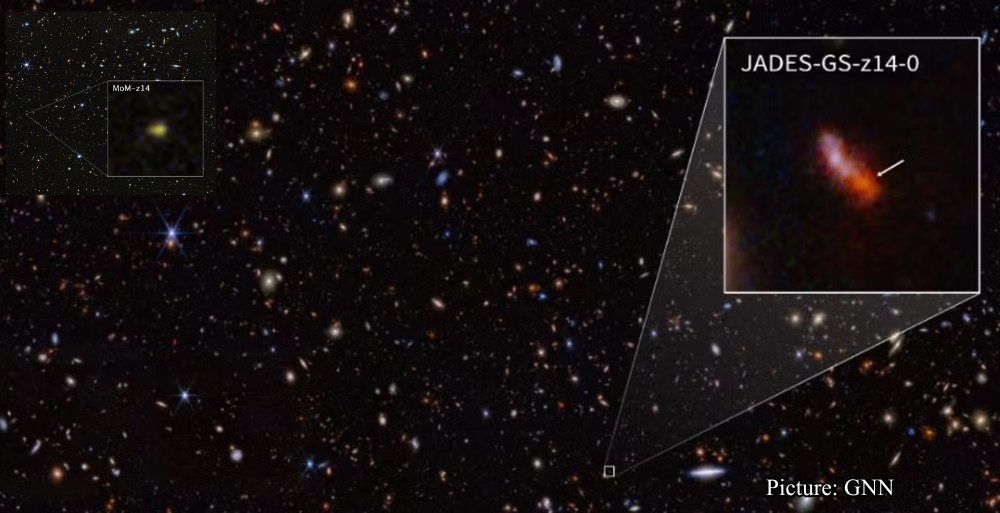
The James Webb Space Telescope has once again pushed the boundaries of our cosmic understanding by confirming the most distant galaxy ever observed, with light that began its journey a mere 280 million years after the Big Bang.
The universe, vast and enigmatic, continues to reveal its secrets through the lens of the James Webb Space Telescope (JWST). This marvel of modern engineering has once again etched its name in the annals of astronomical history by identifying the most distant galaxy ever observed. The light from this galaxy, which astronomers have named CEERS-93316, began its journey just 280 million years after the Big Bang, a period when the universe was still in its infancy.
The discovery of CEERS-93316 is not merely a testament to the capabilities of the JWST but also a profound glimpse into the early universe’s formative years. This galaxy existed during the epoch of reionization, a pivotal era when the first stars and galaxies began to illuminate the cosmos, ending the cosmic dark ages. The epoch of reionization is a critical period for astronomers because it marks the transition of the universe from an opaque state to one that is transparent, allowing light to travel freely.
The James Webb Space Telescope, launched in December 2021, is equipped with a suite of advanced instruments designed to peer further into the universe than ever before. Its primary mirror, spanning over 6.5 meters, is capable of capturing infrared light from distant celestial objects with unprecedented clarity. This capability is crucial for observing the early universe, as the expansion of the universe shifts the light from these ancient galaxies into the infrared spectrum.
CEERS-93316 was identified as part of the Cosmic Evolution Early Release Science (CEERS) Survey, a program designed to utilize the JWST’s capabilities to study the formation and evolution of galaxies. The discovery was made possible through the combined efforts of astronomers around the globe, who meticulously analyzed the data collected by JWST. The confirmation of CEERS-93316’s distance was achieved through spectroscopic analysis, which allows scientists to determine the redshift of the galaxy, a measure of how much the universe has expanded since the light left the galaxy.
The implications of this discovery are profound. By studying galaxies like CEERS-93316, astronomers can gain insights into the conditions that prevailed in the early universe. These observations can help answer fundamental questions about how the first galaxies formed, how they influenced their surroundings, and how they contributed to the reionization of the universe. Furthermore, understanding the properties of these early galaxies can shed light on the processes that led to the formation of the large-scale structures we observe in the universe today.
The JWST’s ability to break its own record for the most distant galaxy observed is a testament to its revolutionary design and the meticulous planning that went into its development. The telescope’s journey from concept to launch was fraught with challenges, including numerous delays and budget overruns. However, the successful deployment and operation of the JWST have proven that these challenges were worth overcoming, as the telescope continues to deliver groundbreaking discoveries.
The discovery of CEERS-93316 also highlights the collaborative nature of modern astronomy. The CEERS Survey is a testament to the power of international cooperation, bringing together scientists from various institutions and countries to work towards a common goal. This collaborative approach is essential for maximizing the scientific return from the JWST, as it allows researchers to pool their expertise and resources to tackle complex scientific questions.
As the JWST continues its mission, astronomers are eagerly anticipating further discoveries that will enhance our understanding of the universe’s early history. The telescope’s ability to observe the faintest and most distant objects in the universe is expected to yield a wealth of data that will keep scientists busy for decades to come. Each new discovery not only adds to our knowledge of the cosmos but also raises new questions, driving the cycle of scientific inquiry forward.
In conclusion, the confirmation of the most distant galaxy ever observed by the James Webb Space Telescope is a significant milestone in our quest to understand the universe. This discovery not only showcases the incredible capabilities of the JWST but also provides a window into the universe’s formative years. As we continue to explore the cosmos, the findings from the JWST will undoubtedly play a crucial role in shaping our understanding of the universe and our place within it.