









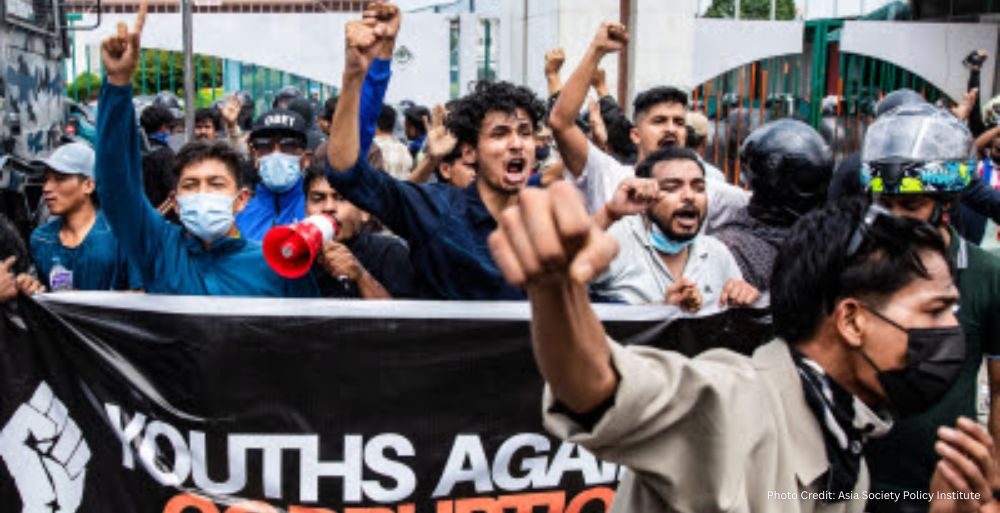
Asia Society Policy Institute (ASPI) has published “The Gen Z Movement and the Future of Nepal”, written by Rishi Gupta, Assistant Director of ASPI Delhi. The paper unpacks Nepal’s historic Gen Z movement by understanding and assessing its drivers and their implications. It also provides a nuanced understanding of the movement’s contributions to Nepal’s relations with neighboring India and China. As a way forward, the paper presents several post-election scenarios and identifies four key challenges facing Nepal’s next government.
Besides the implications for digital connection, Nepal’s September 2025 social media ban brought to the fore larger frustrations among Nepalese youth with rampant nepotism, corruption, unemployment, and political instability in the country. As the protests gained strength, so did the Gen Z movement’s push for change, culminating in the resignation of Prime Minister K. P. Sharma Oli.
“The use of social media to gain popular approval for a leader was unusual and marked a significant shift toward participatory, media-driven political engagement led by Gen Z—a trend that underscores how the political consciousness of Nepalese Gen Z is not an isolated case but rather a part of a broader trend,” writes Gupta.
Looking ahead to the March 5 election, the paper cautions that generational appeal alone will not determine the election outcome. “In terms of voter appeal, the RSP [Rastriya Swatantra Party], with 35-year-old Balendra Shah, and the Nepali Congress, led by Gagan Thapa, may gain an initial edge because of their relatively youthful leadership,” writes Gupta. But “what ultimately matters is not how young a leader appears, but how convincingly they address employment, governance, stability, and national development for all generations.”
According to Gupta, there could be a scenario in which the Thapa-led Nepali Congress and the Balendra-led RSP create a post-election alliance to form a coalition government. Meanwhile, there is a high chance that former-PM Oli might refuse to accept an unfavorable verdict and take the legal route to challenge the dissolution of the house, which could delay the formation of a government.
The paper also assesses regional implications of the Gen Z movement. India moved quickly to engage with the interim government, with Prime Minister Narendra Modi extending support after interim Nepalese Prime Minister Shushila Karki’s appointment. China adopted a more cautious tone, reiterating its core interests while closely monitoring political developments in Kathmandu.
“China’s core interests in Nepal have historically been to secure its Tibet frontier, limit foreign influence—mainly American and Indian—and anchor Kathmandu within its Belt and Road framework to bring Nepal within the ambit of Chinese influence and away from Delhi,” writes Gupta .“A Gen Z–driven movement in Nepal worries China because youth politics tend to be open, networked, and less controllable.”
Read the full report here. Members of the media interested in interviewing Gupta should email pr@asiasociety.org.
Don’t miss ASPI’s upcoming events:
A Conversation with Philippine Secretary of Foreign Affairs Ma. Theresa P. Lazaro
Thursday, 5 March 2026
9 – 10 a.m. EST
Asia Society New York
Join the Asia Society Policy Institute in New York City for a timely discussion with Secretary of Foreign Affairs Ma. Theresa P. Lazaro. She will outline the Philippines’ vision for its ASEAN Chairmanship and will join Ambassador (ret.) Philip S. Goldberg for a fireside conversation on the strategic outlook for the country and the broader foreign policy direction guiding its engagement with the United States, China, India, and other key partners.
Members of the media interested in attending this event should email pr@asiasociety.org.
Asia at the Forefront: Market-Based Solutions for Mitigating Climate Change
Tuesday, 10 March 2026
6 – 7 p.m. EST
Asia Society New York
Join the Asia Society Policy Institute and the Columbia University Climate School for an expert panel discussion on the path to advancing market-based solutions for mitigating climate change. Adam Tooze, Kathryn and Shelby Cullom Davis Professor of History at Columbia University, Cassie Flynn, Global Director of Climate Change at the United Nations Development Programme (UNDP) and Akshat Rathi, Senior Reporter at Bloomberg, will join Alexis Abramson, Dean and Professor of Climate at the Columbia Climate School, for this conversation.
Members of the media interested in attending this event should email pr@asiasociety.org.