






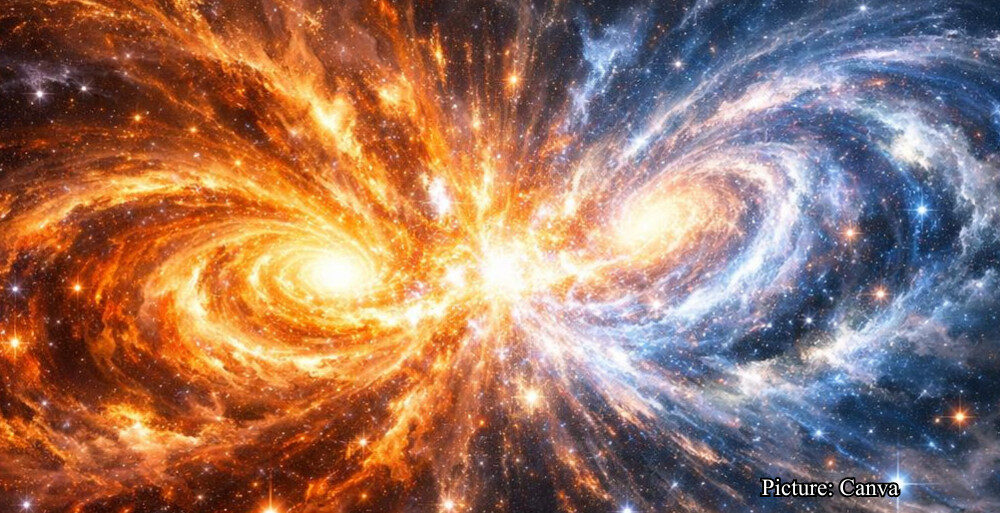
The cosmos has long been a subject of human wonder and inquiry, its vastness both a source of inspiration and a profound mystery. In recent years, our understanding of the universe has been challenged and expanded by groundbreaking theories that seek to unravel its complexities. One such provocative idea comes from a physicist who suggests that the universe is not the empty void we have traditionally imagined, but rather a viscous fluid that permeates all of existence, potentially driving the expansion and contraction we observe. This hypothesis, while still in its theoretical infancy, offers a fresh perspective on the cosmic phenomena that have puzzled scientists for decades.
The notion that the universe could be filled with a viscous fluid is a departure from the conventional view of space as a vacuum. Historically, space has been seen as a largely empty expanse punctuated by celestial bodies and the occasional rogue particle. However, this new perspective aligns with some of the more recent advancements in cosmology and quantum physics, which suggest that space is far from a barren void. Instead, it may be teeming with energy and matter we have yet to fully understand.
The idea of a viscous cosmos is not entirely without precedent. In the early 20th century, the concept of the ‘ether’ was proposed as a medium through which light waves could travel. Although the ether theory was eventually debunked, the search for an underlying structure to the universe continued. More recently, the discovery of dark matter and dark energy, which together are thought to comprise about 95% of the universe’s total mass-energy content, has reignited interest in the unseen components of the cosmos.
The physicist’s theory posits that this cosmic fluidity could be responsible for the universe’s expansion, a phenomenon first observed by Edwin Hubble in the 1920s. Hubble’s discovery that galaxies are moving away from us led to the formulation of the Big Bang theory, which describes the universe’s explosive birth and subsequent expansion. However, the mechanism driving this expansion has remained elusive. Dark energy has been the leading candidate, but its nature is still poorly understood. The idea of a viscous fluid offers an alternative explanation, suggesting that the universe’s expansion might be akin to the flow of a fluid through a medium.
This theory also touches upon the possibility of cosmic contraction, a concept that challenges the idea of a perpetually expanding universe. If the universe is indeed a fluid, its dynamics could allow for phases of contraction, potentially leading to a cyclical model of the cosmos. Such a model would suggest that the universe undergoes periods of expansion and contraction, akin to a cosmic heartbeat, which could have profound implications for our understanding of time and space.
The implications of this theory are profound, not only for cosmology but also for our philosophical understanding of the universe. If space is indeed a viscous fluid, it could redefine our relationship with the cosmos, suggesting that we are not merely observers of a distant and indifferent universe, but participants in a dynamic and interconnected system. This perspective resonates with the principles of quantum mechanics, which emphasize the interconnectedness of all things and the influence of the observer on the observed.
While the idea of a viscous universe is intriguing, it is important to approach it with a healthy dose of skepticism. Theoretical physics is rife with concepts that, while mathematically sound, may not correspond to physical reality. The challenge lies in developing testable predictions and experimental evidence that can either support or refute these ideas. As with any scientific theory, the ultimate test of its validity lies in its ability to withstand scrutiny and produce results that align with observed data.
In the meantime, the hypothesis of a viscous universe serves as a reminder of the boundless creativity and curiosity that drive scientific inquiry. It encourages us to question our assumptions and explore new possibilities, pushing the boundaries of what we know and challenging us to think beyond the conventional. As we continue to explore the mysteries of the cosmos, theories like this one offer a glimpse into the potential future of our understanding, where the universe is not a static backdrop but a dynamic and ever-evolving entity.