








This Valentine\’s Day, as the R. Premadasa Stadium in Colombo prepares for a different kind of high-stakes clash, the Indian film industry is grappling with its own internal conflict. For decades, Bollywood was the global ambassador of the \”sweet\” romance—a world of mustard fields, slow-motion dupatta flips, and protagonists like Raj and Rahul who won over families with a dimpled smile and a heart of gold. However, as we cross into 2026, the landscape has shifted drastically. The chocolate boy has been unceremoniously escorted to the wings, replaced by a brooding, hyper-fixated, and often \”angry\” male lead who treats love not as a soft melody, but as a battlefield.
The current trend is a stark departure from the era of Dilwale Dulhania Le Jayenge or Kuch Kuch Hota Hai. Today, the box office is dominated by what critics call the \”toxic trope\” school of romance. Following the seismic impact of films like Animal and the enduring dark shadow of Kabir Singh, the romantic hero has evolved into a figure of obsession and moral ambiguity. Even established stars are pivoting; Shahid Kapoor, once the quintessential boy-next-door in Jab We Met, now headlines Vishal Bhardwaj’s O’Romeo, a tale defined more by revenge and grit than by traditional courtship. This shift suggests that for modern audiences, \”nice\” no longer lands. In a world characterized by global uncertainty and digital restlessness, breezy rom-coms are increasingly viewed as hollow or out of touch.
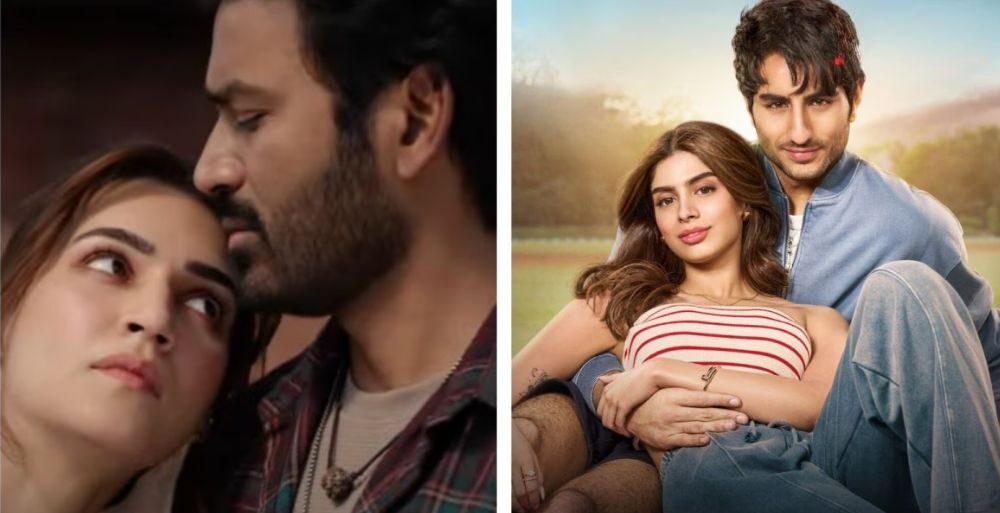
Filmmakers like Aanand L. Rai, who successfully navigated the transition from the quirky Tanu Weds Manu franchise to the intense, Dhanush-led Tere Ishk Mein, argue that cinema is simply reflecting the \”angry world\” around it. There is a sense that collective anxiety and a more connected, cynical audience have made the old-school, innocent love story feel like a relic. When a modern rom-com does release—take Bejoy Nambiar’s Tu Yaa Main as an example—it often feels compelled to \”bait\” the audience with external stressors like survival drama or survivalist subplots just to keep them engaged. Without these high-intensity stakes, the genre often falls into the trap of being \”hate-watched\”—consumed by viewers on OTT platforms specifically to critique its perceived \”cringe\” factor or lack of depth.
The phenomenon of hate-watching has become a legitimate metric for streaming success, but a tragic one for the genre\’s artistic health. While a \”mature\” romance like Aap Jaisa Koi finds its niche on Netflix, mainstream theatrical audiences are gravitating toward larger-than-life, macho spectacles. Trade experts point out that the massive success of newcomers in Saiyaara—a sweeping, emotionally charged epic—proves that romance isn\’t dead, but it must now be mounted with the scale and conviction of an action blockbuster. The casual, lighthearted romantic comedy is being squeezed out, leaving a void where gentle storytelling once stood.
Interestingly, while the new \”angry\” protagonist is in vogue, there is a lingering nostalgia that complicates the narrative. The unprecedented box office success of the Sanam Teri Kasam re-release in late 2025 showed that Gen Z still craves intense emotion, even if they reject the clichés of the nineties. This generation values authenticity and vulnerability, but they seem to prefer it wrapped in a package of high-stakes drama rather than domestic simplicity. The \”chocolate boy\” archetype hasn\’t been cancelled so much as he has been put on a timeout while the industry explores the darker, more \”rugged\” edges of human connection.
As we celebrate Valentine’s Day 2026, the question \”Where is the love?\” remains unanswered for those seeking the simplicity of yesteryear. Bollywood has traded its candy-floss dreams for a more textured, albeit more aggressive, reality. Whether this shift toward the \”angry young lover\” is a permanent evolution or a reactionary phase remains to be seen. For now, the audience seems content to ignore the \”nice guys,\” choosing instead to watch love stories that reflect the chaos, intensity, and occasional toxicity of the modern age.
Where is the love? Why Bollywood has become that place where intense, angry romances are in vogue and rom-coms are only hate-watched