






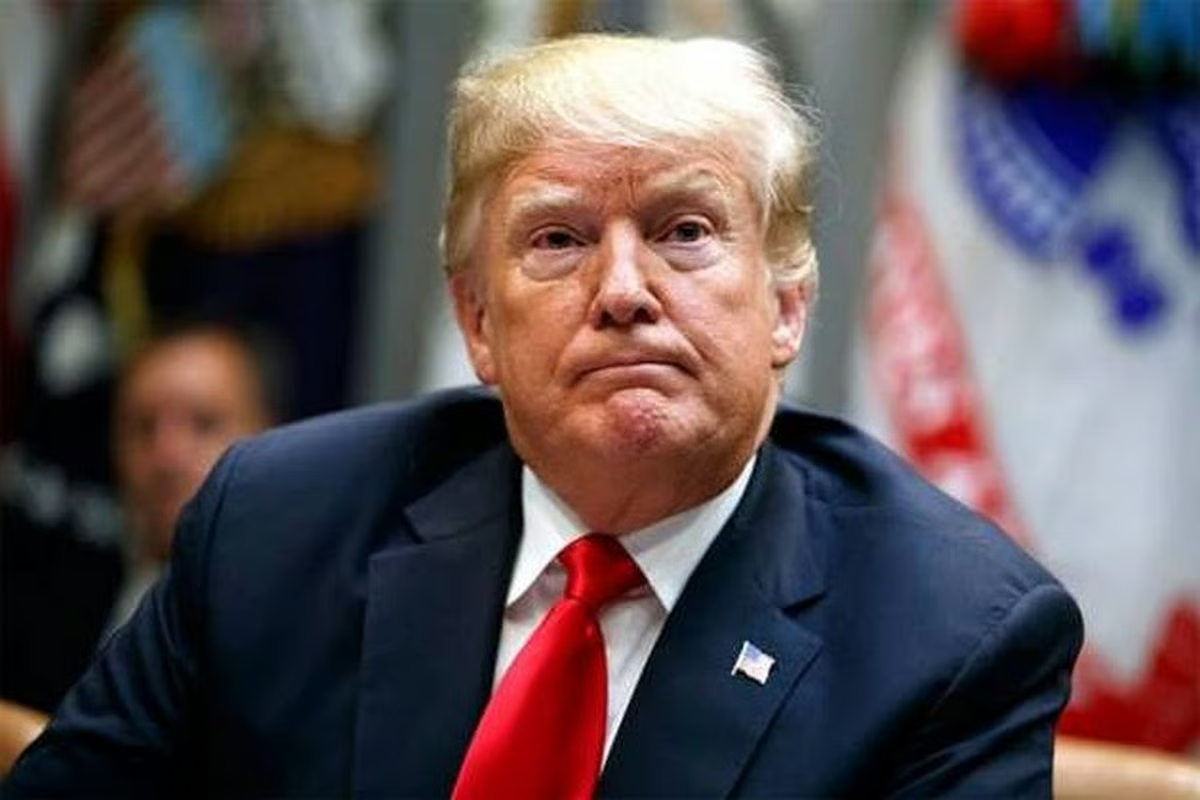
The United States House of Representatives faced a significant procedural setback late Tuesday as three Republican lawmakers crossed party lines to side with the Democratic minority, effectively blocking a leadership-backed effort to shield President Donald Trump’s tariff policies from floor challenges. Speaker Mike Johnson had sought to reinstate a ban that would have prohibited lawmakers from introducing or voting on measures to object to the administration\’s trade levies through July. However, the failure of the procedural vote now paves the way for a series of potential forced votes by Democrats intended to repeal or scale back the president’s economic trade measures, dealing a public blow to the administration’s legislative strategy.
With the current Republican majority operating on razor-thin margins, the dissent of even a small handful of members is enough to stall the Speaker\’s agenda. In this instance, the opposition of Republican Representatives Thomas Massie of Kentucky, Don Bacon of Nebraska, and Kevin Kiley of California proved decisive. Given the current composition of the House, Speaker Johnson can typically only afford to lose a single Republican vote on partisan measures when the Democratic caucus remains unified. The collapse of the vote highlights the ongoing internal tensions within the GOP regarding the balance of power between the executive and legislative branches, particularly concerning international trade and tax policy.
For several months, the Senate has served as a primary site of Republican resistance to the administration’s tariff agenda, having already passed at least three resolutions formally rebuking the trade penalties. Despite this momentum in the upper chamber, similar efforts had been routinely stifled in the House, where leadership used procedural rules to prevent members from forcing a floor debate or a direct vote on the matter. Tuesday’s development effectively removes those procedural barriers, at least temporarily, allowing for a more robust debate on the economic impact of the tariffs that have come to define the administration\’s approach to global commerce.
Following the vote, Representative Don Bacon issued a formal statement clarifying his decision to break with party leadership. While acknowledging that he generally disfavors halting the House’s routine legislative business, Bacon emphasized that the fundamental role of Congress in overseeing trade policy outweighed the need for procedural unity. He characterized the existing tariffs as a net negative for the national economy, describing them as a significant tax burden currently being shouldered by American consumers, manufacturers, and the agricultural sector. His comments reflect a broader concern among moderate and fiscally conservative Republicans who represent districts heavily dependent on international trade and stable supply chains.
The Nebraska congressman further grounded his opposition in constitutional principles, specifically citing Article I, which grants Congress the explicit authority over taxes and tariffs. Bacon argued that for several decades, the legislative branch has incrementally surrendered this power to the executive branch, leading to an imbalance that he believes must be corrected. By voting against the rule, Bacon and his colleagues signaled a desire to reclaim the oversight responsibilities that the Constitution originally intended for the House and Senate. This stance has found resonance with constitutional originalists like Representative Massie, who has long advocated for a reduction in executive agency and a return to legislative supremacy in fiscal matters.
House Republican leadership had attempted to frame the procedural ban as a necessary pause to allow for judicial clarity. GOP leaders argued throughout the week that lawmakers should support the restrictive rule to give the Supreme Court sufficient time to weigh in on pending litigation regarding the legality of the president\’s use of executive authority to impose broad trade duties. They suggested that a premature legislative intervention could complicate the legal standing of the administration\’s trade negotiations. However, this argument failed to persuade the three defecting Republicans, who viewed the delay as an abdication of their immediate duty to address the rising costs facing their constituents.
Speaker Mike Johnson remained candid about the difficulties of managing a fractured and narrow majority during a press engagement following the vote\’s failure. He noted that in the current political environment, he essentially requires total unanimity among his members every day to pass partisan legislation, a standard that was not met on Tuesday night. Despite the loss, Johnson maintained that the vast majority of House Republicans remain in total alignment with the president\’s trade objectives. He stated that the party’s primary goal continues to be providing the president with the necessary latitude to execute his trade policy without constant interference from the floor of the House.
The loss of the procedural vote introduces a new period of uncertainty for the administration’s economic agenda. Democrats have signaled that they intend to use this opening to introduce privileged resolutions that could force members to go on the record regarding specific tariffs on steel, aluminum, and consumer goods. While these resolutions may still face uphill battles to reach a final passage, the ability to force a public debate creates a political challenge for Republicans in swing districts who may be wary of supporting trade policies that are unpopular with local business interests or consumer groups.
The internal GOP friction also highlights a divergence in economic philosophy within the party. While many members have embraced the president’s protectionist trade stance as a tool for domestic industrial renewal, others remain committed to traditional free-trade principles. This divide has become more pronounced as the real-world effects of the tariffs, including retaliatory measures from trading partners, begin to manifest in different sectors of the American economy. Farmers in the Midwest and manufacturers in the Rust Belt have reported varying impacts, leading to the inconsistent support seen on the House floor.
As the House moves forward, the administration will likely look for alternative ways to stabilize its trade authority and prevent further legislative erosion. However, the precedent set by Tuesday’s vote suggests that the Speaker’s control over the floor is not absolute, especially when constitutional prerogatives and economic interests are at stake. For now, the three Republican holdouts have ensured that the debate over the future of American trade policy will remain a central and active focus of the current legislative session, rather than being sidelined by procedural maneuvers.
The White House has yet to issue a formal response to the House vote, though officials have previously defended the tariffs as essential leverage in broader negotiations with foreign powers. Supporters of the president’s policy argue that any sign of congressional division undermines the United States\’ position on the world stage. Conversely, the successful challenge by Massie, Bacon, and Kiley suggests that a growing segment of the legislature views the restoration of congressional oversight as more important than presenting a unified front behind executive trade actions. This tension is expected to persist as the July deadline originally proposed by leadership approaches.
Three House Republicans Defy Leadership to Allow Legislative Challenges Against Trump Tariffs