







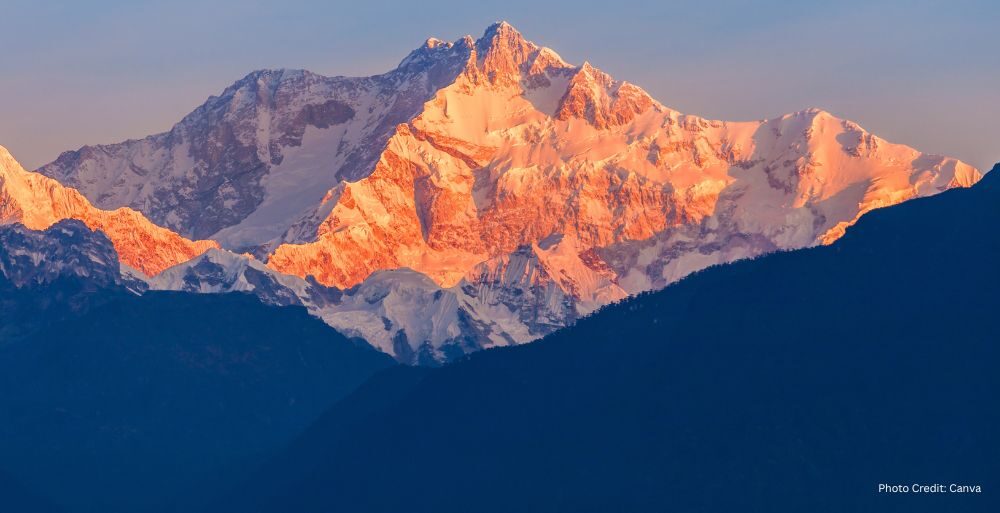
The majestic peaks of the Himalayas have long served as a primary draw for travelers and spiritual seekers alike, offering a scale and presence that few other geographical features on earth can match. Within this vast range of snow-capped giants, one particular peak holds a status of deep reverence and visual wonder. Kanchenjunga, which serves as the highest point in India and the third-highest mountain globally, has earned the evocative moniker of the Golden Mountain of India. This title is not merely a poetic flourish but a literal description of a natural phenomenon that occurs daily when atmospheric conditions are clear. As the first rays of the morning sun or the final light of the evening hit the permanent ice fields and snow-covered ridges of the massif, the white surface transforms into a brilliant, shimmering hue of metallic gold.
Standing at a staggering elevation of 8,586 meters, Kanchenjunga is situated on the border between India and Nepal. Its unique geographic positioning and immense height make it the dominant feature of the skyline across much of Northeast India, particularly within the states of Sikkim and West Bengal. For generations, the local communities and visiting mountaineers have observed how the mountain appears to be coated in melted gold during the transition between day and night. This optical spectacle is caused by the angle of the sunlight passing through the atmosphere, filtering out shorter wavelengths and leaving behind the rich oranges and yellows that illuminate the summit. It is this specific visual transformation that has cemented its reputation among the global travel community as the Golden Mountain.
The regional significance of Kanchenjunga extends far beyond its aesthetic appeal or its height. In Sikkim, the mountain is considered a sacred entity, often viewed as the protective deity of the land. Local traditions and religious practices often revolve around the five peaks that make up the Kanchenjunga massif, which are said to represent the five repositories of God, consisting of gold, silver, gems, grain, and holy books. This spiritual connection adds a layer of cultural depth to the physical beauty of the Golden Mountain. Because of its sacred status, early mountaineering expeditions often agreed to stop just short of the actual summit to respect local beliefs that the top of the mountain should remain untrodden by human feet.
For those seeking to witness the golden glow of the peak, several specific locations in the Eastern Himalayas have become legendary. Tiger Hill, located near the town of Darjeeling, is perhaps the most famous vantage point in the world for viewing the Kanchenjunga sunrise. Every morning, hundreds of visitors gather in the pre-dawn cold, waiting for the precise moment when the gray silhouette of the mountain catches the light. The experience is often described as transformative, as the darkness gives way to a pale pink that rapidly intensifies into the signature golden radiance. The sheer scale of the mountain face means that even from several dozen miles away, the detail of the ridges and glaciers is visible to the naked eye during these clear moments.
Beyond the well-trodden paths of Darjeeling, other regions offer equally compelling perspectives of the mountain. In the quiet village of Charkhole within the Kalimpong district, the views are prized for being unobstructed and sweeping. Unlike the busier tourist hubs, Charkhole provides a silent environment where the natural sounds of the forest accompany the visual drama of the mountain. Similarly, the Batasia Loop offers a unique perspective where the engineering marvel of the Darjeeling Himalayan Railway provides a foreground for the distant Himalayan range. The 360-degree views available from this location allow for a comprehensive look at the surrounding peaks, though Kanchenjunga remains the undisputed centerpiece of the horizon.
The state of Sikkim provides even closer access to the mountain’s presence. In Lower Pelling, the geography allows for direct views of the massif from many residential and hotel balconies. Pelling is situated at a higher altitude than many Bengal hill stations, placing the observer at a more direct eye level with the base of the high Himalayan clouds. The Rumtek Kanchenjunga View Point, located near the historically significant Rumtek Monastery, offers a panoramic vista that combines cultural architecture with natural grandeur. These spots are particularly valued by photographers who require crystal-clear visibility, which is most common in the early hours of the day before rising temperatures cause clouds to form around the high ridges.
Timing is a critical factor for anyone hoping to see the Golden Mountain in its full glory. The Himalayan weather is notoriously unpredictable, and the massive height of Kanchenjunga means it often creates its own localized weather systems. The most reliable windows for clear skies occur during two specific periods of the year. The first is from October to December, following the retreat of the monsoon rains. During these months, the air is scrubbed clean of dust and haze, resulting in a sharp, high-contrast view of the peaks against a deep blue sky. The second window occurs in the spring months of March and April. While there may be more localized mist during this time, it is also the season when the rhododendrons bloom in the lower valleys, providing a colorful contrast to the white and gold of the high peaks.
Reaching the viewpoints for Kanchenjunga involves navigating the winding mountain roads of the Eastern Himalayas. While the mountain itself is rugged and remote, the surrounding infrastructure has developed to support a robust tourism industry. Travelers typically arrive via the Bagdogra International Airport or the New Jalpaiguri railway station, both located in the plains of West Bengal. From there, a journey of several hours by road leads into the higher elevations. For those heading specifically to Sikkim, the Pakyong Airport offers a closer landing point, though flights are highly dependent on weather conditions. The road networks connecting Siliguri to Gangtok, Darjeeling, and Kalimpong are well-serviced by taxis and buses, making the Golden Mountain accessible to those willing to undertake the climb into the hills.
The enduring appeal of Kanchenjunga lies in its ability to inspire a sense of wonder that transcends simple sightseeing. The phenomenon of the golden sunrise is a reminder of the raw, untouched power of the natural world. Even as modern travel makes these remote corners of the globe more accessible, the mountain remains a formidable and silent witness to the passage of time. The sight of the golden peaks at dawn is a memory that stays with travelers long after they have descended back to the plains, serving as a testament to why this specific Himalayan giant is uniquely honored with the title of the Golden Mountain of India.