








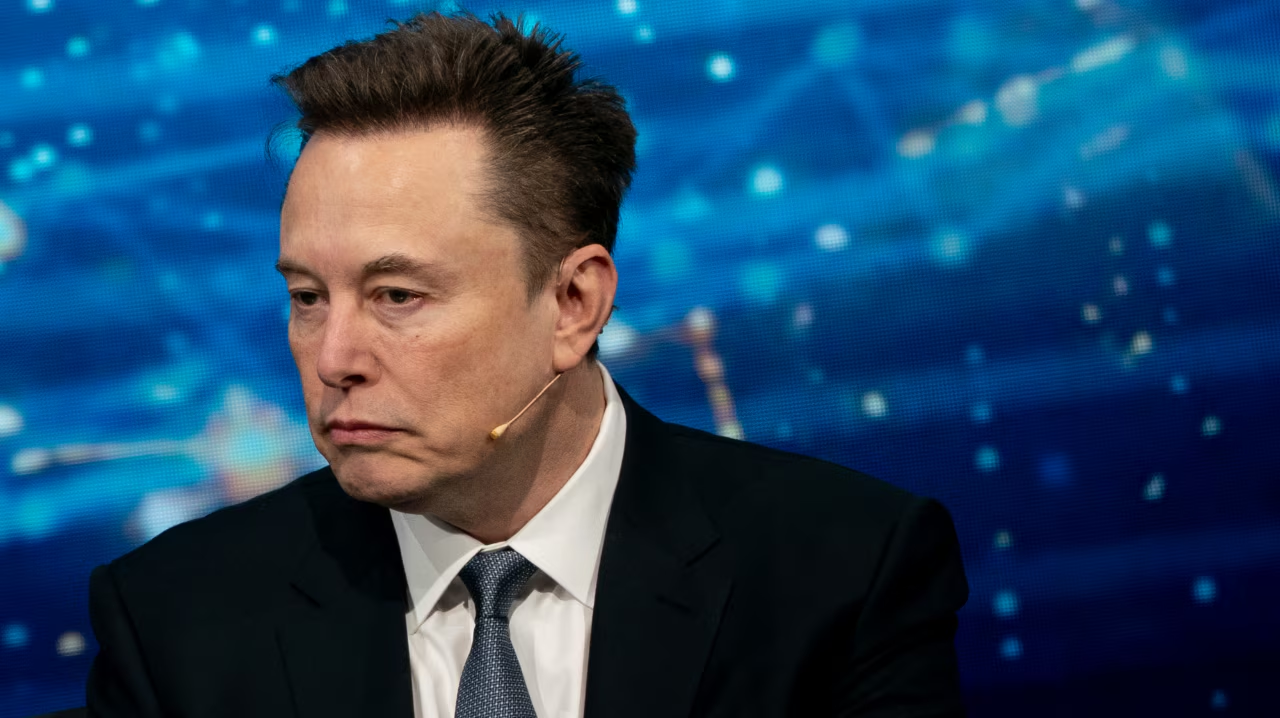
Elon Musk, the billionaire chief executive of Tesla and SpaceX, recently ignited a public discourse regarding the intersection of personal satisfaction and extreme wealth. In a social media post that resonated across digital platforms, Musk suggested that the traditional adage claiming money cannot buy happiness is accurate. The sentiment, shared with his millions of followers, included a somber emoji, signaling a reflective or perhaps melancholic perspective from the individual currently ranked as the wealthiest person in the world. With a net worth fluctuating around several hundred billion dollars, Musk’s commentary offers a rare glimpse into the psychological landscape of those at the pinnacle of global capital.
The timing of Musk’s reflection comes at a significant juncture for his various business ventures and personal trajectory. As the leader of several high-profile companies, including the social media platform X and the infrastructure firm The Boring Company, Musk remains a central figure in the global economy. His influence extends from the automotive sector to aerospace and telecommunications. However, his recent admission suggests that the accumulation of unprecedented resources and the successful execution of grand technological ambitions do not necessarily insulate an individual from the complexities of emotional well-being. This perspective has historical precedent among the ultra-wealthy, yet it remains a point of contention for those observing from different economic strata.
While the world’s first potential trillionaire ponders the emotional utility of his fortune, the vast majority of the American public is grappling with far more tangible financial challenges. New data from the National Endowment for Financial Education indicates that 88 percent of adults in the United States entered 2026 experiencing significant financial stress. This figure highlights a stark contrast between the philosophical contemplations of the elite and the daily realities of the average household. For most Americans, the struggle is not whether additional income will provide ultimate joy, but whether it will provide the basic security necessary to navigate a modern economy characterized by rising costs and debt.
The financial landscape for the typical American family remains precarious following a series of economic shifts over the previous year. Approximately 77 percent of adults reported experiencing a major financial setback in 2025. These setbacks were not limited to a single sector but spanned a variety of life events, including unexpected medical emergencies, job losses, and significant repairs to essential property such as vehicles or homes. These events often serve as a catalyst for long-term economic instability, pushing families toward high-interest debt or the depletion of what little savings they had managed to accumulate during more prosperous periods.
Inflation and the cost of living continue to be the primary drivers of this widespread anxiety. When surveyed about their anticipated major expenses for the current year, excluding primary housing costs like rent or mortgages, Americans consistently pointed to three specific areas of concern. Debt repayment led the list, with 40 percent of respondents identifying it as a top priority. This reflects the lingering impact of consumer credit usage and student loans on monthly disposable income. Additionally, 36 percent of participants cited home-related expenses, while 32 percent noted that transportation costs were a significant burden on their annual budgets.
The lack of a financial safety net is perhaps the most telling metric of the current economic climate. Only 36 percent of U.S. adults expressed total confidence in their ability to cover an unexpected expense of 2,000 dollars. This leaves nearly two-thirds of the population in a vulnerable position should an emergency arise. In the absence of liquid savings, many Americans indicated they would be forced to rely on credit cards, borrow from friends or family members, or utilize buy-now-pay-later services. Some even suggested they would be forced to sell personal belongings to bridge the gap. These methods of coping with financial shocks often lead to a cycle of debt that is difficult to break.
Public sentiment regarding personal financial health is largely split between resignation and disappointment. Roughly 41 percent of the population feels their current financial situation aligns with their previous expectations, suggesting a sustained period of low growth or stagnation for many. More concerningly, 38 percent of individuals report that their financial circumstances are worse than they had anticipated. This sense of downward mobility or unfulfilled expectations contributes to the broader atmospheric stress that Musk’s comments touched upon, albeit from an entirely different vantage point.
The debate over the relationship between money and happiness is not a new phenomenon in the field of behavioral economics. Numerous studies have attempted to find the point at which incremental increases in income no longer correlate with increased life satisfaction. While some research suggests a plateauing effect once basic needs and moderate comforts are met, other studies indicate that the sense of control and security provided by wealth continues to improve well-being even at higher levels. For Musk, whose resources are effectively limitless, the realization that wealth does not solve every internal struggle may be a personal truth, but for the 88 percent of Americans facing stress, the absence of money remains a primary source of unhappiness.
The disconnect between the billionaire class and the working public is often magnified by social media interactions. Musk’s post quickly became a lightning rod for criticism and discussion, with many pointing out that while money may not guarantee happiness, it provides a level of freedom and security that is currently out of reach for millions. The ability to access top-tier healthcare, secure a safe environment for one’s family, and pursue personal interests without the looming threat of bankruptcy is a form of happiness that remains inextricably linked to financial means. For those working multiple jobs or living paycheck to paycheck, the philosophical nuances of wealth’s limitations are a luxury they cannot afford to consider.
As the United States moves further into 2026, the focus for policymakers and financial institutions remains on addressing the underlying causes of this widespread stress. Bridging the gap between the affluent and the financially insecure requires more than just a change in perspective; it requires structural adjustments to how wealth is distributed and how social safety nets are maintained. The data suggests that for a significant portion of the country, the pursuit of happiness is currently secondary to the pursuit of solvency. Until the majority of Americans feel they can handle a basic financial surprise without falling into debt, the conversation around the “limits” of wealth will likely continue to be viewed through a lens of skepticism.
In conclusion, Elon Musk’s recent comments serve as a reminder of the complex relationship humans have with capital. While he may find the emotional returns on his billions to be diminishing, the vast majority of the American public is still searching for the baseline level of financial stability that allows for such reflections. The ongoing economic data provides a sobering reality check to the high-level musings of tech leaders. As long as the cost of living, debt levels, and the lack of emergency savings remain prevalent issues for 88 percent of the population, the value of money will continue to be measured not by the happiness it can buy, but by the misery it can prevent.