









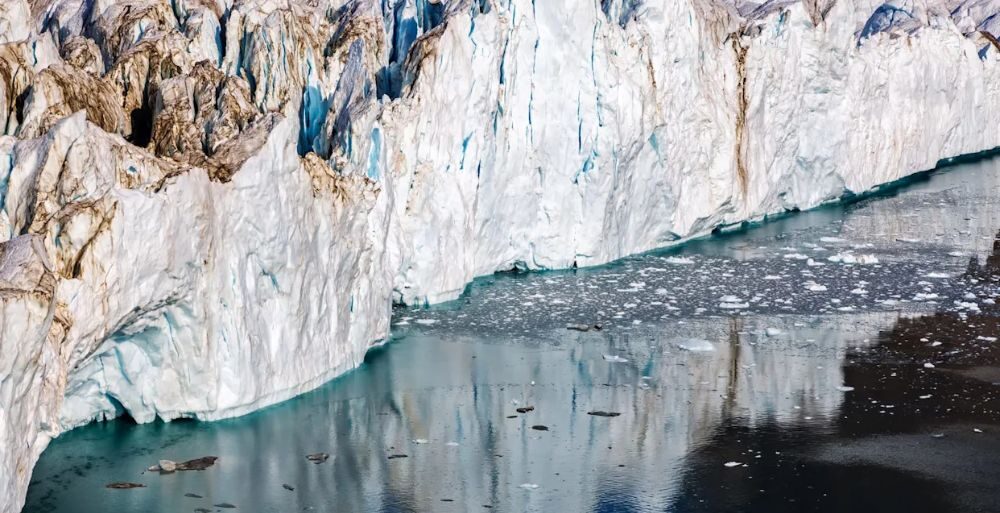
Rising global temperatures and escalating atmospheric pollution could lead to the nearly total disappearance of the Greenland ice sheet over the next millennium according to a new scientific study focused on the long term stability of polar regions. The research indicates that under high emission scenarios the massive ice sheet could melt almost entirely by the year 3000 resulting in a global sea level rise of approximately 7.4 meters or 24.3 feet. This projection highlights a critical tipping point where the interactions between the ice sheet and the atmosphere create self sustaining feedback loops that accelerate the rate of mass loss beyond previous estimates.
The study utilized a sophisticated methodology that paired a specific Greenland ice sheet model with a regional climate model to simulate the effects of significant warming and pollution over an initial three hundred year period. Following this phase the climate variables were held steady for the remainder of the millennium to allow researchers to isolate and evaluate the specific interactions between the ice sheet and the atmosphere. This approach enabled the scientific team to investigate the role of amplifying feedback mechanisms over extended timescales which had not been explored in such granular detail in prior climate research.
According to Frans Steenhoudt of the Free University of Brussels the Greenland ice sheet has been losing mass at an accelerated rate since the 1990s primarily due to surface melt and ice calving. These processes are direct consequences of rising global temperatures driven by the combustion of fossil fuels such as gas coal and oil for energy production. The new findings suggest that as the ice sheet thins it enters a cycle where it melts faster due to its lower elevation where temperatures are naturally higher. This elevation feedback is compounded by changes in precipitation patterns where falling snow is increasingly replaced by rain as the local environment warms.
The research team identified several atmospheric shifts that contribute to the instability of the ice sheet. As the ice surface retreats and thins the local climate experiences decreased precipitation and increased cloud cover. These variables interact to further accelerate the loss of ice mass. By the end of the millennium the simulations showed that the sheet had reached a state of near total collapse. While different wind patterns could potentially mitigate some of the melting if cold air is directed toward the ice fringes the prevailing high warming scenario suggests that atmospheric feedbacks become the dominant force in the degradation of the ice sheet.
Lead author Chloë Paice noted that the feedbacks between the ice sheet and the atmosphere ultimately become so powerful under high warming conditions that the ice sheet loses its fundamental stability. Paice emphasized that previous simulations that did not account for these complex interactions likely underestimated the total mass loss expected over the coming centuries. The inclusion of high resolution regional climate models is now viewed as essential for accurately representing the physical processes that govern the behavior of large scale ice masses.
The Greenland ice sheet represents one of only two major ice sheets on Earth alongside the Antarctic ice sheet. Together these two bodies of ice contain approximately 99 percent of the land ice on the planet and 68 percent of its freshwater. The potential loss of the Greenland sheet poses a significant threat to global coastal communities as the resulting sea level rise would submerge vast areas of inhabited land. Other recent studies have documented additional factors contributing to this decline including the expansion of crevasses and the eruption of subglacial lakes which further destabilize the underlying structure of the ice.
Beyond the immediate physical changes to the Arctic landscape the study underscores the importance of long term sea level rise projections for global infrastructure planning. The transition from a stable ice mass to a rapidly melting one is driven by the human influenced accumulation of greenhouse gases in the atmosphere. Monitoring the thinning of the ice and the changes in its internal composition remains a priority for the international scientific community as they seek to provide accurate data for adaptation and mitigation strategies.
The research suggests that the current trajectory of industrial emissions could lock in these feedback loops making the eventual loss of the ice sheet a near certainty unless significant changes in global energy consumption are realized. The findings advocate for a shift toward sustainable practices and cleaner energy sources to slow the rate of warming and potentially preserve the remaining stability of the polar regions. This includes large scale transitions in transportation and manufacturing as well as individual efforts to reduce carbon footprints through increased efficiency and the adoption of renewable technologies.
As the scientific community continues to refine its models the role of the cryosphere remains a central pillar of climate science. The Greenland ice sheet is not merely a passive responder to temperature changes but an active participant in the climate system that can influence weather patterns and sea levels across the globe. Understanding the threshold at which the ice sheet loses its stability is vital for determining the urgency of climate policy and the timeline for necessary coastal defenses.
The study concludes that the integration of ice sheet atmosphere feedbacks is a necessary step for the next generation of climate modeling. By capturing the nuances of how wind precipitation and cloud cover interact with the ice surface researchers can provide a more comprehensive picture of the future. This data is intended to help policymakers and communities prepare for the shifting geography of the world’s coastlines and the economic and social challenges that accompany a significant rise in sea levels.