








The Indian Institute of Management Ahmedabad has formally entered into a strategic partnership with prominent Indian-American philanthropists Chandrika Krishnamurthy Tandon and Ranjan Tandon to establish a dedicated institution for the study of artificial intelligence. This initiative is supported by a significant endowment of 100 crore rupees, which is approximately 11 million dollars, marking a major milestone in the development of specialized academic centers in India. The signing of the memorandum of understanding took place in New Delhi during a ceremony attended by high-ranking government officials and academic leaders, underscoring the national importance of the project. The new entity will be known as the Krishnamurthy Tandon School of Artificial Intelligence and is designed to operate as a specialized center within the existing framework of the Indian Institute of Management Ahmedabad.
Union Education Minister Dharmendra Pradhan served as the primary witness to the exchange of the agreement, emphasizing that the project aligns with the broader national vision for technological advancement and digital transformation. The event also featured virtual participation from India’s Ambassador to the United States, Vinay Kwatra, highlighting the international cooperation and the influence of the Indian diaspora in the United States on the domestic educational landscape. The establishment of this school is viewed as a critical step in preparing for the upcoming India-AI Impact Summit 2026, a major event intended to showcase the nation’s capabilities in the emerging technology sector. Minister Pradhan noted that under the current administration of Prime Minister Narendra Modi, there has been a consistent push to strengthen the global standing of the country in the field of artificial intelligence through both infrastructure and human capital development.
The Krishnamurthy Tandon School of Artificial Intelligence will focus on the intersection of technology, management, and public policy. Unlike traditional computer science programs that focus primarily on the technical aspects of algorithm development, this school intends to prioritize real-world deployment and societal impact. The curriculum and research goals are being designed to address how artificial intelligence can be integrated into governance, business operations, and social welfare programs. This multidisciplinary approach is expected to produce a new generation of leaders who understand not only the mechanics of machine learning but also the ethical and economic implications of its widespread adoption. By housing the school within the Indian Institute of Management Ahmedabad, the project leverages the institution’s long-standing reputation for excellence in management education and its deep connections to the corporate world.
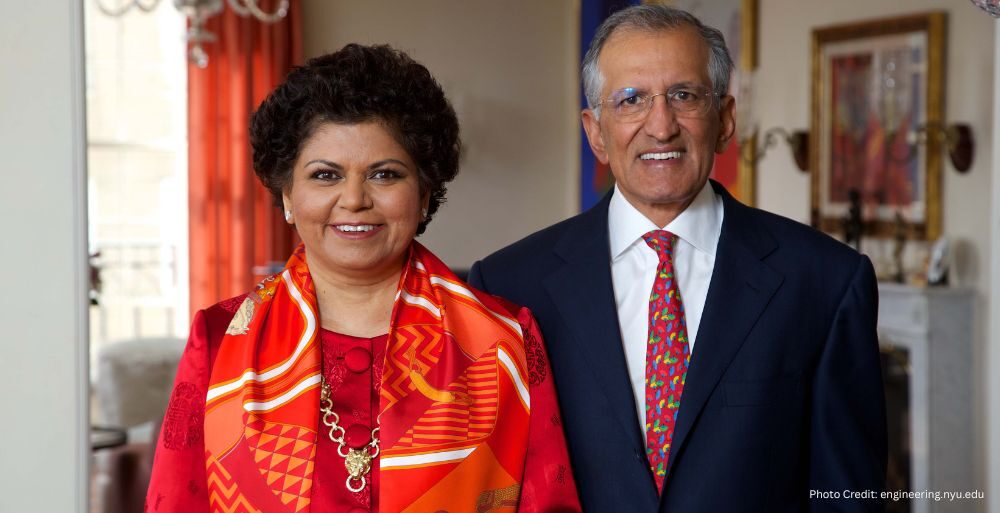
Chandrika Krishnamurthy Tandon, an alumna of the Indian Institute of Management Ahmedabad, has a long history of professional success and philanthropic engagement. Her career, which includes a partnership at McKinsey and Company and the founding of Tandon Capital Associates, has been defined by a focus on business transformation and financial services. Alongside her husband Ranjan Tandon, a successful investor and founder of Libra Advisors, the couple has become well-known for their substantial contributions to higher education and the arts in both the United States and India. Their previous major gift to New York University’s Tandon School of Engineering is a testament to their commitment to advancing technical education. This latest contribution to their alma mater in India reflects a desire to give back to the institution that helped shape their careers while simultaneously addressing a critical need for advanced AI research in South Asia.
The minister acknowledged the vital role that alumni-led initiatives play in the growth of academic institutions. He stated that such contributions do more than just provide financial stability; they help build national capacity in emerging technologies and foster a culture of giving that can sustain public institutions over the long term. The participation of the Tandon family is seen as a model for other successful members of the Indian diaspora who wish to contribute to the modernization of the Indian educational system. By bridging the gap between global expertise and local institutional needs, these types of partnerships help ensure that Indian students have access to world-class facilities and research opportunities without needing to leave the country.
Structurally, the school aims to function as a collaborative hub. It will facilitate interactions between faculty members, industry leaders, policymakers, and international partners. The goal is to move beyond theoretical academic work and focus on application-led and case-based research. This means the school will actively seek out problems currently facing the industry and the public sector, using artificial intelligence to develop scalable and deployable solutions. The research output is intended to be practical, offering frameworks that can be used by businesses to improve efficiency or by government agencies to enhance the delivery of public services. This focus on utility is a hallmark of the Indian Institute of Management Ahmedabad’s approach to education and research, which often prioritizes the integration of theory and practice.
The ceremony in New Delhi was attended by several other key figures in the Indian education sector, including Higher Education Secretary Dr. Vineet Joshi and the Director of the Indian Institute of Management Ahmedabad, Professor Bharat Bhasker. Also present were Joint Secretary for Higher Education Purnendu Banerjee and various senior representatives from the Ministry of Education. Their presence signaled a unified government support for the project and a commitment to ensuring the school has the regulatory and institutional backing necessary to succeed. Professor Bhasker remarked on the transformative potential of the gift, noting that it would allow the institute to stay at the forefront of the digital revolution and provide students with a competitive edge in the global job market.
As artificial intelligence continues to reshape the global economy, the establishment of dedicated schools like this one is becoming increasingly common in major educational centers. However, the specific focus on management and policy sets the Krishnamurthy Tandon School of Artificial Intelligence apart from many technical institutes. As the technology matures, the demand for professionals who can manage AI-driven organizations and navigate the complex regulatory environments surrounding data privacy and algorithmic bias is expected to grow exponentially. This new school is positioned to meet that demand by providing a curriculum that is as much about human-centric leadership as it is about data science.
The endowment of 100 crore rupees provides a permanent financial foundation for the school, ensuring that it can attract top-tier faculty and invest in the high-performance computing infrastructure required for advanced AI research. It also allows for the creation of scholarships and fellowships to support students and researchers from diverse backgrounds, further enhancing the institute’s mission of inclusive excellence. This financial independence is crucial for maintaining the long-term sustainability of the center and allowing it to pursue ambitious research projects that may take years to yield results.
In the broader context of India’s economic development, the move toward artificial intelligence is seen as a way to leapfrog certain stages of industrial growth. By investing heavily in digital infrastructure and specialized education, the government and its partners hope to position the country as a global leader in the knowledge economy. The partnership between the Indian Institute of Management Ahmedabad and the Tandon family is a significant step toward this goal, combining private philanthropy with public institutional strength to create a center of excellence that will likely influence the trajectory of AI education in India for decades to come.