








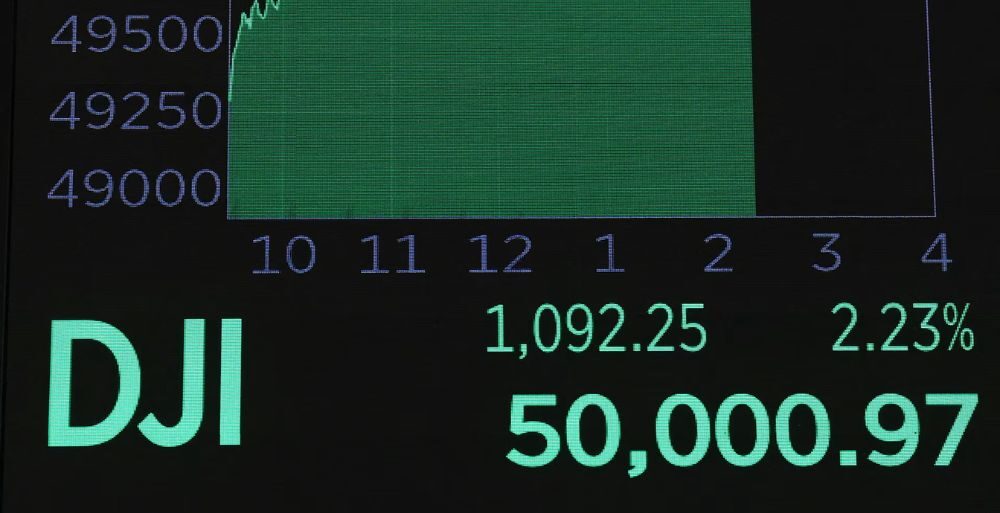
The Dow Jones Industrial Average crossed the historic 50,000 threshold on Friday as a broad-based rally in technology and small-cap stocks fueled the market’s strongest performance since May.
Global financial markets witnessed a significant turning point during Friday’s trading session, characterized by a resurgence in investor confidence that propelled the Dow Jones Industrial Average to a record-breaking close above 50,000. This psychological and technical milestone comes amid a volatile period for Wall Street, as investors recalibrate their expectations for corporate earnings and the long-term trajectory of artificial intelligence investments. The S&P 500 rose by 2%, marking its most robust single-day gain since the spring, while the Nasdaq composite climbed 2.2%, largely driven by a recovery in the semiconductor sector.
The primary catalysts for the day’s upward momentum were the major chipmakers, which saw substantial inflows following a week of heavy selling. Nvidia, a bellwether for the artificial intelligence movement, saw its shares jump 7.8%, recouping a significant portion of its double-digit losses from earlier in the week. Similarly, Broadcom rose 7.1%, effectively erasing its weekly decline. These gains reflect a persistent, albeit cautious, optimism regarding the massive capital expenditures being directed toward AI infrastructure by the world’s largest technology conglomerates.
The narrative of heavy investment was bolstered by recent commentary from Amazon leadership. Chief Executive Officer Andy Jassy indicated that the company anticipates spending approximately $200 billion this year on various technological frontiers, including AI, robotics, and satellite communications. While such high levels of spending have recently sparked concerns among analysts regarding the immediate return on investment, the market chose to focus on the growth potential of these “seminal opportunities.” Despite the broader market rally, Amazon shares slipped 5.6% as some investors questioned the sustainability of such aggressive capital allocation.
This tension between massive spending and profit realization has been a recurring theme throughout the recent earnings season. While Alphabet and other hyperscalers have signaled their intent to maintain high levels of investment, the market remains sensitive to any signs that these expenditures might not translate into immediate bottom-line growth. Furthermore, the software sector has faced recent headwinds as advancements in automated tools, such as those recently released by Anthropic, raise questions about the future demand for traditional enterprise software services. Despite these underlying anxieties, the Friday session provided a reprieve from the selling pressure that had dominated much of the month.
The cryptocurrency market also showed signs of stabilization, providing a tailwind for equities linked to the digital asset ecosystem. Bitcoin recovered from a precarious position, climbing back above the $70,000 mark after threatening to break below $60,000 late Thursday. This stabilization followed a multi-week decline that saw the asset lose nearly half of its value from its October peak. The rebound in bitcoin prices triggered sharp rallies in related stocks, with Robinhood Markets gaining 14%, Coinbase Global rising 13%, and MicroStrategy—a firm known for its significant bitcoin holdings—soaring 26.1%.
Beyond the tech and crypto sectors, small-cap stocks exhibited remarkable strength. The Russell 2000 index, which tracks smaller U.S. companies, outperformed the broader market with a 3.6% gain. This movement suggests that investors are gaining confidence in the domestic economic outlook. Smaller firms are often more sensitive to the health of the U.S. consumer and local economic conditions compared to their multinational counterparts. This sentiment was supported by preliminary data from the University of Michigan, which indicated a surprise improvement in consumer sentiment, particularly among households with exposure to the equity markets.
The travel and leisure sector also participated in the rally, as improved consumer sentiment suggested a potential increase in discretionary spending on air travel. Major carriers saw significant gains, with United Airlines, Delta Air Lines, and American Airlines all rising between 7.6% and 9.3%. This sector’s performance is often viewed as a leading indicator of consumer confidence and the general willingness of households to spend beyond essential goods and services.
In the commodities market, the extreme volatility seen in recent weeks began to subside. Gold prices rose 1.8% to settle near $4,980 per ounce, while silver saw more modest gains. The precious metals had recently experienced a period of intense price appreciation as investors sought safe-haven assets amid geopolitical uncertainty and concerns over rising sovereign debt levels. However, the rapid pace of those gains led to warnings from some market observers that the rally had become unsustainable. The recent calming of these markets suggests a transition toward a more measured valuation environment.
International markets presented a mixed but generally positive picture. European indexes mostly finished higher, despite a significant drag from the automotive sector. Stellantis saw its shares plummet by 25% after the company announced a multi-billion dollar charge and a strategic pivot away from its previous electric vehicle production targets. The automaker cited an overestimation of the speed of the global energy transition, opting instead to align its production more closely with current consumer preferences for traditional and hybrid vehicles.
In Asia, the Nikkei 225 managed a modest gain, aided by a leadership transition at Toyota Motor. The announcement that Chief Financial Officer Kenta Kon would succeed Koji Sato as CEO was greeted positively by the market, as investors looked for stability in Japan’s largest automaker. Meanwhile, the fixed-income market remained relatively quiet, with the 10-year Treasury yield holding steady at 4.20%. The lack of significant movement in yields provided a stable backdrop for the equity rally, as it suggested that inflation expectations and interest rate forecasts remain anchored for the time being.
While the Friday surge was impressive, the S&P 500 still concluded its third losing week in four. The path forward for the markets remains contingent on several factors, including the continued performance of Big Tech and the clarity of the Federal Reserve’s future monetary policy. Analysts will be closely watching upcoming economic data to determine if the improved consumer sentiment translates into sustained economic growth or if the market’s recent volatility is a precursor to a more prolonged correction. For now, the Dow’s achievement of the 50,000 level serves as a notable milestone in a complex and rapidly evolving financial landscape.