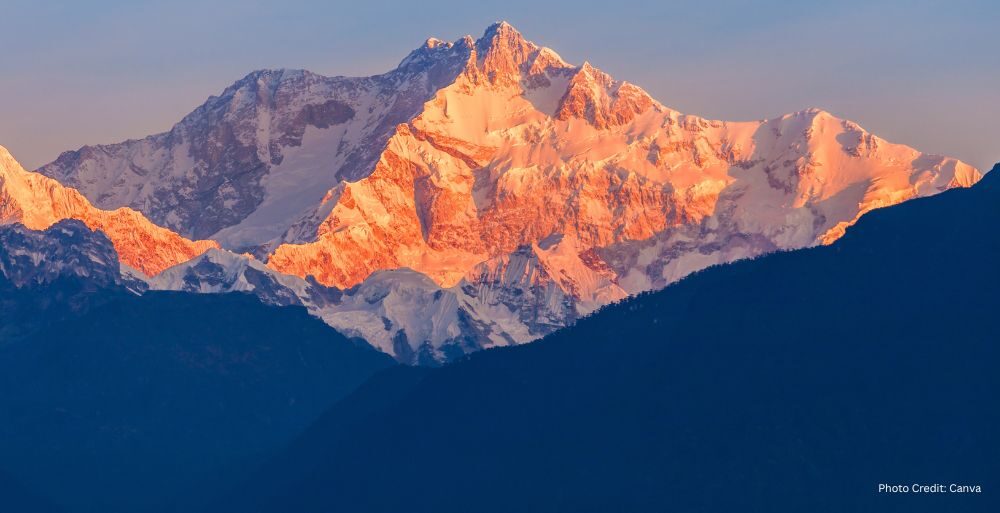








The majestic Kanchenjunga, standing as India’s highest peak, has long been revered by locals and travelers alike as the Golden Mountain due to its spectacular light displays at dawn.
High within the eastern reaches of the Himalayan range, straddling the border between India and Nepal, rises the formidable mass of Kanchenjunga. Reaching an elevation of 8,586 meters, it holds the distinction of being the third-highest mountain on Earth and the tallest peak within the sovereign borders of India. Beyond its geological significance, the mountain carries a deeply poetic and enduring nickname among trekkers, mountaineers, and the indigenous communities of the region: the Golden Mountain. This title is not merely an aesthetic observation but a reflection of a natural phenomenon that has defined the cultural and spiritual landscape of the Himalayas for centuries.
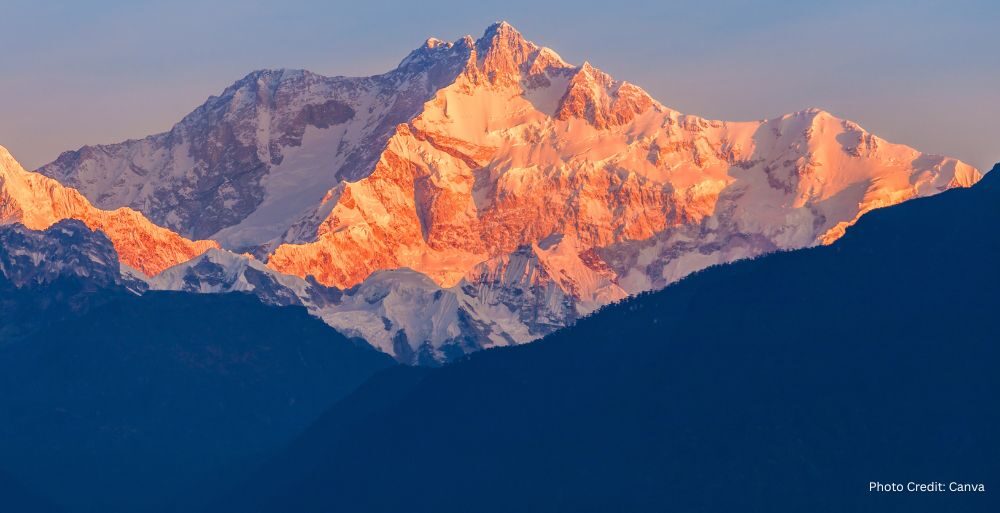
The designation of Kanchenjunga as the Golden Mountain originates from the physics of light and the unique geography of the mountain’s five primary peaks. Unlike many other summits that may appear stark white or gray under the midday sun, Kanchenjunga is positioned in a manner that allows it to catch the first and last rays of sunlight with remarkable clarity. At the break of dawn and the onset of dusk, the vast snowfields and glacial expanses of the mountain act as a natural canvas. As the sun sits low on the horizon, its light must pass through a thicker layer of the Earth’s atmosphere, filtering out blue and violet wavelengths and leaving behind the warmer spectrum of reds, oranges, and yellows. When this light strikes the pristine snow of Kanchenjunga, the peak undergoes a visual transformation, glowing in deep shades of amber, copper, and brilliant gold. For a few fleeting minutes each day, the mountain appears as though it has been dipped in molten metal, a sight that has inspired countless legends and a sense of profound awe among those who witness it.
The name Kanchenjunga itself is steeped in linguistic and spiritual history, derived from the Tibetan words “Kang” meaning snow, “Chen” meaning big, “Dzö” meaning treasury, and “Nga” meaning five. Translated literally as The Five Treasures of the High Snow, the name refers to the mountain’s five distinct peaks, which are believed by local residents to represent five repositories of God’s wealth: gold, silver, precious stones, grain, and sacred texts. This etymological connection to “gold” as one of the fundamental treasures reinforces the mountain’s identity as a place of immense value and divine presence. In the traditions of the Sikkimese and Tibetan people, Kanchenjunga is far more than a geological feature; it is considered a powerful guardian deity and the physical manifestation of the protector of the land. This reverence is so deep that modern mountaineering expeditions, out of respect for local religious beliefs, traditionally stop a few feet short of the actual summit to ensure the “true top” remains untrodden by human feet.
Geographically, Kanchenjunga serves as a massive sentinel over the Indian states of Sikkim and West Bengal. Its Indian face is most prominently visible from high-altitude vantage points such as Darjeeling and Tiger Hill, where tourists gather in the early hours of the morning specifically to witness the “golden” transition. The surrounding region is protected by the Kanchenjunga National Park, a UNESCO World Heritage site that is unique for its “mixed” criteria status, recognizing both its incredible biodiversity and its sacred cultural significance. The park is home to a variety of rare and endangered species, including the snow leopard and the red panda, all of which exist under the shadow of the great Golden Mountain. The glaciers that flow from its slopes, such as the Zemu Glacier, are vital water sources for the rivers that sustain the valleys below, further cementing the mountain’s role as a provider of life and abundance.
While other Himalayan giants such as Nanda Devi in Uttarakhand or Dhaulagiri in Nepal are also known to display golden hues under specific atmospheric conditions, none are as inextricably linked to the title of the Golden Mountain in the Indian consciousness as Kanchenjunga. Its sheer scale and the proximity of populated hill stations make its daily transformation a public spectacle rather than a remote occurrence. The visual drama is most pronounced during the post-monsoon months of October and November when the air is at its clearest, stripped of the haze and moisture that can obscure the mountain during the summer months. During this window, the contrast between the dark, waking valleys and the illuminated, golden summit creates a three-dimensional effect that has been the subject of countless paintings, photographs, and literary descriptions.
The enduring fascination with the Golden Mountain also speaks to the broader relationship between the Indian people and the Himalayas. In many Indian philosophies, mountains are seen as the bridge between the earthly and the divine. The daily “crowning” of Kanchenjunga in gold is often interpreted as a spiritual metaphor for enlightenment or the presence of a higher power. For the local Lepcha and Bhutia communities, the mountain is the source of their origin myths and the final resting place of their ancestors’ spirits. This cultural weight ensures that Kanchenjunga is viewed with a level of sanctity that transcends its status as a mere destination for adventure sports or scientific study. Even as modern technology allows for high-definition captures of the sunrise, the experience of seeing the mountain turn to gold in person remains a rite of passage for many travelers in the region.
In contemporary times, the Golden Mountain has become a symbol of environmental conservation and the fragility of the Himalayan ecosystem. As global temperatures rise, the very snow and ice that allow Kanchenjunga to reflect its golden light are under threat. Climate scientists monitor the mountain’s glaciers closely, noting that the retreat of ice could eventually alter the way the peak interacts with sunlight, potentially dulling the brilliance of its famous glow. Consequently, the mountain serves as a prominent reminder of the need to protect the natural heritage of the Indian subcontinent. It remains a focal point for sustainable tourism in Sikkim, where the state government has implemented strict regulations to ensure that the influx of visitors hoping to see the golden sunrise does not compromise the integrity of the sacred landscape.
Ultimately, Kanchenjunga’s identity as the Golden Mountain is a blend of optical reality and human imagination. It is a phenomenon that bridges the gap between the physical world of rock and ice and the metaphysical world of myth and belief. Whether it is viewed as a scientific marvel of light refraction or a divine treasure chest of the gods, the mountain continues to captivate the Indian imagination. As the first light of day touches the highest point in India, the golden glow serves as a daily renewal of the mountain’s majesty, standing as a silent, shimmering guardian over the eastern Himalayas. For those who stand in the cold morning air of the foothills, watching the gray silhouette of the horizon burst into a fiery, metallic brilliance, there is no question why Kanchenjunga has earned its place as the definitive Golden Mountain of the East.