







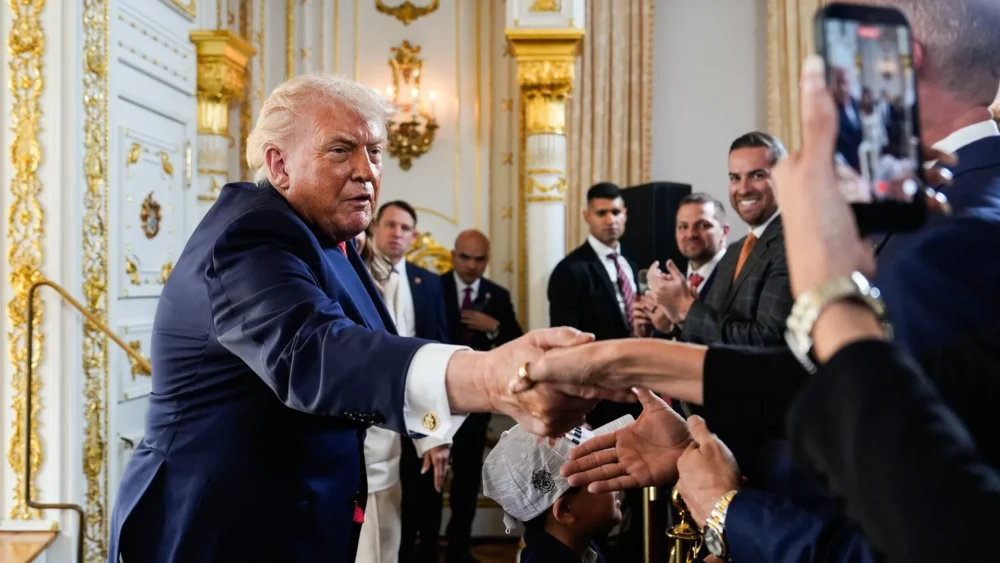
US President Donald Trump on Saturday announced sweeping new tariffs on Denmark and several key European allies, escalating a high-stakes geopolitical standoff linked to his long-running push for US control over Greenland. The move has sent shockwaves through transatlantic relations, raising concerns about trade retaliation, NATO unity, and growing militarisation of the Arctic.
In a post on his social media platform Truth Social, Trump said the United States would impose a 10 percent tariff on imports from Denmark and allied European countries starting February 1, with rates set to rise sharply to 25 percent by June 1 if no agreement is reached.
“We have subsidized Denmark, and all of the Countries of the European Union, and others, for many years by not charging them tariffs, or any other forms of remuneration,” Trump wrote. “Now, after centuries, it is time for Denmark to give back — World Peace is at stake!”
Tariffs Tied Directly to Greenland Acquisition
According to Trump, the tariffs will remain in force “until such time as a Deal is reached for the Complete and Total purchase of Greenland.” The measures apply not only to Denmark but also to Norway, Sweden, France, Germany, the United Kingdom, Netherlands, and Finland.
Trump claimed that the US has sought to acquire Greenland for over 150 years, but Denmark has consistently refused. He argued that advances in military technology and missile defence systems — which he referred to as “The Golden Dome” — have made American ownership of the Arctic territory strategically urgent.
“Because of modern-day weapons systems, both offensive and defensive, the need to acquire is especially important,” the president said.
Rising Military Tensions in the Arctic
The announcement comes amid heightened military activity in the Arctic. In recent days, troops from several European nations, including France and Sweden, arrived in Greenland to participate in joint military exercises organised by Denmark. Copenhagen has also increased its own military presence in and around the territory, citing security concerns.
“These countries, who are playing this very dangerous game, have put a level of risk in play that is not tenable or sustainable,” Trump wrote. “Therefore, it is imperative that strong measures must be taken so that this potentially perilous situation ends quickly, and without question.”
US officials have repeatedly argued that Greenland’s strategic location makes it essential for safeguarding American and allied interests against Russia and China, both of which have expanded their Arctic ambitions in recent years.
Diplomatic Efforts — And Clear Disagreements
Earlier this week, US Vice President J.D. Vance and Secretary of State Marco Rubio held talks at the White House with Greenlandic Foreign Minister Vivian Motzfeldt and Danish Foreign Minister Lars Løkke Rasmussen.
Rasmussen later described the meeting as a “brilliant opportunity” to exchange views but acknowledged sharp differences. “We share the challenges linked to the situation in the Arctic,” he told Fox News. “But we didn’t agree that it can only be achieved if the US conquers Greenland.”
Trump dismissed Denmark’s ability to counter Russian and Chinese influence in the region. “Only the United States of America, under President Donald J. Trump, can play in this game,” he wrote. “Nobody will touch this sacred piece of land, especially since the national security of the United States — and the world at large — is at stake.”
NATO Allies Alarmed by Escalation
The administration has not ruled out the use of military force in Greenland, a stance that has drawn strong opposition from Denmark, European allies, and even some Republicans in Congress. Critics warn that such actions could fracture the NATO alliance at a time of heightened global instability.
Public opinion polls in the US have also shown limited support for military action over Greenland, with many Americans questioning the economic and diplomatic costs of such a move.
Despite the hardline rhetoric, Trump said the US remains “immediately open to negotiation” with Denmark or other European countries, suggesting that tariffs could be lifted if talks move in Washington’s favour.
A Defining Moment for Transatlantic Relations
The tariff announcement marks one of the most aggressive steps yet in Trump’s renewed second-term push to reshape US alliances, trade relationships, and global security architecture. By explicitly linking trade penalties to territorial acquisition, the administration has blurred the lines between economic policy and geopolitical coercion — a move that analysts say could set a dangerous precedent.
As Europe weighs its response and markets brace for potential retaliation, the Greenland dispute is fast becoming a defining test of US–European relations in the Arctic age — where climate change, security, and great-power competition intersect.