








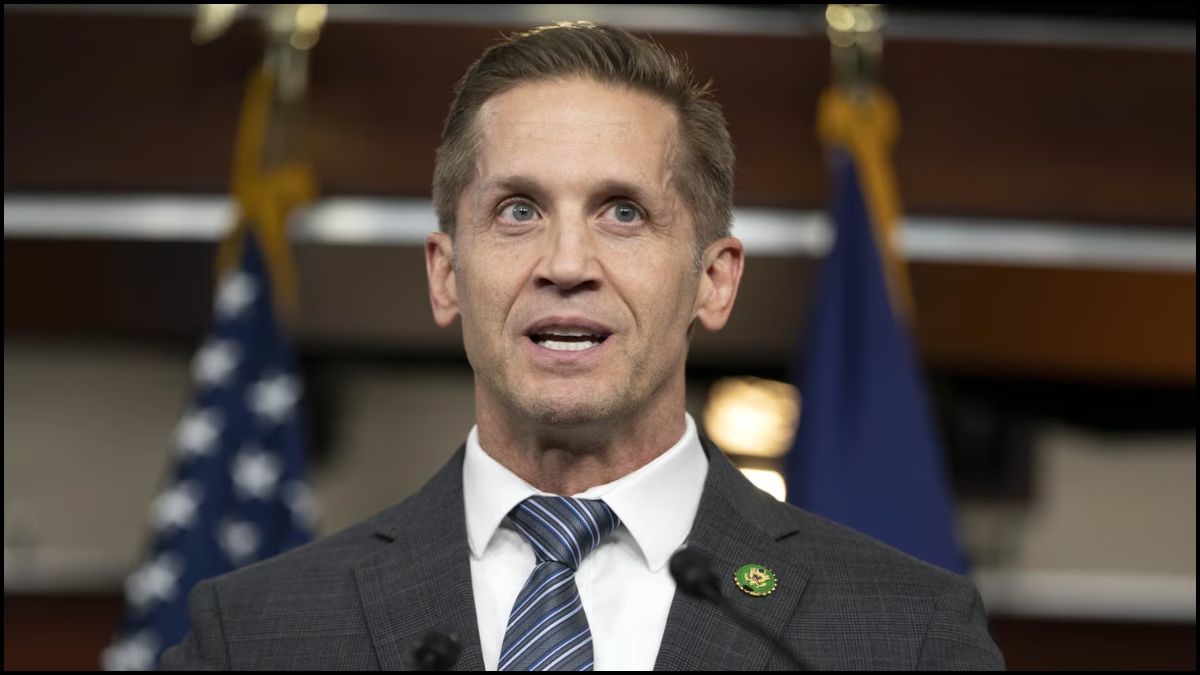
At a time when global power equations are rapidly shifting, India’s growing economic and strategic relevance to the United States was underscored in strong terms by Rich McCormick, a Republican member of the US Congress. Speaking at an event hosted by the Centre for Strategic and International Studies (CSIS) on January 12, McCormick drew a sharp contrast between India and Pakistan, stating that New Delhi brings capital, talent, and long-term value to the United States — something he argued Islamabad does not.
“Pakistan is a country with 300 million people. But you don’t see it bringing investments into America,” McCormick said during the discussion. “India not only takes investments, but it also brings investments into the United States.”
His remarks, delivered at a prominent Washington policy forum, reflect a growing bipartisan recognition in the US political establishment that India’s rise is reshaping global economic and geopolitical dynamics — and that alienating New Delhi could come at a significant cost to American interests.
India’s Rise as a ‘Dominant Country’
McCormick emphasised that India is no longer just an emerging market, but a nation increasingly asserting itself as a “dominant country” across multiple regions. He pointed to India’s expanding middle class, growing consumer base, and global business footprint as key drivers of its influence.
“India is growing as a nation and establishing itself as a dominant country in various regions,” he said, adding that the country’s middle class is beginning to exert real influence on the world market.
According to McCormick, India’s economic ascent is not limited to inward growth. Indian companies, entrepreneurs, and investors are now active contributors to the US economy, creating jobs, driving innovation, and strengthening cross-border commercial ties.
Talent as a Strategic Asset
Beyond capital flows, McCormick highlighted India’s role as a global talent powerhouse — a factor he described as central to America’s own competitiveness.
“Talent matters, and India is supplying a tremendous amount of talent,” he said. “Not just in exporting talented people, but also in what they are filling in.”
His comments reflect the reality that Indian-origin professionals play critical roles across sectors in the US, from technology and healthcare to academia and entrepreneurship. Indian-founded companies and startups have become significant employers, reinforcing the argument that India’s relationship with the US is not transactional, but deeply structural.
Warning Against Pushing India Away
McCormick offered a clear warning about the consequences of straining ties with India. In his view, the strategic costs of alienating New Delhi would far outweigh any short-term political or economic disagreements.
“Hence, he argued that the US could be in big trouble if it pushes a country like India away,” he said. “If America embraces Indians as friends, we will have peace and prosperity. If we alienate them, it is going to be a big trouble for all of us.”
The remarks come amid ongoing frictions between Washington and New Delhi over trade barriers, tariffs, and market access issues. However, McCormick’s comments suggest that many US lawmakers see these disputes as manageable within the broader context of a long-term partnership.
Bipartisan Support for the Long Game
Also present at the CSIS event was Ami Bera, a Democratic lawmaker and one of the most prominent Indian American voices in Congress. Bera echoed McCormick’s assessment, stressing that despite periodic tensions, the US–India relationship remains strategically indispensable.
“Although frictions exist, both the countries remain committed to a long-term strategic and economic partnership that goes beyond short-term disputes over tariffs, visas, and market access,” Bera said.
He further noted that American corporations consistently view India as a primary destination for large-scale investment — a pattern that does not extend to Pakistan.
“You don’t see American companies making multibillion-dollar investments in Pakistan,” Bera said. “That’s all happening in India.”
Strategic Logic Beyond Short-Term Disputes
Both lawmakers agreed that the logic of cooperation between the US and India remains overwhelming, even as negotiations continue on trade and regulatory issues. For Washington, India represents not only a vast market, but also a strategic partner in technology, defence, supply chain diversification, and regional stability.
“We’re playing the long game,” Bera said, summing up the bipartisan consensus that increasingly defines US policy thinking on India.
As global competition intensifies and alliances are recalibrated, the message from Capitol Hill appears clear: India is not just a partner of convenience, but a pillar of America’s future economic and strategic outlook — one that US lawmakers believe cannot be taken for granted.