


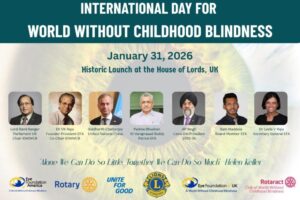


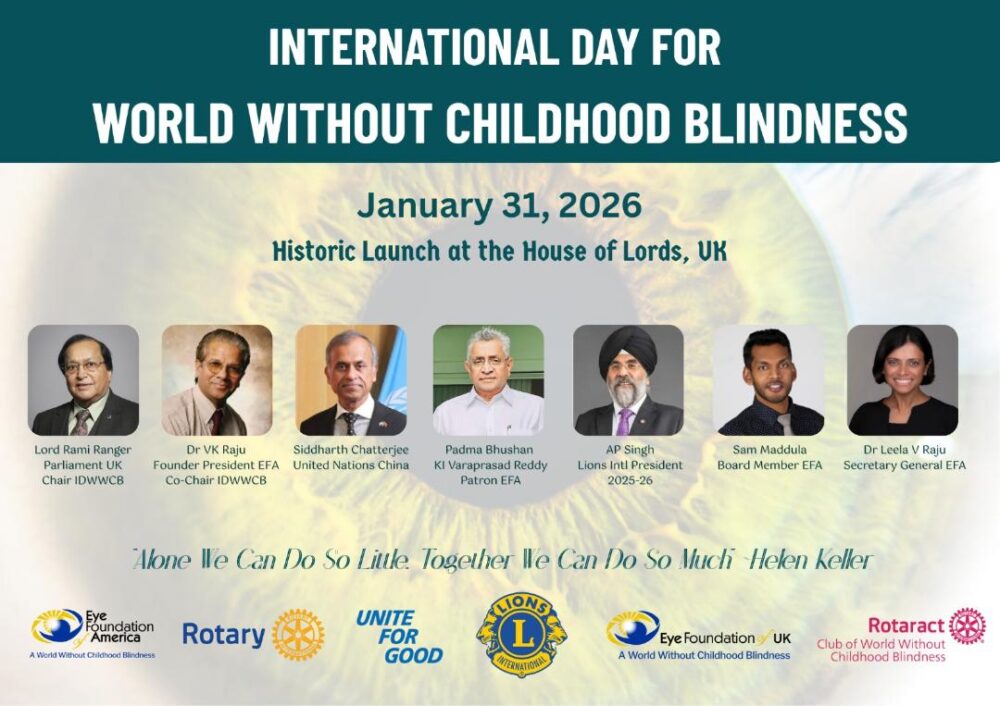
London, January 2026 — Global leaders from health, public policy, philanthropy, and youth movements will gather at the House of Lords on January 31, 2026, to commemorate the International Day for a World Without Childhood Blindness (IDWWCB), a landmark global observance dedicated to eliminating preventable childhood blindness.
The high-level commemoration represents a defining moment for a movement that began nearly five decades ago and has since transformed the lives of millions of children across continents. By hosting the observance at one of the world’s most influential legislative institutions, organisers aim to elevate childhood vision care from charity-driven interventions to a core global development and public health priority.
A Legacy That Began With One Eye Camp
The International Day traces its origins to January 31, 1977, when Dr. V. K. Raju, then a young ophthalmologist, conducted his first free eye camp in Vijayawada, India. With no institutional backing or funding, that modest initiative laid the foundation for what would later become the Eye Foundation of America (EFA), now one of the world’s leading humanitarian organisations in childhood vision care.
“Every child deserves to see the world with clarity and purpose,” Dr. Raju said while reflecting on the journey. “Let’s join hands to eradicate childhood blindness and unlock a brighter future for generations to come.”
Today, nearly 49 years later, that vision has evolved into a global movement, culminating in the formal observance of IDWWCB and its recognition on the international stage.
The House of Lords: A Global Signal
The 2026 observance is chaired by Lord Rami Ranger, a philanthropist and longtime advocate of humanitarian causes. Hosting the event at the House of Lords, he said, carries deep symbolic and practical significance.
“This gathering marks not just a commemoration, but a collective moral commitment,” Lord Ranger said. “Childhood blindness is a solvable problem, but it requires our collective action.”
Lord Ranger, who serves as a board member of both the Eye Foundation of America and the Eye Foundation of the UK, has been honoured by Her Majesty the Queen on eight occasions for his contributions to business leadership and community service. “Together, we can ensure that every child has access to quality eye care and a chance to reach their full potential,” he added.
Global Voices Unite for Childhood Vision
The event will bring together a diverse group of global leaders, reflecting the cross-sector nature of the challenge. Distinguished participants include Siddharth Chatterjee, Padma Bhushan awardee K. I. Varaprasad Reddy, Padma Shri awardee Dr. Mukesh Batra, Dr. Leela V. Raju, and Sam Maddula.
Their participation underscores the growing consensus that childhood vision is not only a medical issue, but a development imperative spanning education, economic inclusion, and equity.
Why Childhood Blindness Demands Urgent Attention
Childhood blindness remains one of the most preventable yet devastating public health challenges worldwide. Experts estimate that more than 90 percent of learning is vision-dependent, meaning untreated eye conditions can permanently limit a child’s educational outcomes, employment prospects, and overall well-being.
The International Day for a World Without Childhood Blindness aligns closely with the United Nations Sustainable Development Goals, particularly SDG 3 (Good Health and Well-Being) and SDG 4 (Quality Education). Vision care is also recognised as one of the most cost-effective health interventions, with the treatment of a single child often changing the trajectory of an entire family.
“A world without childhood blindness is possible,” said Dr. Leela V. Raju, President of the Eye Foundation of America. “But it requires vision care to be recognised as a birthright, not a privilege.”
From Camps to Sustainable Systems
Over the decades, EFA has evolved from conducting individual eye camps to building sustainable eye care ecosystems across multiple regions. Its impact includes screening millions of children in India, the United States, Africa, Nepal, and other underserved regions, performing more than 400,000 sight-restoring surgeries, and delivering vision interventions to over two million children.
The organisation has also led global efforts in the prevention and treatment of Retinopathy of Prematurity (ROP), a leading cause of childhood blindness, while integrating eye care into broader public health and education systems.
“IDWWCB transforms charity into responsibility—and vision into policy,” said Sam Maddula, highlighting the movement’s shift toward long-term systemic change.
A Call to the World
The January 31 commemoration at the House of Lords serves as a unified call to governments, multilateral institutions, corporate leaders, medical professionals, and civil society organisations worldwide. The message is unequivocal: no child should lose their sight due to poverty, geography, or lack of access to care.
Drawing inspiration from Helen Keller’s enduring words — “Alone we can do so little. Together we can do so much” — organisers say the global movement is entering a decisive phase.
As leaders convene in London to mark this historic launch, the International Day for a World Without Childhood Blindness stands as both a celebration of progress achieved and a rallying cry for the work ahead. With nearly five decades of momentum behind it and growing global recognition, the movement is now poised to transform the future for millions of children worldwide.