






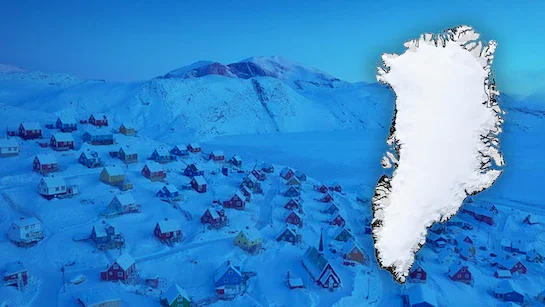
Greenland, the world’s largest island, has once again emerged at the centre of global geopolitical debate after U.S. President Donald Trump renewed his interest in acquiring the Arctic territory, citing national security concerns and questioning Denmark’s legal claim over the region.
Trump’s remarks have revived international scrutiny of Greenland’s colonial past, its evolving relationship with Denmark, its strategic importance in the Arctic, and the complex question of what Greenlanders themselves want for their future.
From Inuit Homeland to Danish Colony
Greenland’s history stretches back thousands of years. Archaeological evidence shows Inuit peoples migrating from Asia and North America settled the island as early as 2,500 BC. Around 985 AD, Norse settlers led by Erik the Red established farming communities in southern Greenland, building churches and trading settlements.
Over time, the Inuit way of life prevailed. By around 1400 AD, the Viking settlements had vanished, leaving Inuit hunters and gatherers as the dominant culture.
Denmark’s involvement began in earnest in 1721, when missionary Hans Egede arrived to reassert Danish-Norwegian influence. His arrival marked the beginning of Greenland’s colonial era. Today, Egede’s statue still stands overlooking Nuuk’s colonial harbour — viewed by many Greenlanders as a reminder of lost traditions and imposed rule.
U.S. Recognition of Danish Sovereignty
Greenland’s modern legal status was shaped by international diplomacy. In 1916, when the United States purchased the Danish West Indies (now the U.S. Virgin Islands), the treaty included a U.S. declaration recognising Denmark’s political and economic interests across all of Greenland.
That recognition remains a cornerstone of Denmark’s claim to sovereignty.
Greenland’s Current Political Status
Greenland transitioned from colony to formal Danish territory in 1953 under Denmark’s constitution, a move made without consulting Greenland’s population. Today, the island enjoys extensive self-rule under a 2009 agreement that allows it to declare independence through a referendum, followed by approval from Denmark’s parliament.
Autonomy covers most domestic matters but excludes foreign policy and defence unless specifically agreed. Greenland has a population of just under 57,000 people spread across 17 towns, with no roads connecting them — underscoring its logistical and economic challenges.
A Strained Relationship With Denmark
Relations between Greenland and Denmark have been complicated by historical grievances. In the 1950s, Inuit communities were forcibly relocated into larger towns, eroding indigenous languages and traditions. Denmark formally apologised in 2022 for a controversial experiment that sent Greenlandic children to Denmark to be culturally “re-educated.”
Further controversy emerged with revelations that thousands of Greenlandic women and girls were fitted with intrauterine devices without consent between 1966 and 1991. Denmark issued an official apology in 2025 for the decades-long birth control campaign.
A 2025 documentary also alleged that Denmark and private companies profited from Greenland’s cryolite mining industry for over a century with little benefit to local communities — deepening calls for accountability.
Greenland and Europe
Greenland joined the European Community in 1973 through Denmark but withdrew in 1985 after gaining home rule. Today, it holds Overseas Country and Territory status with the European Union, maintaining special fisheries agreements while remaining outside the EU’s political framework.
The American Military Footprint
The United States has maintained a military presence in Greenland since World War II. Under a 1951 agreement, Washington operates the Pituffik Air Base in northwest Greenland, with the freedom to build facilities while notifying Danish and Greenlandic authorities.
Denmark has long accepted this arrangement, acknowledging it lacks the capacity to independently defend Greenland and benefits from NATO security guarantees.
Why Trump Wants Greenland
President Trump has repeatedly described Greenland as a national security priority. He argues that U.S. control is necessary to prevent Russia or China from gaining influence in the Arctic.
“The shortest route between Europe and North America runs through Greenland,” a defence analyst explained, noting its role in missile early-warning systems and Arctic surveillance.
As Arctic ice melts, military activity by NATO, Russia, and China has intensified. The U.S. is seeking to expand radar coverage and maritime monitoring in waters used by Russian submarines. Moscow, however, has dismissed claims that it or Beijing pose a threat to Greenland, calling such arguments “hysteria.”
Greenland also holds untapped mineral, oil, and gas resources. While development has been slow, the island’s capital Nuuk is geographically closer to New York than Copenhagen — a fact often cited by U.S. strategists.
What Greenlanders Want
Public opinion in Greenland largely supports independence in principle. However, many residents caution against rushing the process due to economic realities. Fishing accounts for more than 90 percent of exports, while Danish subsidies fund roughly half of Greenland’s public budget, supporting healthcare, education, and infrastructure.
Some policymakers have floated the idea of a Compact of Free Association with the U.S., similar to arrangements with Pacific island nations. Such agreements offer U.S. defence guarantees in exchange for strategic access — but their long-term benefits remain uncertain.
Firm Rejection From Copenhagen and Nuuk
Trump’s renewed rhetoric has drawn firm responses. Danish Prime Minister Mette Frederiksen reiterated that Greenland “cannot be annexed,” calling previous purchase proposals “absurd.”
Greenland’s Prime Minister Jens-Frederik Nielsen echoed that stance, stating that international security concerns do not justify violating Greenland’s right to self-determination.
As global attention returns to the Arctic, Greenland finds itself balancing history, sovereignty, security, and opportunity — at the intersection of great-power competition and an unresolved quest for self-rule.