








In a significant step aimed at easing international travel and deepening bilateral ties, Germany has announced a visa-free transit facility for Indian passport holders, allowing Indian travellers to pass through German airports without requiring a separate transit visa.
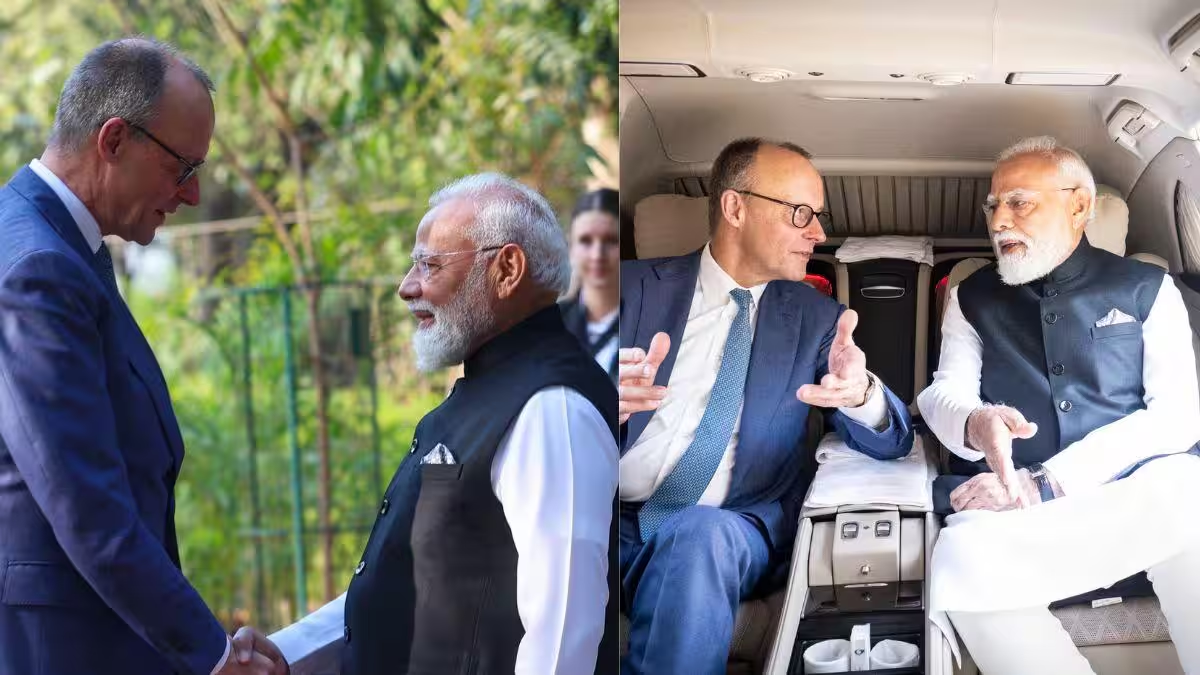
The decision was formalised in the India–Germany joint statement issued on Monday following German Chancellor Friedrich Merz’s official visit to India from January 12–13. The visit marked Chancellor Merz’s first trip to India and his first visit to Asia since assuming office as Federal Chancellor, underscoring Berlin’s renewed focus on strengthening engagement with New Delhi.
What the Visa-Free Transit Facility Means
Under the new arrangement, Indian nationals transiting through German airports en route to third countries will no longer need to apply for a transit visa, a requirement that previously added cost, paperwork, and processing time to international travel.
In practical terms, the move is expected to make journeys smoother, faster, and more efficient for Indian travellers, particularly those flying to destinations in Europe, North America, and Latin America via German hubs such as Frankfurt and Munich.
Officials described the step as a mobility-friendly measure that aligns Germany with other European nations that have eased transit rules for Indian passport holders in recent years.
Leaders Highlight Importance of People-to-People Ties
Prime Minister Narendra Modi welcomed the announcement and thanked Chancellor Merz for the decision, describing it as an important facilitator of closer engagement between the two countries.
The joint statement noted that the visa-free transit facility “will not only facilitate and ease travel of Indian nationals, but will further intensify people-to-people links.” Both leaders reaffirmed that “strong people-to-people ties constitute a vital pillar of the Strategic Partnership” between India and Germany.
The two sides also welcomed the expanding exchange of students, researchers, skilled professionals, artists, and tourists, recognising the growing interconnectedness of their societies.
Recognition of the Indian Community in Germany
Germany and India jointly acknowledged the valuable contribution of the Indian community to Germany’s economy, innovation ecosystem, and cultural life. Indian professionals play a significant role in sectors such as information technology, engineering, healthcare, research, and manufacturing, areas critical to Germany’s economic competitiveness.
Officials said easing mobility barriers, including transit restrictions, supports this contribution by making cross-border movement more accessible for professionals and families alike.
Education and Skills at the Core of Bilateral Talks
Education and skills cooperation featured prominently during the discussions between Prime Minister Modi and Chancellor Merz. The leaders took note of the rising number of Indian students in Germany, as well as the expansion of joint and dual degree programmes between Indian and German universities.
They also welcomed initiatives aimed at supporting the integration of Indian students and graduates into the German job market, reflecting Germany’s growing demand for skilled talent and India’s large pool of highly trained professionals.
The joint statement emphasised the importance of strengthening institutional partnerships, particularly between Indian Institutes of Technology (IITs) and German technical universities, to promote research collaboration and innovation.
Indo-German Roadmap on Higher Education
As part of their future-oriented agenda, both sides agreed to develop an Indo-German Comprehensive Roadmap on Higher Education, aimed at expanding cooperation across teaching, research, vocational training, and academic mobility.
Prime Minister Modi also invited leading German universities to establish campuses in India under the framework of India’s New Education Policy, which encourages global academic collaboration and foreign university participation.
Officials said such initiatives would deepen mutual understanding, enhance knowledge exchange, and create long-term linkages between young people in both countries.
A Broader Signal of Strategic Alignment
Analysts view the visa-free transit decision as more than a technical travel measure. It reflects a broader strategic alignment between India and Germany, as both countries seek to strengthen economic, educational, and cultural ties amid shifting global dynamics.
By easing transit restrictions, Germany signals trust in Indian travellers and reinforces its commitment to facilitating mobility as a cornerstone of its partnership with India.
As air travel rebounds and cross-border engagement intensifies, the move is expected to be welcomed by students, professionals, business travellers, and tourists alike—marking another step forward in the evolving India–Germany relationship.