








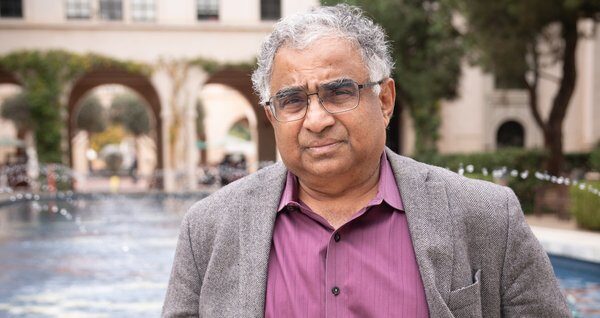
In a moment of immense pride for the global scientific community and the Indian diaspora, Professor Shrinivas “Shri” Kulkarni, an Indian-origin astronomer based in the United States, has been awarded the Gold Medal of the Royal Astronomical Society (RAS) — the highest honour conferred by one of the world’s most prestigious scientific institutions.
The award recognises Professor Kulkarni’s exceptional and sustained contributions to astronomy and astrophysics, particularly his pioneering work in time-domain astronomy, a field that focuses on studying celestial objects and events that change over time. With this recognition, Kulkarni joins an elite list of legendary scientists whose work has shaped humanity’s understanding of the universe.
A Career Defined by Groundbreaking Discoveries
Professor Kulkarni, currently the George Ellery Hale Professor of Astronomy and Planetary Science at the California Institute of Technology (Caltech), has spent decades pushing the boundaries of astronomical research. His work has transformed how scientists observe and interpret the dynamic universe.
Among his most influential contributions is his role in establishing that gamma-ray bursts originate far beyond the Milky Way, a discovery that reshaped theories about some of the most powerful explosions in the cosmos. He has also played a key role in identifying brown dwarfs, objects that exist in the boundary zone between stars and planets.
One of Kulkarni’s early achievements — the discovery of the first millisecond pulsar — remains close to his heart. Reflecting on that breakthrough, he once described it as “the most fun achievement of my life,” underscoring the joy and curiosity that continue to drive his scientific pursuits.
Revolutionising the Study of the Dynamic Sky
Perhaps Professor Kulkarni’s most lasting legacy lies in his leadership of major sky-survey projects that have revolutionised modern astronomy. He was instrumental in the creation of the Palomar Transient Factory and later the Zwicky Transient Facility, which systematically scan the night sky to detect transient and explosive cosmic events.
These facilities have enabled astronomers to identify supernovae, fast radio bursts, variable stars, and other fleeting phenomena with unprecedented speed and precision. By combining advanced instrumentation with data-driven analysis, Kulkarni helped usher in a new era where the universe is observed not as a static backdrop, but as a constantly evolving system.
A fellow astronomer remarked, “Shri Kulkarni changed the way we look at the sky. His vision turned transient events from rare surprises into a systematic field of study.”
Humility Behind a Historic Achievement
Reacting to the announcement of the Gold Medal, Professor Kulkarni expressed humility and gratitude. “I was genuinely surprised, especially considering the extraordinary scientists who have received this honour before me,” he said. He was quick to credit the collaborative spirit of astronomy, adding, “This recognition belongs as much to my collaborators, students, engineers, and survey teams as it does to me.”
His words reflect a career built not only on individual brilliance but on teamwork, mentorship, and shared scientific ambition.
Inspiring Generations of Scientists
Beyond his research achievements, Kulkarni is widely respected as a mentor and educator who has guided generations of students and researchers. His influence extends across institutions and continents, shaping how young scientists approach discovery, experimentation, and collaboration.
Colleagues note that his work continues to influence the design of future observatories and space missions, ensuring that his contributions will remain relevant for decades to come. His leadership in both theory and instrumentation has helped bridge gaps between observation, technology, and interpretation.
A Moment of Pride for Indian Science
Professor Kulkarni’s recognition is being celebrated as a landmark moment for Indian-origin scientists worldwide, highlighting the global impact of talent nurtured across borders. His journey from academic beginnings rooted in India to the forefront of international astronomy serves as a powerful reminder of the value of curiosity, perseverance, and global collaboration.
As the Royal Astronomical Society honours his lifetime of achievements, Kulkarni’s story stands as an inspiration for aspiring scientists — proof that dedication to understanding the universe can lead not only to discovery, but to lasting global recognition.