






France has delivered one of its strongest warnings yet to Washington, asserting that Europe has every right to reject proposals from the United States that undermine its sovereignty, values, or collective interests. The remarks reflect growing unease across European capitals as President Donald Trump’s renewed “America First” agenda continues to strain long-standing transatlantic ties.
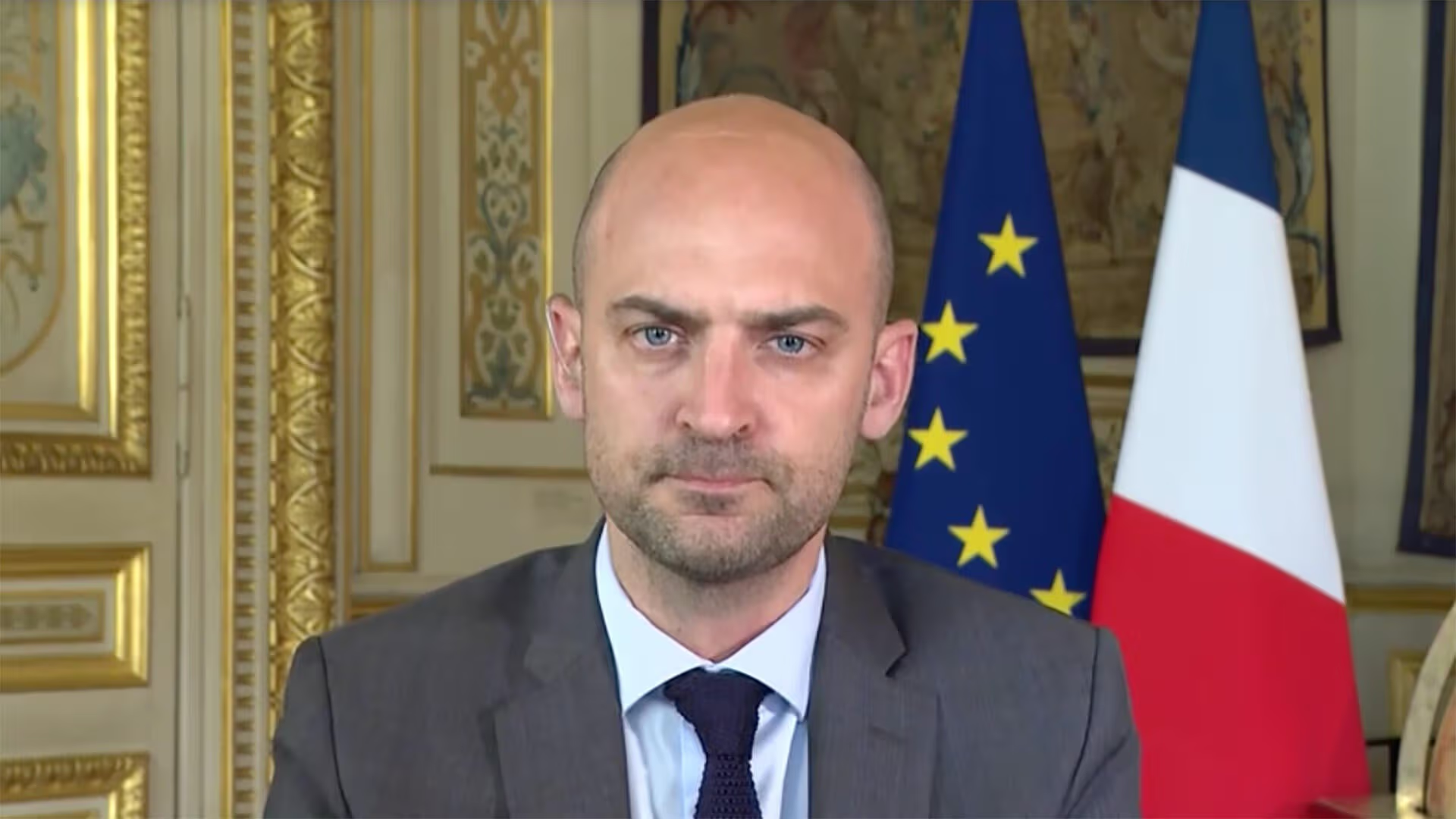
Speaking in Paris during his annual address to French ambassadors, French Foreign Minister Jean-Noël Barrot said Europe should not hesitate to push back, even against its closest historical ally, when fundamental principles are at stake.
“In just a few months, the new U.S. administration has decided to rethink the ties that bind us. That is its right,” Barrot said. “And it is also our right to say no to an historic ally, however historic it may be, when its proposal is unacceptable.”
The statement underscores a broader shift in Europe’s diplomatic posture, as leaders reassess how to respond to Washington’s increasingly unilateral approach to foreign policy, trade, and security matters.
Rising Friction in Transatlantic Relations
Barrot’s comments come amid mounting frustration among U.S. allies who argue that Trump’s policies have disrupted decades of cooperation built on shared values and mutual trust. European officials say recent U.S. actions signal a readiness to use economic pressure, political influence, and strategic leverage to force compliance rather than consensus.
A particular flashpoint has been Trump’s renewed interest in Greenland, the autonomous and mineral-rich territory of Denmark. The U.S. president has argued that Greenland is vital to American national security, a claim that has alarmed European leaders and revived fears of territorial coercion.
“Claims to Greenland are not for sale,” Barrot said, grouping the issue alongside trade pressure and military intimidation as part of a pattern of coercive behavior.
Europe Under Pressure From Multiple Fronts
In a notable escalation of rhetoric, Barrot suggested that Europe now faces external pressure not only from traditional adversaries, but also from unexpected quarters.
“Europe is being assailed from the outside by adversaries who seek to unravel our historic bonds,” he said. “They dream of exploiting our divisions once again, as they have done for centuries.”
Without naming the United States directly in that context, Barrot placed Washington’s recent actions alongside threats from Russia, whose invasion of Ukraine has reshaped Europe’s security landscape.
“They are already testing the strength of our Union through threats and coercion,” he said, citing “territorial incursions on our eastern flank, trade blackmail, and claims to Greenland.”
The remarks mark a rare moment in which a senior French official appeared to place pressure from Washington and Moscow within the same strategic frame — a signal of how seriously Paris views the current moment.
Germany Echoes French Concerns
France is not alone in its assessment. Earlier this week, German President Frank-Walter Steinmeier issued unusually blunt criticism of Washington, warning that shared values between Europe and the United States were eroding.
He spoke of a “breakdown of values by our most important partner” and cautioned that the world risked becoming “a den of robbers, where the most unscrupulous take whatever they want.” His comments reinforced the sense that Europe’s largest economies are increasingly aligned in their concerns over U.S. policy direction.
Alarm Over Political Interference and Sanctions
Barrot also criticized what he described as U.S. interference in Europe’s internal political affairs, particularly ahead of France’s presidential election, which is less than 18 months away. He condemned efforts to support political movements that seek to distance Europe from its shared democratic heritage — an apparent reference to Washington’s perceived backing of far-right parties across the continent.
In addition, the French foreign minister sharply denounced U.S. sanctions imposed on European anti-disinformation campaigners and former European Union officials, including former EU commissioner Thierry Breton. Washington has justified the measures by alleging attempts to censor U.S. social media platforms.
“These are, in reality, a challenge to our ability to choose our own rules within our own borders,” Barrot said. “France will resist such pressure.”
European officials argue that such sanctions represent an unacceptable intrusion into the EU’s regulatory autonomy and digital governance.
A Call for Strategic Independence
Underlying Barrot’s remarks was a broader call for Europe to strengthen its strategic independence — politically, economically, and technologically. While reaffirming the importance of the transatlantic alliance, he made clear that loyalty does not mean submission.
Diplomats in Paris say the message is not about severing ties with Washington, but about redefining them on more equal terms.
“Friendship does not mean alignment at any cost,” a senior French official said privately. “It means mutual respect.”
A Defining Moment for Europe
As geopolitical tensions rise and global power dynamics shift, Europe faces a defining choice: whether to continue relying on long-standing alliances without question, or to assert a more autonomous voice on the world stage.
Barrot’s speech suggests France believes the moment for deference has passed.
“Europe must be able to say no,” one diplomat summarized, “even to its closest ally — especially when its core interests and values are on the line.”