







India’s traditional medicine and wellness sector continues its steady global expansion, with exports of AYUSH and herbal products rising to $688.89 million in the financial year 2024–25, marking a 6.11 percent increase over the previous year, according to official government data released on Sunday.
The growth, up from $649.2 million in 2023–24, reflects increasing international demand for India’s ancient healthcare systems and wellness products, driven by structured export promotion, quality standardization, and growing recognition of holistic healthcare practices worldwide.
Government officials attributed much of this momentum to the establishment of the AYUSH Export Promotion Council (AYUSHEXCIL), which was set up to create a focused institutional framework for promoting Indian traditional medicine exports across global markets.
Strategic Push Behind Export Growth
Since its formation, AYUSHEXCIL has played a key role in facilitating exports by supporting Indian manufacturers and exporters through international trade fairs, buyer–seller meets, regulatory guidance, and market access initiatives. The council has also worked closely with exporters to navigate diverse regulatory environments across regions such as North America, Europe, the Middle East, and Southeast Asia.
Officials said that this structured approach has helped Indian AYUSH products gain greater visibility and credibility in international markets that are increasingly receptive to alternative and preventive healthcare systems.
“India’s traditional systems of medicine are no longer confined to domestic use. They are emerging as globally sought-after wellness solutions,” a senior official associated with the export promotion effort said, noting that demand has been particularly strong for Ayurvedic formulations, herbal supplements, and wellness therapies.
Ayush Quality Mark Boosts Global Trust
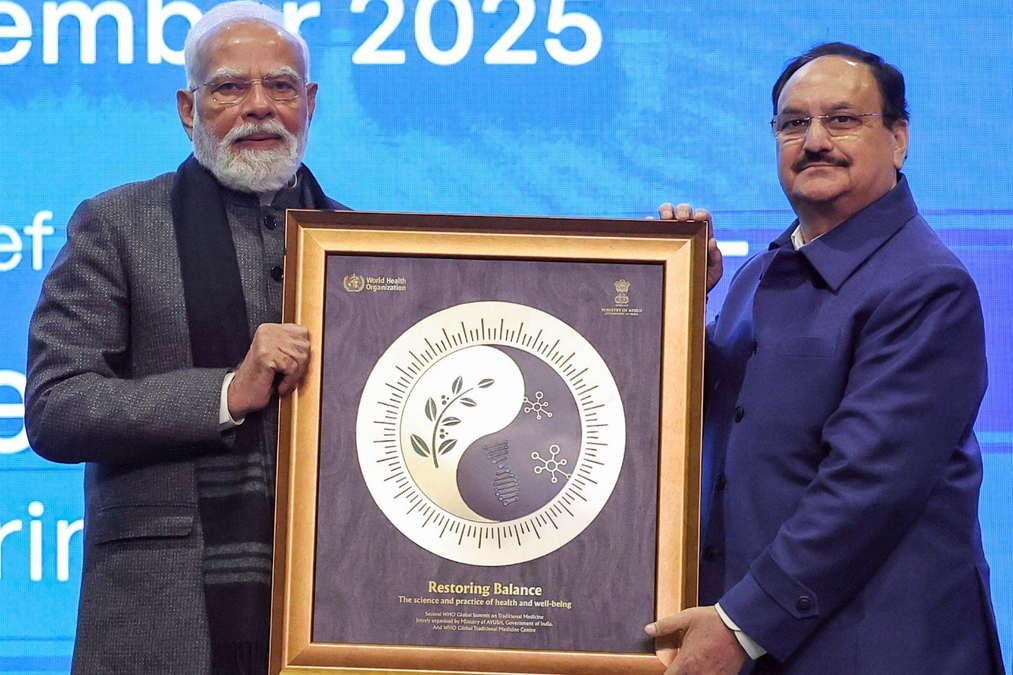
A significant development supporting export growth has been the rollout of the Ayush Quality Mark, a certification programme launched by Prime Minister Narendra Modi in 2025. The initiative aims to ensure that AYUSH products meet stringent quality, safety, and manufacturing standards aligned with global benchmarks.
Industry stakeholders say the quality mark has helped build confidence among international buyers, regulators, and consumers, particularly in markets where compliance and traceability are critical.
“The Ayush Quality Mark is not just a certification—it is a trust-building mechanism,” said an industry expert familiar with export compliance. “It signals that Indian products are reliable, standardized, and globally competitive.”
Trade Agreements Open New Doors
India’s AYUSH exports have also benefited from the inclusion of traditional medicine systems in key bilateral and multilateral trade agreements. Formal recognition of AYUSH products under agreements such as the India–Oman Comprehensive Economic Partnership Agreement (CEPA) and the India–New Zealand Free Trade Agreement (FTA) has eased regulatory pathways and improved market access.
Trade analysts note that such recognition represents a strategic shift, positioning traditional medicine alongside pharmaceuticals and wellness products in global trade frameworks.
“These agreements validate India’s traditional knowledge systems as legitimate components of global healthcare trade,” a trade policy analyst said. “That recognition has long-term implications for export growth and brand India.”
Broad Spectrum of Healthcare Systems
AYUSHEXCIL, working in consultation with the Ministry of AYUSH and the Ministry of Commerce, continues to promote a wide range of Indian healthcare systems internationally. These include Ayurveda, Yoga, Unani, Siddha, Sowa-Rigpa, Homeopathy, and other indigenous wellness practices.
Officials emphasized that global interest is no longer limited to products alone, but increasingly extends to integrated wellness solutions, including preventive healthcare, lifestyle management, and mind-body therapies.
Yoga and Ayurveda, in particular, have seen strong global uptake, aided by India’s sustained soft-power diplomacy and international wellness tourism initiatives.
A Sector Poised for Long-Term Growth
Experts believe the steady growth in AYUSH exports reflects a broader global shift toward natural, preventive, and holistic healthcare approaches. Rising awareness about lifestyle-related diseases, mental well-being, and immunity has created space for traditional systems that emphasize balance and long-term health.
“With the right mix of quality assurance, scientific validation, and regulatory alignment, AYUSH can become one of India’s most distinctive global export sectors,” said a healthcare policy expert.
The government has signaled that it will continue to invest in research, standardization, and international engagement to strengthen India’s position as a global hub for traditional medicine.
As India builds on its cultural heritage with modern quality frameworks and trade diplomacy, the AYUSH sector appears poised to play a growing role in the country’s healthcare exports and global wellness leadership.