






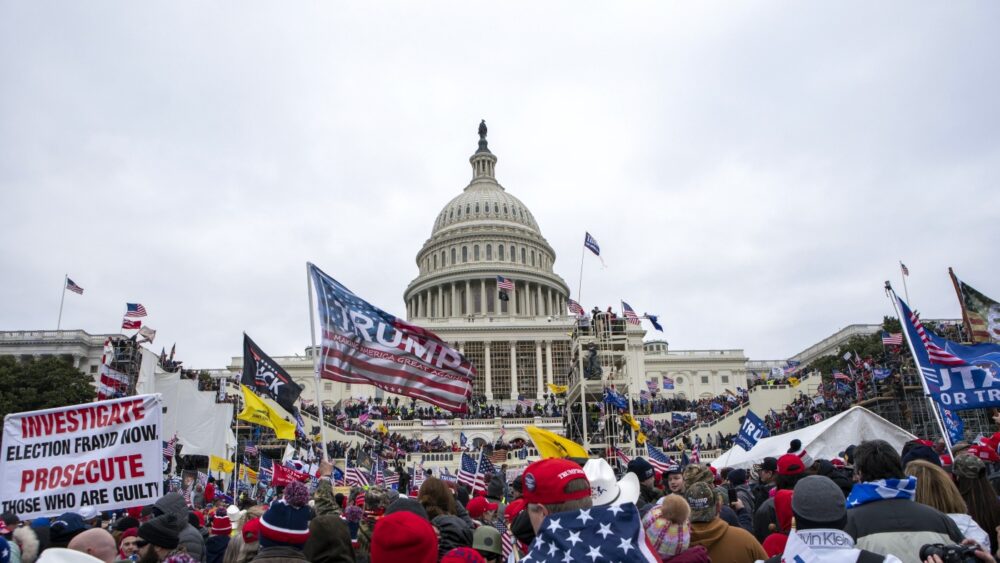
As the United States marks five years since the January 6, 2021 attack on the U.S. Capitol, new investigative reporting has reignited a fierce debate over memory, accountability, and the preservation of democratic history. An extensive investigation has revealed how the Trump administration, since returning to office, has taken deliberate steps to remove, rewrite, or obscure government records documenting the violent assault carried out by Trump supporters in an attempt to overturn the 2020 election.
The findings come at a moment when public understanding of January 6 appears increasingly fractured. While millions watched the attack unfold live and later followed congressional hearings that laid out the scope of the violence, investigators say a coordinated effort is now underway to reframe — and in some cases erase — what actually happened.
“This is a really striking moment for how history is being treated,” said investigative correspondent Tom Dreisbach. “Five years ago, there was broad agreement across party lines about what January 6 was. Today, that consensus has been systematically dismantled.”
In the immediate aftermath of the attack, political leaders from both parties described the event as an assault on democracy. Prominent Republicans, including Senator Ted Cruz, publicly labeled it an act of domestic terrorism. The FBI echoed that characterization. Even Donald Trump, then nearing the end of his first term, acknowledged that rioters had “defiled the seat of democracy” and said they must “pay.”
That narrative has since shifted dramatically. Trump has issued mass pardons to more than 1,500 individuals charged in connection with January 6, including those convicted of violent assaults against law enforcement officers. He has repeatedly referred to those involved as “great patriots” and denied that violence took place at all.
“I pardoned J6 people who were assaulted by our government,” Trump said in a recorded statement last year. “They didn’t assault. They were assaulted.”
Investigators say the documentary evidence overwhelmingly contradicts that claim. Court records, video footage, and sworn testimony show hundreds of defendants engaging in acts of violence, including beating officers with poles, spraying them with chemical agents, and crushing them against doors and barricades.
According to Dreisbach, the effort to reshape the historical record has gone far beyond rhetoric. The Justice Department has deleted public records related to January 6 prosecutions, removed references to the attack as a riot, and dismissed dozens of prosecutors who worked on the cases. In one particularly controversial move, the department hired a former January 6 defendant who had previously called police officers “Nazis” and openly encouraged violence against them.
“These actions aren’t happening in isolation,” Dreisbach said. “They represent a systematic attempt to change how the public understands one of the most significant attacks on American democracy in modern history.”
To counter that erasure, journalists and researchers have compiled an extensive public archive preserving thousands of pieces of evidence from the cases. The archive includes videos submitted in court, a detailed timeline of events, and a searchable database of prosecutions — material that shows planning, coordination, and explicit calls for violence long before the Capitol was breached.
One video reviewed during the investigation shows a rioter named Russell Taylor preparing weapons ahead of the attack. In the footage, Taylor displays carbon-fiber knuckles, hatchets, and a stun gun. He later pleaded guilty to conspiracy to obstruct Congress.
Other recordings capture rioters openly discussing revolution and civil war as they stormed the building. Chants calling for the execution of then–Vice President Mike Pence and House Speaker Nancy Pelosi echoed through the halls of the Capitol.
“If the government is no longer for the people, it is your duty to overthrow that government,” one rioter can be heard saying in court-submitted footage. Another declares bluntly, “This is war.”
Leaders of extremist groups including the Proud Boys and Oath Keepers were convicted of seditious conspiracy — among the most serious charges brought in the cases. They received lengthy prison sentences before being released under Trump’s mass pardons.
The aftermath of those pardons has been uneven. Some former defendants have publicly threatened retaliation against political figures, while others struggle to find employment due to their criminal records. Several individuals have since been charged with new crimes, including violent threats and sexual offenses. The White House has dismissed reporting on those cases as “left-wing talking points,” arguing that January 6 defendants were unfairly prosecuted for political reasons.
Perhaps the most enduring impact of January 6 has been felt by the police officers who defended the Capitol. Investigators reviewed hundreds of videos showing officers choking from pepper spray, collapsing from exhaustion, and bleeding from broken bones.
“One of the hardest moments of my life was returning home and seeing my wife at 2:30 a.m., weeping in despair and relief,” one injured officer wrote in a victim impact statement. “Knowing that I made it home.”
Another officer described injuries that continue to prevent him from playing with his children. Many officers have spoken of lasting psychological trauma. Daniel Hodges, a Washington, D.C., police officer who was beaten and crushed during the attack, said the experience fundamentally changed him.
“I’ve been diagnosed with major depressive disorder, anxiety adjustment disorder, and PTSD symptoms,” Hodges said. “It’s made me a little bitter about humanity, but not completely. I still have hope. I still believe we can be better.”
For some officers, the most painful wound has not been physical, but historical.
“The hardest part now,” one officer told investigators, “is watching the day be rewritten, watching the truth be whitewashed.”
Five years on, the battle over January 6 is no longer just about what happened inside the Capitol. It is about whether a nation can preserve an honest record of an attack on its democratic institutions — and whether facts can survive political power.