








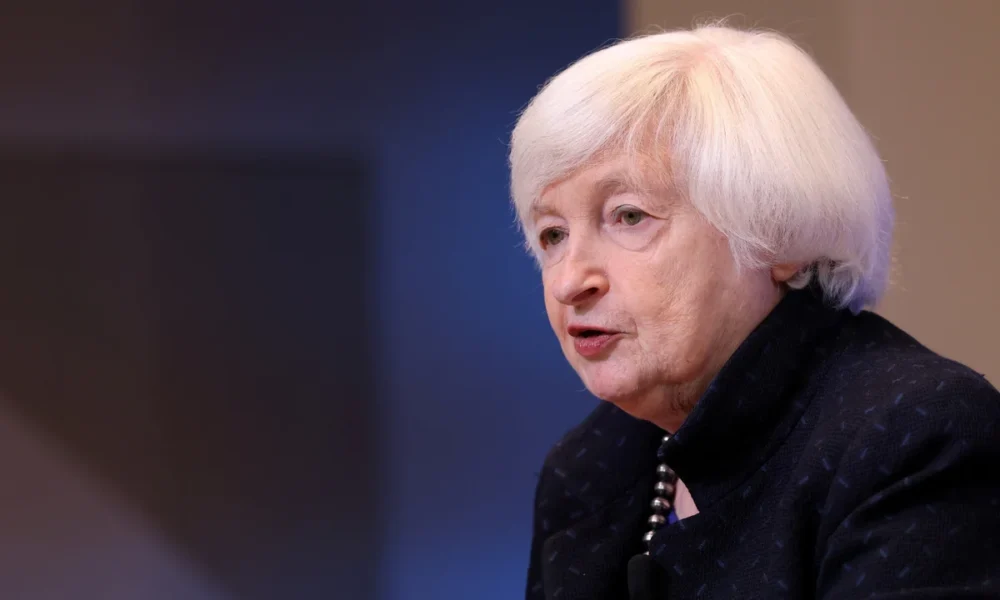
As the United States enters 2026 with its national debt crossing an unprecedented $38 trillion, alarm bells are ringing louder across the economic establishment. Former Federal Reserve Chair and Treasury Secretary Janet Yellen has warned that the country may be approaching a dangerous threshold—one economists have cautioned against for decades—where the weight of government debt begins to undermine the very tools designed to control inflation.
Speaking at a panel hosted by the American Economic Association, Yellen drew attention to what economists call “fiscal dominance,” a condition in which a government’s borrowing needs begin to overpower the central bank’s ability to manage inflation through interest rates.
“The preconditions for fiscal dominance are clearly strengthening,” Yellen said, noting that U.S. debt is on a steep trajectory and could reach nearly 150% of gross domestic product over the next three decades if current trends continue.
To illustrate the danger, economists often turn to history. More than two millennia ago, the Roman Empire faced a similar dilemma—mounting state obligations paired with political resistance to taxation. Roman emperors responded by debasing their currency, gradually reducing the silver content in coins while maintaining their face value. While this tactic delayed fiscal reckoning, it ultimately eroded trust in money itself, destabilizing the broader economy.
Modern America is not shaving silver from coins, but economists warn the parallel is conceptual rather than literal. The risk today is not immediate default, but a slow erosion of purchasing power if inflation becomes the preferred adjustment mechanism over taxes or spending cuts.
Economists often describe fiscal dominance through a simple metaphor. The U.S. Treasury acts as the driver of a car, spending to meet government priorities, while the Federal Reserve functions as the brake, raising interest rates to slow inflation when spending overheats the economy. But today, the car is towing a $38 trillion trailer. If the Fed slams the brakes too hard, the strain of higher interest payments could make government finances unsustainable, risking default or political crisis. To avoid that outcome, the Fed may feel compelled to ease off—even if inflation remains high.
The result, economists warn, is a scenario where inflation is no longer a policy failure but an outcome tolerated to keep the system running.
Eric Leeper, a professor at the University of Virginia and former Federal Reserve economist, argues that fiscal dominance is not just about numbers—it is about public behavior and expectations. For much of U.S. history, he said, government debt operated under what economists call the “Hamilton Norm,” the belief that any borrowing today would eventually be repaid through future tax surpluses.
That expectation, Leeper argues, has weakened.
“Trump put his name on the checks that went out to people,” Leeper said, referring to pandemic-era stimulus payments issued under both the Trump and Biden administrations, which together totaled nearly $5 trillion. “He was communicating that this is not a loan to tide you over. This is a gift.”
When citizens begin to view government debt as a permanent transfer rather than a future tax obligation, inflation dynamics shift dramatically. If people no longer believe taxes will rise to pay off the debt, they are more likely to spend immediately, pushing prices higher. In such a world, the Federal Reserve’s traditional tools lose effectiveness.
Leeper did not spare Yellen herself from criticism, arguing that policies she supported during the COVID crisis contributed to today’s predicament.
“When Yellen finally utters that phrase—that we might be seeing signs of fiscal dominance—well, she was kind of part of it,” Leeper said. He pointed to her calls for Congress to “go big” on stimulus while simultaneously assuring the public that inflation risks were manageable.
The current environment has also flipped conventional economic theory on its head. In textbook economics, higher interest rates reduce spending. But with federal debt exceeding 120% of GDP, Leeper argues rate hikes have become expansionary rather than contractionary.
Interest payments on U.S. debt now exceed $1 trillion annually, flowing directly into the private sector as income.
“The private sector’s income in the form of interest payments is going up,” Leeper said. “That’s not contractionary. That’s expansionary.”
Heather Long, chief economist at Navy Federal Credit Union, says the bond market is already reacting.
“The bond market is the new king in the United States,” Long said, warning that once countries cross the 120% debt-to-GDP threshold, investors gain enormous leverage. As confidence erodes, investors demand higher returns, pushing up borrowing costs for mortgages, car loans, and businesses—often independent of the Fed’s policy decisions.
While economists stop short of predicting imminent collapse, they agree the margin for error is shrinking.
“America always does the right thing after exhausting every other option,” Leeper said, echoing a familiar political adage. “Until that faith really gets shattered, we’re okay. But if that starts to get shattered, then we’re really in deep doo-doo.”