





Union Minister for External Affairs S. Jaishankar on Friday (January 2, 2026) asserted that India cannot extend the benefits of good neighbourliness to a country that continues to support terrorism, stating that national security and the protection of citizens remain non-negotiable.
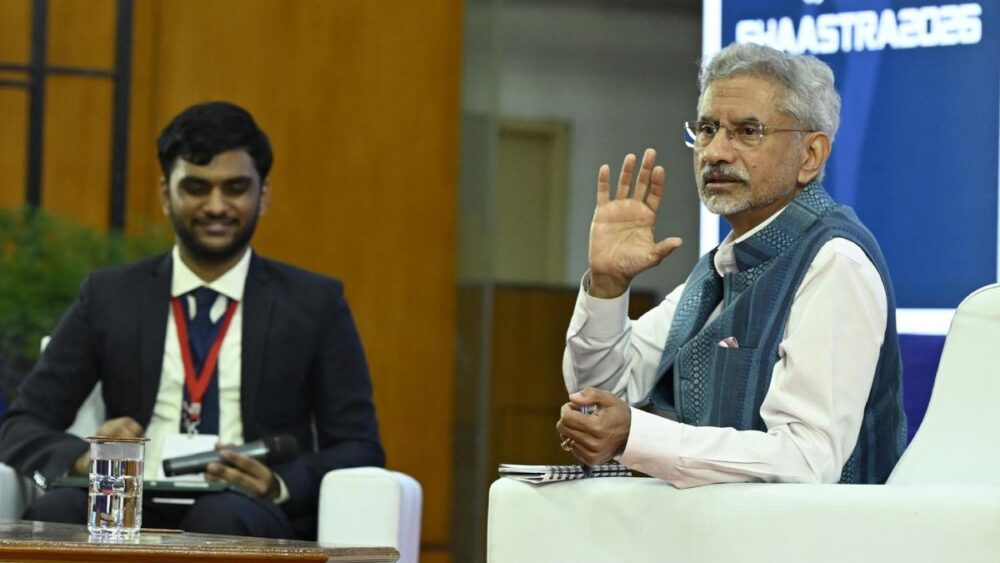
Speaking at the launch of the IITM Global Research Foundation at Indian Institute of Technology Madras, the Minister said that while India believes in peaceful coexistence, it also reserves the right to defend itself against persistent security threats.
“You can also have bad neighbours… unfortunately we do,” Dr. Jaishankar said while responding to questions from students. Referring to India’s western neighbour, he added, “If a country decides that they will deliberately, persistently and unrepentantly continue with terrorism, we have a right to defend our people against terrorism. We will exercise that right. How we do it is our decision. Nobody can tell us what we should or should not do.”
The Minister also inaugurated the IITM Festival Fortnight, which includes an open house allowing public access to IIT Madras laboratories and innovation centres, alongside Shaastra, the institute’s annual technical festival, and Saarang, its annual cultural festival.
Foreign Policy Rooted in Strength at Home
During a fireside chat with Mith R. Jain, Co-Curricular Affairs Secretary at IIT Madras, Dr. Jaishankar explained that countries succeed globally only when they are strong domestically. He said India’s foreign policy is guided by the principle of Vasudhaiva Kutumbakam—the world as one family—but clarified that this outlook does not imply strategic naïveté.
“When we say Vasudhaiva Kutumbakam, it does not mean we see the world as hostile,” he said. “But we have limited resources. The real challenge is how to create maximum impact with those resources. Indian diplomacy today focuses on leveraging our strengths and partnering with institutions globally to achieve that.”
Citing an example, he said an IIT Madras campus in Tanzania demonstrated how India’s foreign policy could amplify the global impact of domestic academic institutions.
Communicating India’s Intentions Clearly
On concerns about other countries misreading India’s intentions, the Minister emphasized transparent communication. “If you communicate well, clearly and honestly, other countries respect it,” he said, adding that India should take pride in its cultural heritage and civilizational continuity.
“We are among the few ancient civilizations that have survived to become major modern nation-states,” he said. “Our decision to adopt democracy made it a universal political model. Partnership with the West is also important, and that is how we help shape the world.”
Indus Waters Treaty and Good Neighbourliness
Dr. Jaishankar also addressed the Indus Waters Treaty, describing it as a historical gesture of goodwill rooted in neighbourly relations. However, he said decades of terrorism had eroded the basis for such goodwill.
“Many years ago, we agreed to a water-sharing arrangement believing it was an act of good neighbourliness,” he said. “But if there are decades of terrorism, there is no good neighbourliness. You cannot say, ‘Please share water with me,’ while continuing terrorism. That is not reconcilable.”
India’s Support to Neighbours in Crisis
The Minister stressed that India continues to be a responsible regional partner. He pointed out that during the COVID-19 pandemic, India prioritised neighbouring countries for vaccine supplies. He also cited assistance provided during the Ukraine conflict, when India supplied fuel, food and fertilisers to affected neighbours.
Highlighting Sri Lanka’s recent economic crisis, Dr. Jaishankar noted that India extended a $4 billion support package at a time when negotiations with the International Monetary Fund (IMF) were progressing slowly.
IITM Global Expansion
As part of the IITM Global initiative, IIT Madras has signed multiple memoranda of understanding with institutions across the United States, the United Kingdom, Germany, Dubai, the Asia-Pacific region—including Singapore and Malaysia—and under the India-for-Global framework. These collaborations focus on joint research, startup and industry partnerships, global talent exchange and translating deep-tech innovation into real-world applications.
V. Kamakoti, Director of IIT Madras, said the IITM Global Research Foundation follows a four-pronged strategy: global technology transfer, joint international projects, overseas market access for Indian start-ups, and attracting foreign investment.
Initially, IIT Madras will establish a presence in five locations, including the United States, Dubai, Malaysia and Germany, with plans to expand further based on outcomes.
The event underscored the convergence of India’s foreign policy objectives with its academic and innovation ecosystem, highlighting how strategic diplomacy and institutional excellence can jointly advance national interests on the global stage.