








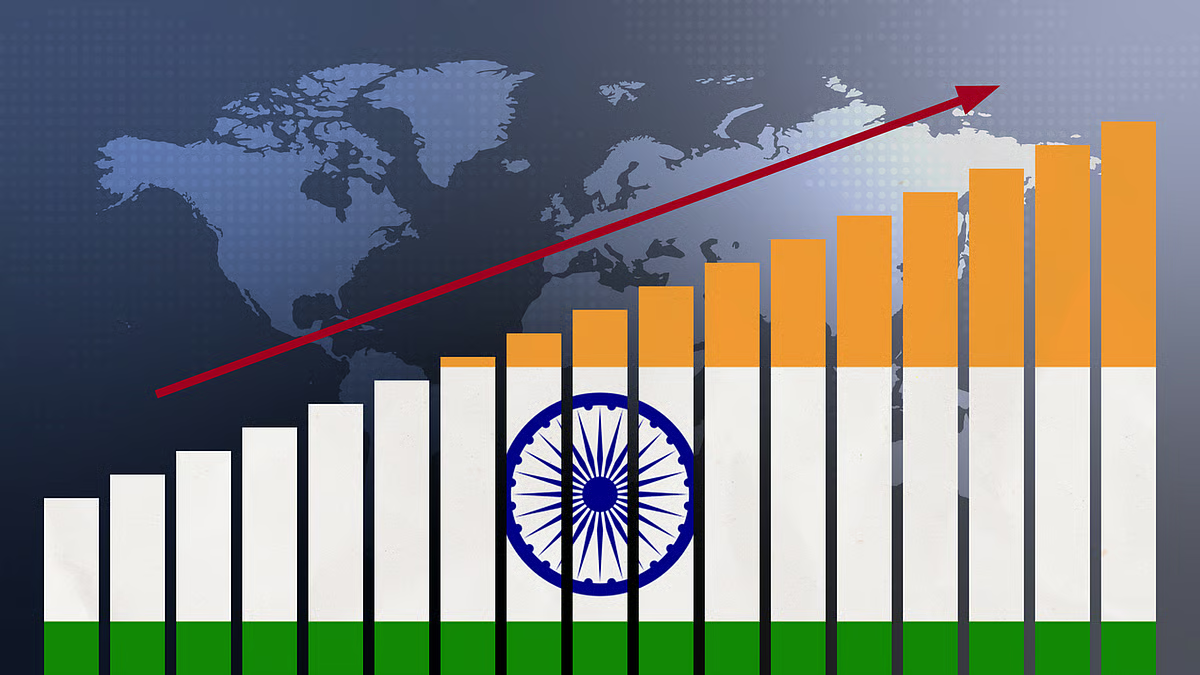
India has crossed a historic threshold in its economic journey, officially overtaking Japan to emerge as the world’s fourth-largest economy by nominal GDP. The achievement marks a defining moment for a country that has spent decades transitioning from a largely inward-looking economy to a globally integrated growth engine. More than a shift in rankings, the milestone reflects India’s structural resilience, policy discipline, and growing influence in the global economic order.
With its economy now valued at approximately $4.18 trillion, India has moved ahead of Japan, a nation long considered a benchmark of industrial and technological sophistication. Government assessments describe this moment as the culmination of sustained reforms and macroeconomic stability, rather than a short-term statistical outcome.
“India has entered a rare phase of high growth combined with low inflation,” the economic assessment stated, describing the current environment as a Goldilocks phase — one that offers ideal conditions for investment, consumption, and long-term expansion.
A Decade of Accelerated Growth
India’s rise has been particularly striking over the last ten years. During this period, the size of the economy has nearly doubled, supported by expanding domestic demand, large-scale infrastructure investment, and a growing services sector. Unlike many advanced economies grappling with stagnation, India has maintained strong momentum even amid global uncertainties.
Recent data shows real GDP growth accelerating beyond earlier projections, driven by manufacturing recovery, resilient services exports, and improved capital formation. Consumption spending has remained robust, aided by rising incomes and a stable price environment. Analysts note that India’s growth has been broad-based, spanning urban and rural markets, rather than being concentrated in a few sectors.
“The strength of domestic demand continues to anchor India’s economic performance,” the review noted, adding that private investment is beginning to complement public capital expenditure in a meaningful way.
The Goldilocks Advantage
What sets India apart in the current global context is its ability to grow rapidly without triggering runaway inflation. Inflationary pressures, particularly in food and fuel, have eased considerably, allowing policymakers greater flexibility. Headline inflation has moderated to levels not seen in several years, defying concerns typically associated with fast-growing emerging economies.
This stability has enabled the Reserve Bank of India to adopt a supportive monetary stance. Over the past year, the central bank implemented cumulative interest-rate cuts aimed at stimulating credit growth while maintaining financial discipline.
“The present macroeconomic situation represents a rare opportunity,” the assessment observed, “where growth impulses are strong and inflation risks are well-contained.”
Lower borrowing costs have improved access to credit for businesses and households, supporting expansion plans, job creation, and consumption. For investors, both domestic and foreign, this balance has enhanced confidence in India’s medium-term prospects.
External Stability and Global Confidence
India’s economic ascent has also been supported by improving external fundamentals. The current account deficit has remained manageable, aided by strong services exports, steady remittance inflows, and diversification of trade partners. Technology services, digital exports, and professional consulting have continued to offset merchandise trade pressures.
Foreign exchange reserves remain comfortable, providing a buffer against global volatility. This external stability has played a crucial role in sustaining investor sentiment at a time when many economies face capital flow uncertainties.
Economists point out that India’s external resilience strengthens its credibility as a long-term growth destination rather than a cyclical emerging market play.
A Shift in Global Economic Power
India’s overtaking of Japan carries symbolic and strategic significance. Japan, with its advanced manufacturing base and technological leadership, represented the pinnacle of post-war economic success in Asia. India’s rise past it underscores a broader rebalancing of global economic power toward younger, consumption-driven economies.
Demographics play a central role in this shift. India’s youthful population, expanding workforce, and growing middle class contrast sharply with aging populations in many advanced economies. This demographic dividend, combined with digital adoption and infrastructure upgrades, positions India uniquely among major economies.
Projections suggest that if current trends persist, India could surpass Germany within the next few years to become the world’s third-largest economy. Long-term forecasts estimate the economy could reach $7 trillion or more by the end of the decade, fundamentally altering global economic hierarchies.
Challenges Ahead, Momentum Intact
Despite the celebratory tone, policymakers have acknowledged that sustaining this trajectory will require continued reform. Employment generation, skill development, manufacturing competitiveness, and climate-aligned growth remain critical priorities. However, the current phase offers a strong platform from which to address these challenges.
“This milestone should be viewed not as an endpoint, but as a foundation for the next stage of India’s growth story,” the assessment concluded.
A Defining Moment
India’s emergence as the world’s fourth-largest economy is more than a numerical upgrade — it is a statement of intent. In an era of global uncertainty, India stands out as a rare case of scale, stability, and sustained growth. As the world recalibrates its economic expectations, India’s Goldilocks phase may well define the contours of global growth in the years ahead.