








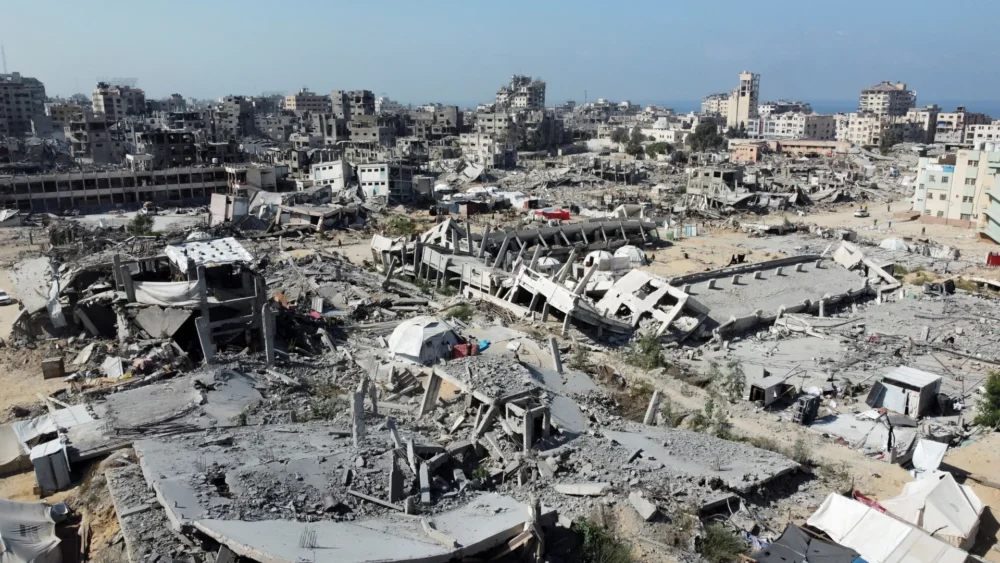
Israel on Tuesday intensified military operations across the Gaza Strip, launching fresh air and artillery strikes just weeks after an October 10 ceasefire agreement came into effect. Gaza authorities have accused Israel of repeatedly violating the truce, raising concerns over the durability of the US-brokered arrangement and the prospects for a lasting peace in the region.
According to local officials, Israeli warplanes carried out multiple aerial assaults across northern, central, and southern Gaza. Air strikes were reported in Beit Lahia, where Israeli jets targeted residential areas, while additional strikes hit locations east of the Maghazi refugee camp. Simultaneously, Israeli artillery fire was directed toward western parts of Rafah, further escalating tensions across the besieged enclave.
The renewed bombardment comes amid mounting allegations from Gaza’s authorities that Israel has systematically breached the October ceasefire. In a statement issued earlier this week, Gaza’s Government Media Office in Gaza claimed that Israeli forces have committed 969 ceasefire violations since the truce took effect. These alleged breaches, officials said, have resulted in the deaths of 418 civilians and injuries to more than 1,100 people, deepening the humanitarian crisis in the territory.
“These repeated attacks show that the ceasefire exists only on paper,” a spokesperson for the Media Office said, accusing Israel of undermining international mediation efforts and destabilising an already fragile situation.
Strikes follow high-level US-Israel talks
The latest military escalation unfolded just hours after Israeli Prime Minister Benjamin Netanyahu met US President Donald Trump at Trump’s Mar-a-Lago estate in Florida. During the meeting, both leaders reiterated that the complete disarmament of Hamas is essential for achieving long-term peace and security in the region.
However, uncertainty continues to surround the implementation of the second phase of the US-brokered Gaza peace plan, which was expected to outline steps toward de-escalation, reconstruction, and political dialogue. Analysts note that the absence of clarity on this phase has contributed to growing mistrust on the ground, particularly as violence resumes despite the ceasefire framework.
Addressing accusations of Israeli ceasefire violations, President Trump dismissed concerns over Israel’s actions. “I’m not concerned about anything that Israel is doing,” Trump said, adding that Israel had fulfilled “100 per cent of its commitment” under the Gaza ceasefire plan. His remarks have drawn criticism from Palestinian representatives and humanitarian groups, who argue that such statements risk emboldening further military action.
Political symbolism amid conflict
In a move that drew both praise and controversy, Prime Minister Netanyahu announced the creation of the ‘Israel Prize for Peace’, naming President Trump as its first-ever recipient. The prize, according to Israeli officials, was established to recognise Trump’s role in brokering diplomatic initiatives in the region.
Responding to the announcement, Trump said the honour was “really surprising and very much appreciated.” Supporters hailed the gesture as a reaffirmation of the close US-Israel alliance, while critics questioned the timing of the award amid renewed violence in Gaza.
Humanitarian and regional implications
The fresh air strikes have intensified fears of a broader escalation at a time when Gaza’s civilian population remains extremely vulnerable. Humanitarian agencies warn that continued bombardment could further strain hospitals, disrupt aid delivery, and worsen living conditions for more than two million residents already facing shortages of food, water, and medical supplies.
Regional observers caution that without credible enforcement of the ceasefire and transparent steps toward its next phase, the agreement risks collapsing altogether. “Ceasefires are only meaningful when violations are addressed and accountability is ensured,” a Middle East analyst said. “Otherwise, they become pauses rather than pathways to peace.”
As the situation evolves, the renewed Israeli strikes underscore the fragility of diplomatic efforts and the enduring volatility of the Gaza conflict. With civilian casualties rising and political positions hardening, hopes for a sustained calm heading into the new year remain uncertain.