





The United States has announced a $2 billion commitment to United Nations humanitarian relief, seeking to reaffirm its role as the world’s largest aid donor even as President Donald Trump’s administration presses ahead with sweeping cuts to foreign assistance and demands far-reaching reforms across the UN system.
The pledge, unveiled on Monday, comes with sharp language and stricter conditions. Senior US officials warned that UN humanitarian agencies must “adapt, shrink, or die” as budgets tighten and donor patience wears thin. While the funding is significant, it represents a fraction of what Washington has provided in previous years and underscores a fundamental shift in how the US wants humanitarian aid to be delivered and overseen.
Officials argue that the new pledge still signals America’s continued leadership in global relief efforts, even as overall funding levels fall. “This is about doing more with less — and doing it better,” a senior State Department official said ahead of the announcement.
A smaller pledge, a bigger structural shift
According to UN data, US humanitarian funding has reached as high as $17 billion annually in recent years for UN-backed efforts, though American officials say only $8–10 billion of that was voluntary. In addition, Washington pays billions more each year in mandatory UN dues.
Under the new approach, the $2 billion will not be spread directly across multiple UN agencies. Instead, it will be placed into a centralized umbrella fund, managed through the UN Office for the Coordination of Humanitarian Affairs.
This model is central to Washington’s reform agenda — one that has unsettled humanitarian workers who fear it could slow responses and reduce aid delivery in some of the world’s most fragile regions.
Critics argue the pullback by the US and other Western donors has already had devastating consequences. “Cuts of this scale inevitably translate into more hunger, displacement, and disease,” said one humanitarian official, warning that reduced aid also weakens US diplomatic influence abroad.
A year of turmoil for global aid agencies
The announcement follows a bruising year for major UN organizations, including refugee, migration, and food assistance agencies. The Trump administration has already slashed foreign aid by billions of dollars, forcing agencies to cut programs, scale back operations, and eliminate thousands of jobs. Other traditional donors, including European nations and Japan, have also reduced their contributions.
The $2 billion pledge is being shaped through a preliminary agreement with UN Office for the Coordination of Humanitarian Affairs (OCHA), led by Tom Fletcher, a former British diplomat.
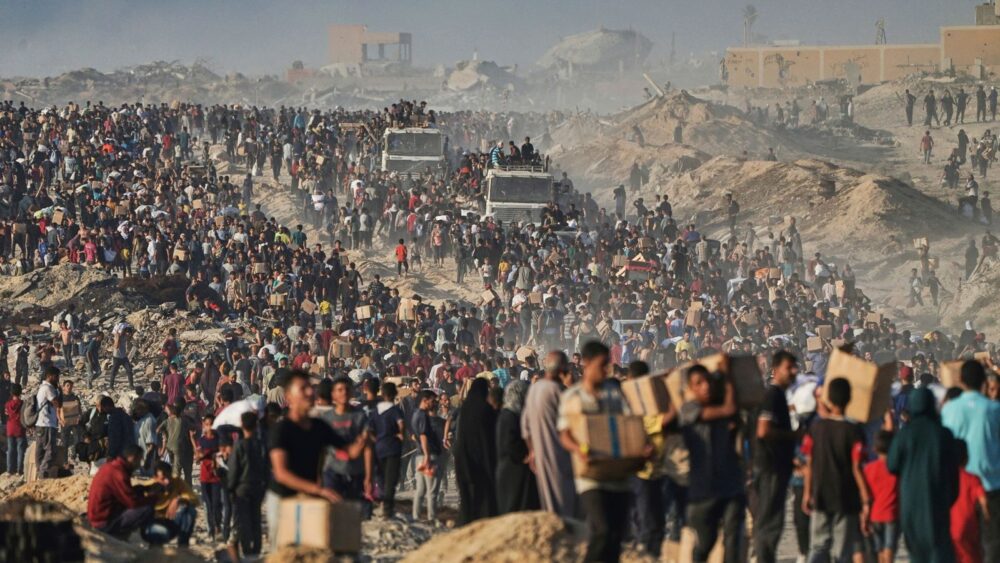
At the same time, global humanitarian needs are rising sharply. Famine has been recorded this year in parts of Sudan and Gaza, while floods, droughts, and extreme weather events — increasingly linked to climate change — have displaced millions worldwide.
Funding cuts are expected to ripple through UN-affiliated bodies such as the International Organization for Migration, the World Food Programme, and UNHCR. All have received significantly less US funding this year compared with allocations under the Biden administration — and even compared with Trump’s first term.
US pushes for consolidation and control
Under the proposed framework, OCHA would take on a far stronger coordinating role, effectively acting as a central gatekeeper for humanitarian funding.
A senior US official said Washington is seeking “more consolidated leadership authority” within the UN humanitarian system. “OCHA is going to control the spigot,” the official said, referring to how funds would be released and redirected.
“This humanitarian reset at the United Nations should deliver more aid with fewer tax dollars,” said Michael Waltz, adding that assistance must be “focused, results-driven, and aligned with US foreign policy.”
In a statement, the United States Department of State said the agreement requires the UN to reduce “bureaucratic overhead, unnecessary duplication, and ideological creep,” stressing that reform is particularly urgent for agencies doing life-saving work.
Targeted aid and notable exclusions
A central goal of the overhaul is the creation of pooled funding that can be directed toward specific crises and countries. Seventeen nations will be prioritized initially, including Bangladesh, Congo, Haiti, Syria, and Ukraine.
Notably absent from the list is Afghanistan, often described as one of the world’s most severe humanitarian crises. The Palestinian territories are also excluded at this stage, with US officials saying those needs would be addressed separately through funding linked to Trump’s still-evolving Gaza peace plan.
US officials say the initiative has been months in the making and reflects Trump’s long-standing view that the United Nations has immense potential but has drifted from its core mission.
A cautious welcome from the UN
Fletcher welcomed the agreement, striking an optimistic note despite the funding pressures.
“At a moment of immense global strain, the United States is demonstrating that it is a humanitarian superpower, offering hope to people who have lost everything,” he said.
Whether the new model delivers faster, more effective aid — or deepens tensions between donors and humanitarian agencies — will become clear in the months ahead. What is certain is that the era of ever-expanding humanitarian budgets is over, and the global aid system is entering a period of painful transformation.