









A renewed push in Congress to dismantle a long-standing student work authorization program has reignited debate over high-skilled immigration, workforce competition, and executive authority. Republican lawmakers have reintroduced legislation aimed at terminating the Optional Practical Training (OPT) program, arguing that it operates outside congressional authorization and disadvantages American workers.
The proposed Fairness for High-Skilled Americans Act, reintroduced by Paul A. Gosar, seeks to formally end OPT, a program administered by United States Citizenship and Immigration Services, which allows foreign students to work in the U.S. after completing their education.
In parallel with the bill, Gosar and several other House Republicans have sent a letter urging senior White House and homeland security officials to take immediate executive action to shut down the program.
Lawmakers Urge Immediate Termination
In their letter, the lawmakers called on Stephen Miller, the Deputy Chief of Staff for Policy and Homeland Security Advisor, and Kristi Noem to identify OPT as a program that is “dangerously unauthorized, abused, and costly to the American taxpayer.”
“We encourage you to identify OPT as a program that is dangerously unauthorized, abused, and costly to the American taxpayer,” the lawmakers wrote, arguing that the program was never approved by Congress and therefore lacks proper statutory oversight.
According to the letter, OPT was created administratively in 1992 and expanded significantly under the Obama administration without explicit congressional authorization.
What Is the OPT Program?
The Optional Practical Training (OPT) program allows foreign students on F-1 visas to remain in the United States temporarily after completing their studies in order to gain work experience related to their field of education.
Under current rules:
- Students may receive up to 12 months of OPT employment authorization.
- Graduates in science, technology, engineering, and mathematics (STEM) fields may apply for a 24-month STEM OPT extension, allowing them to work for up to three years after graduation.
Supporters of OPT say the program helps U.S. companies address talent shortages, particularly in high-tech sectors, while offering international students practical experience that enhances their education.
Critics Say OPT Circumvents Congress
Opponents of OPT, however, argue that the program effectively functions as a guest-worker visa without congressional approval and undermines limits placed on other employment-based immigration pathways.
Lawmakers backing the Fairness for High-Skilled Americans Act claim that OPT allows foreign graduates to work in the U.S. beyond the duration of their student visas while bypassing the H-1B visa cap set by Congress.
According to the lawmakers, foreign students who complete just one year at a U.S. higher-education institution can work in STEM fields for up to three years through OPT and its extension — a period they say rivals or exceeds traditional work visa durations.
“This program completely undercuts American workers, particularly higher-skilled workers and recent college graduates,” Gosar said while introducing the legislation. “It provides employers with a tax incentive to hire low-wage foreign labor under the guise of student training.”
Economic and Labor Concerns
Critics argue that OPT gives employers financial incentives to hire foreign workers over American graduates. Because OPT participants are often exempt from certain payroll taxes, including Social Security and Medicare contributions, employers may face lower labor costs when hiring OPT workers.
“American students are competing against a system that artificially lowers wages,” said a congressional aide familiar with the legislation. “That’s not a level playing field.”
Supporters of termination also claim that the lack of congressional authorization leaves OPT vulnerable to abuse and insufficient regulatory safeguards, particularly for domestic workers.
Supporters Warn of Workforce Impact
Advocates of OPT strongly dispute those claims, arguing that the program is essential to maintaining U.S. competitiveness in global talent markets.
Industry groups and universities have long maintained that OPT fills gaps in the labor market, especially in STEM fields, and helps retain graduates trained at American institutions.
“Eliminating OPT would push highly trained graduates to competing economies,” said a former university immigration adviser. “Countries like Canada and the U.K. are actively courting this talent.”
Executive Action vs. Congressional Authority
A key argument advanced by Gosar and his colleagues is that OPT was created by executive authority — and therefore can be dismantled the same way.
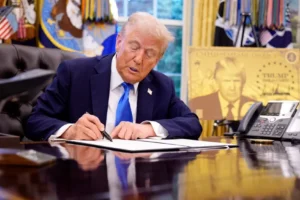
“OPT was created by a pen and can be terminated by the President’s pen,” the lawmakers wrote, warning that incremental reforms could inadvertently legitimize the program.
They pointed to the example of Deferred Action for Childhood Arrivals, arguing that partial measures could end up codifying OPT rather than eliminating it.
The Fairness for High-Skilled Americans Act aims to enact a “clean termination” of OPT and prohibit the creation of similar programs unless explicitly authorized by Congress.
What Happens Next?
If enacted, the bill would mark one of the most significant changes to U.S. student and employment-based immigration policy in decades. However, the legislation faces an uncertain future in a divided Congress, where immigration reform has repeatedly stalled.
In the meantime, lawmakers are pressing the administration to act unilaterally, framing OPT as an executive overreach that should be reversed without waiting for legislative consensus.
As debates over immigration, workforce protection, and global competitiveness intensify ahead of upcoming elections, the future of OPT remains uncertain — and millions of international students and U.S. employers are watching closely.