








The brutal lynching of a young Hindu factory worker in Bangladesh has sent shockwaves across South Asia, intensifying fears that a growing leadership vacuum and deteriorating law-and-order situation are emboldening extremist violence against religious minorities.
Dipu Chandra Das, 27, was killed last Thursday after co-workers at a garment factory outside Dhaka accused him of blasphemy during a workplace discussion. What began as a verbal dispute reportedly escalated into mob violence, ending with Das being dragged into the street, lynched, and his body set on fire.
The killing, which authorities describe as one of the most disturbing recent episodes of mob violence, comes amid a broader period of instability in Bangladesh, where extremist groups are increasingly exploiting political uncertainty and social tensions ahead of a national election scheduled for February.
A Routine Workday Turns Deadly
Das worked long 12-hour shifts inspecting clothing produced for international fashion brands, earning the equivalent of about $150 a month. According to colleagues and family members, he was a quiet, educated man — a college graduate, married for three years, and the father of a toddler daughter.
On Thursday evening, toward the end of the factory shift, a discussion reportedly broke out among workers about religion. The New York Times quoted a colleague, Selim Mia, as saying that some Muslim workers had remarked that the upcoming Friday prayers were an opportunity to repent for the week’s sins.
Das allegedly responded that such emphasis sounded superstitious. When challenged about Hindu beliefs, he reportedly replied that all religions contain elements of superstition. According to Mia, the exchange quickly spiraled.
“People started accusing him of insulting Prophet Muhammad,” Mia said.
As rumors spread within and beyond the factory floor, an angry crowd formed outside. Das was dragged into the street, beaten, tied to a tree, and burned. Police later said they have not been able to verify whether Das made any blasphemous statement.
Arrests and Official Response
By Monday, Bangladeshi authorities had arrested 12 people, including two of Das’s co-workers, the factory manager, and a floor supervisor. Naimul Hassan, a senior police official, questioned why those in charge failed to intervene.
“Why didn’t they hand him over to the police, or why didn’t they take any measure to save him?” Hassan said.
Police said one additional woman was arrested on suspicion of inciting violence. As is standard practice, authorities did not immediately release the names of all suspects.
A Family’s Grief
Das’s brother, Opu Chandra Das, described the harrowing hours leading up to the discovery of his brother’s death.
“At around 7 p.m., we received a call saying my brother was in trouble and we should come quickly,” he said. “But around 8 or 8:30 p.m., they called again to say my brother was no more.”
When Opu reached the scene later that night, his brother’s body lay bloodied and burned in the street. Security forces struggled to keep the mob from further desecrating the remains as they transported the body for a post-mortem.
The following evening, Opu accompanied his brother’s corpse on a lonely journey back to their village, about 40 miles away, escorted by police. Out of fear, only a handful of relatives attended the cremation.
“People were scared,” Opu said. “They thought they could be targeted next.”
Political Vacuum and Rising Extremism
Human rights groups say the killing reflects a broader breakdown of security following the fall of Bangladesh’s longtime leader Sheikh Hasina, who fled to India last August after being toppled in student-led protests.
Since then, Bangladesh has been governed by an interim administration led by Muhammad Yunus, an 85-year-old Nobel Peace Prize winner. His government has condemned recent violence, framing it as part of a broader security struggle rather than targeted religious persecution.
However, the lynching of Das — and the public celebration of the killing by some extremist elements — has cast doubt on that assessment.
“Religious minorities are particularly vulnerable in periods of political transition,” said a Dhaka-based human rights researcher. “What we’re seeing is extremist groups testing boundaries and exploiting uncertainty.”
Regional Pattern of Religious Violence
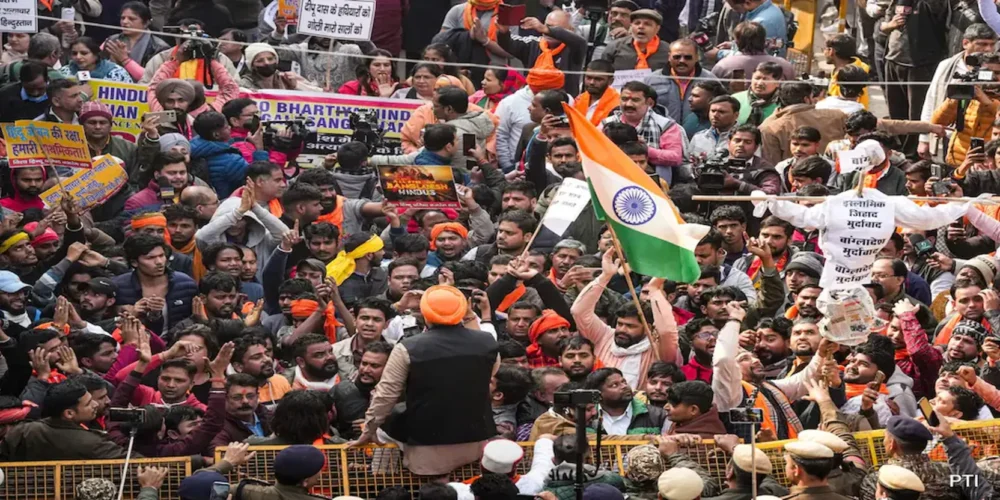
The killing has sparked concern in India, where Prime Minister Narendra Modi’s government has repeatedly raised alarms about the treatment of Hindus in Bangladesh.
But analysts say the violence fits into a wider South Asian pattern of religious intolerance.
In Pakistan, accusations of blasphemy have repeatedly led to mob lynchings amid rising Islamist militancy. In Afghanistan, most of the remaining Sikh and Hindu population fled after deadly attacks before the Taliban’s return to power.
India, too, has seen its own surge in mob violence. Hindu vigilante groups have targeted Muslims and other minorities, often over allegations of cow slaughter. Last week, police said a migrant laborer, Ram Narayan Baghel, was lynched in southern India after being mistaken for a Bangladeshi Muslim — a label often used loosely by Hindu nationalist politicians.
Human Rights Alarm Bells
International observers warn that Bangladesh’s upcoming election could further inflame tensions if extremist groups continue to operate with impunity.
“This is not just about one horrific murder,” said a regional analyst. “It’s about the erosion of trust in institutions meant to protect citizens, regardless of faith.”
For the Das family, however, the political implications offer little comfort.
“My brother worked hard, minded his own life, and believed in harmony,” Opu said. “He never imagined words could cost him his life.”
As Bangladesh grapples with its uncertain future, the lynching of Dipu Chandra Das has become a stark symbol of the dangers minorities face when law, leadership, and tolerance falter — and a reminder that without swift accountability, fear can spread as fast as rumor.