









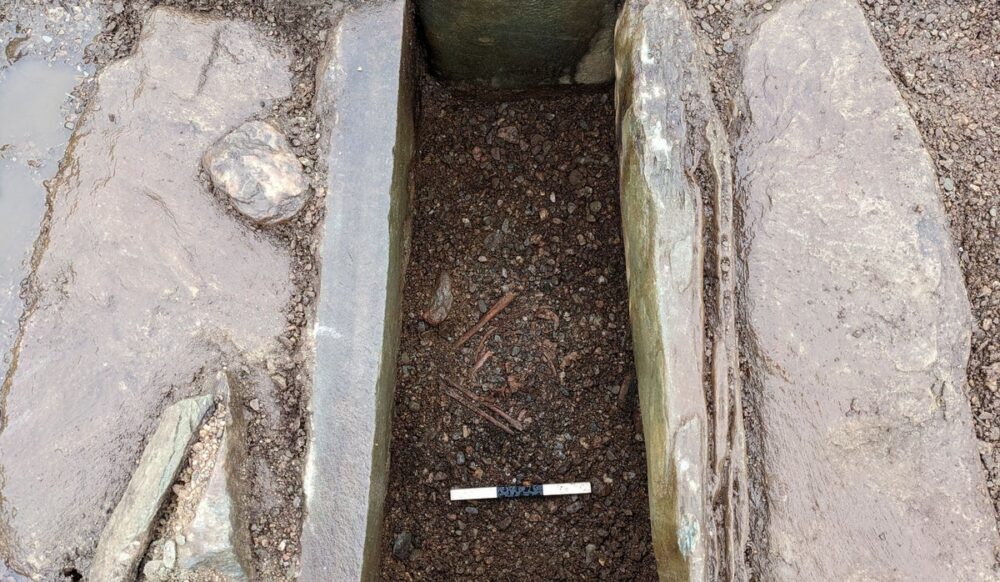
Long before the Black Death devastated medieval Europe, a far older and more mysterious form of the plague spread across vast stretches of Eurasia. For decades, scientists struggled to understand how this ancient disease — which emerged during the Bronze Age — managed to persist for nearly 2,000 years and travel enormous distances without the flea-borne transmission that defined later outbreaks.
Now, researchers say a surprising discovery may finally explain how it happened: plague DNA found in the remains of a domesticated sheep that lived more than 4,000 years ago.
In a study published in Cell, scientists report the first known evidence that the ancient plague bacterium infected animals — not just humans — during the Bronze Age. The finding offers a critical missing link in understanding how the disease circulated so widely among early societies.
A Breakthrough Hidden in a Tooth
The breakthrough came from an unlikely source: the tooth of a Bronze Age sheep uncovered in what is now southern Russia. Inside the ancient tooth, researchers detected genetic material from Yersinia pestis, the bacterium responsible for plague.
“It was alarm bells for my team,” said Taylor Hermes, a University of Arkansas archaeologist and co-author of the study. “This was the first time we had recovered the genome of Yersinia pestis from a non-human sample.”
Until now, all confirmed Bronze Age plague genomes had been recovered from human remains. That led researchers to believe the disease spread primarily through human-to-human contact — a theory that never fully explained its remarkable geographic reach.
“This sheep changed the picture entirely,” Hermes said.
Why Animals Matter in Ancient Disease Spread
The Bronze Age, which lasted roughly from 3300 to 1200 B.C., was a period of dramatic social and technological change. Communities began keeping larger herds of domesticated animals, using horses for long-distance travel, and expanding trade routes across Eurasia.
Those developments, scientists say, created ideal conditions for diseases to jump between species.
“Our plague sheep gave us a breakthrough,” Hermes explained. “It had to be more than just people moving. We now see it as a dynamic between humans, livestock, and some still unidentified natural reservoir.”
Researchers believe the sheep likely contracted the bacteria from another animal — possibly rodents or migratory birds — that carried the pathogen without becoming ill. From there, the disease could have passed to humans through close contact during herding, slaughtering, or daily care.
This animal-human transmission model helps explain how the plague persisted for centuries, even before fleas became its primary vector in later outbreaks.
The Challenge of Ancient DNA
Extracting usable DNA from ancient animal remains is notoriously difficult. Unlike human burials, which were often protected by ritual practices, animal remains were typically exposed to harsh environmental conditions.
“When we test livestock DNA, we get a complex genetic soup of contamination,” Hermes said. “Soil, microbes, modern DNA — everything mixes together.”
The DNA fragments recovered from ancient animals are often tiny, sometimes as short as 50 genetic “letters,” compared with the more than three billion letters in a modern human genome. Separating meaningful pathogen DNA from this background noise requires painstaking work and advanced technology.
That’s what makes this discovery particularly remarkable.
“This was a lucky find,” Hermes said. “But it also shows that livestock remains can preserve crucial information about ancient diseases.”
Rewriting the History of the Plague
When plague returned in the Middle Ages as the Black Death, it spread rapidly through flea-infested rats and killed an estimated one-third of Europe’s population. But Bronze Age plague behaved differently.
Earlier versions of Yersinia pestis lacked the genetic mutations that allow flea transmission. Without animals acting as intermediaries, scientists couldn’t explain how the disease traveled so effectively across Eurasia.
The sheep genome fills that gap.
“This discovery forces us to rethink how ancient diseases moved,” Hermes said. “Livestock weren’t just passive companions to human migration — they were active participants in disease ecology.”
Lessons for the Modern World
Beyond solving an ancient mystery, the findings carry modern relevance. Many of today’s most dangerous diseases — from influenza to COVID-19 — began as animal-borne infections before jumping to humans.
The Bronze Age plague, researchers note, may be one of the earliest documented examples of zoonotic disease spread facilitated by human behavior.
“As people moved into new environments and interacted more closely with animals, they created pathways for pathogens,” Hermes said. “That pattern hasn’t changed.”
The researchers caution that their conclusions are based on a single ancient sheep genome, which limits how broadly the findings can be applied. More samples are needed to confirm how widespread animal infection was and which species played key roles.
What Comes Next
The study was led by scientists at the Max Planck Institute for Infection Biology, with senior authors Felix M. Key and Christina Warinner, who is affiliated with both Harvard University and the Max Planck Institute for Geoanthropology.
The research was funded by the Max Planck Society, which has also supported follow-up fieldwork in the region.
Next, the team plans to analyze additional ancient animal and human remains from across Eurasia. Their goals include identifying the original wild reservoir of the bacteria and mapping how plague spread alongside Bronze Age trade, herding, and migration routes.
“Understanding how ancient diseases emerged and spread helps us anticipate future risks,” Hermes said. “It reminds us that human health has always been deeply connected to the animals we live with.”
Thousands of years later, a single sheep tooth has reopened a chapter of human history — and revealed how closely our fate has always been tied to the unseen world of microbes.