






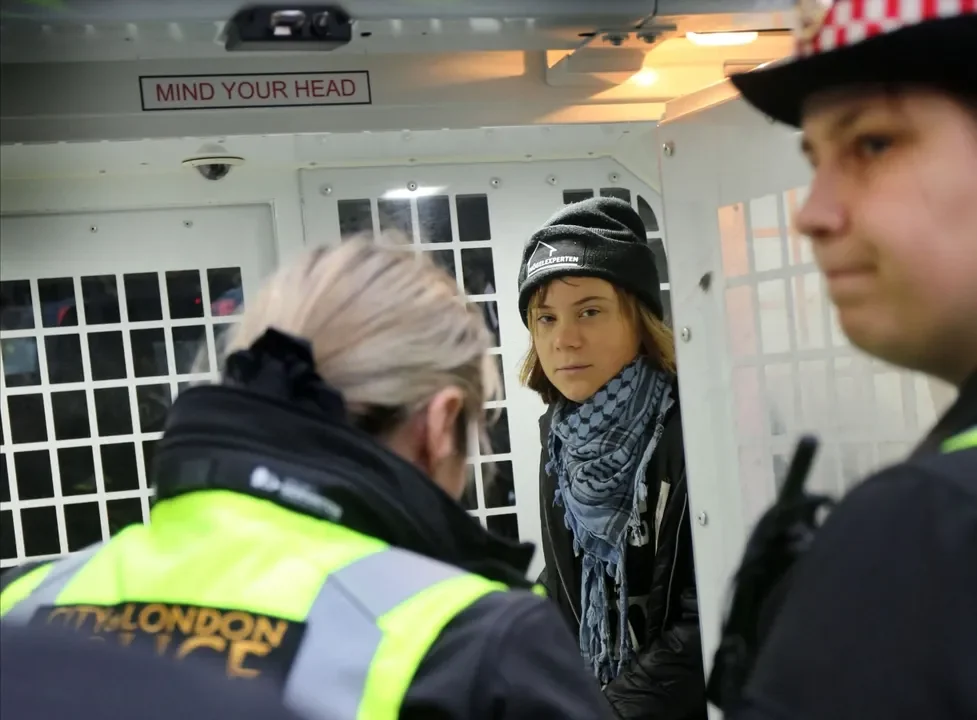
Climate activist Greta Thunberg was arrested in central London on Tuesday while supporting pro-Palestinian activists who are on a hunger strike to protest their continued detention without bail as they await trial over earlier demonstrations.
The arrest came amid a broader protest action in the City of London, Britain’s historic financial district, where tensions have intensified around demonstrations linked to the Israel-Palestine conflict and the UK government’s recent designation of certain protest groups as banned organisations.
Support for Hunger-Striking Activists
Thunberg, 22, was detained while standing alongside members of a group calling itself Prisoners for Palestine, which has been campaigning for the release of eight activists currently held in custody. The group shared video footage on social media showing Thunberg holding a placard in support of the hunger strikers and Palestine Action, an organisation the British government formally proscribed earlier this year under terrorism legislation.
According to Prisoners for Palestine, the hunger strike is aimed at protesting what they describe as prolonged detention without bail for activists charged in connection with protests carried out across the UK.
“Eight Palestine Action members are currently refusing food to demand justice,” the group said in a statement. “Two of the prisoners have now been on hunger strike for 52 days and are at a critical stage, where death is a real possibility.”
Paint Protest and Police Action
The demonstration involving Thunberg formed part of a wider protest on Tuesday, during which two other activists sprayed red paint on the pavement outside an insurance company’s offices in the City of London. Prisoners for Palestine said the insurer was targeted because of its alleged links to Elbit Systems, an Israel-based defence firm that has been the focus of repeated protests by pro-Palestinian groups.
The City of London Police confirmed that officers arrested a man and a woman on suspicion of criminal damage in connection with the paint-spraying incident. Police later arrested a third woman on suspicion of supporting a banned organisation — an offence under UK counterterrorism laws.
British police typically do not identify suspects by name prior to formal charges being filed, and authorities did not officially confirm Thunberg’s identity at the time of the arrest.
Growing Scrutiny of Protest Movements
The arrest of Thunberg, one of the world’s most recognisable activists, has drawn renewed attention to the UK government’s handling of protests related to the Israel-Gaza war and the expanding use of counterterrorism legislation against activist networks.
Palestine Action was banned earlier this year after the government said the group’s activities crossed the threshold from protest into serious criminality. Ministers have argued that the designation is necessary to protect public safety and critical infrastructure.
Civil liberties groups, however, warn that the move risks criminalising political expression. “The line between protest and extremism is becoming dangerously blurred,” one UK-based rights advocate said. “Arrests like this will inevitably raise questions about freedom of assembly.”
Government Response
The British government has so far declined to intervene in the cases of the hunger-striking detainees, stressing that decisions about bail and detention rest with the courts.
“These are operational matters for the independent judicial system,” a government spokesperson said earlier this month. “Ministers cannot interfere in ongoing legal proceedings.”
That position has done little to ease concerns among campaigners, who argue that prolonged pre-trial detention — particularly in cases involving non-violent protest — violates basic human rights principles.
Thunberg’s Expanding Activism
Thunberg, who rose to global prominence as a teenager through her school strikes for climate action, has increasingly spoken out on broader social justice and geopolitical issues in recent years. She has previously voiced strong support for Palestinian civilians and criticised Western governments for what she describes as double standards on human rights.
Her arrest in London follows a series of high-profile confrontations with police at protests across Europe, highlighting the extent to which her activism has moved beyond environmental issues into wider political terrain.
Supporters say her presence brings global visibility to causes that might otherwise be ignored. Critics argue she is inserting herself into complex conflicts beyond her expertise.
For now, the focus remains on the condition of the hunger-striking detainees and the legal consequences facing those arrested in Tuesday’s protest. As demonstrations continue and court cases progress, the episode underscores the increasingly fraught intersection of protest, policing, and politics in Britain.